Surrender Monument, Vicksburg

Mike Serpa

Lt. Colonel
Joined
Jan 24, 2013
Surrender Interview Site-
By the end of June, General Pemberton realized his situation was desperate. The hope of relief by General Johnston's army had quickly disappeared. Over 10,000 soldiers in Pemberton's Army of Vicksburg were incapacitated due to illness, wounds, and malnutrition. His supplies and munitions were at critically low levels. He learned that Grant was preparing for another massive assault on the Confederate works in early July.

After a meeting with his division commanders, Pemberton concluded that surrender was inevitable. On the morning of July 3, 1863, he gave orders to display a white flag of truce, and sent representatives to deliver a message to General Grant proposing a meeting to discuss surrender terms. Grant agreed and at 3:00 p.m., Generals Grant and Pemberton met under the shade of an oak tree midway between the opposing lines.

The commanders could not reach an agreement, but discussions among subordinate officers, and an exchange of notes between Grant and Pemberton late in the day, brought about agreement for final terms of surrender.

The next morning, July 4, the Confederate defenders marched out of their trenches, stacked their arms, and were paroled. After 47 days, the siege of Vicksburg was over.
http://www.nps.gov/vick/historyculture/interview.htm

Original Surrender Monument, Vicksburg, Miss.- LOC 4#a24833
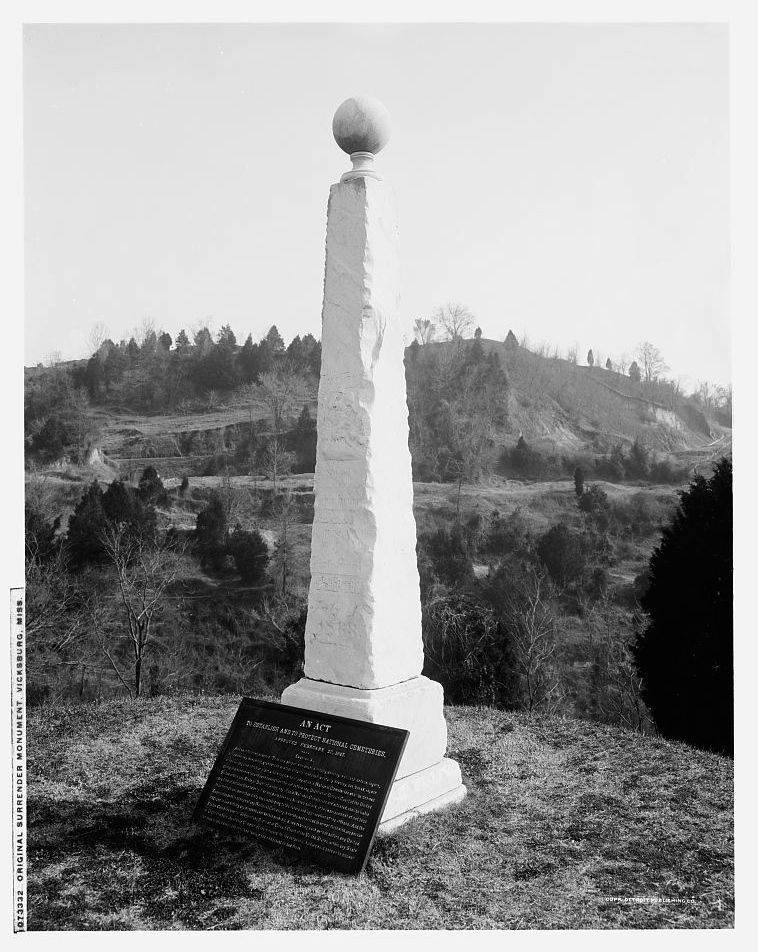
OSM.jpg


Surrender Monument, Vicksburg, Miss.- LOC #4a05074
SM.jpg


Interesting TV News story. Tells the story of both monuments.
http://www.wjtv.com/story/26479887/mystery-monday-surrender-monument-gouged-and-chafed-in-vicksburg
 
Surrender Interview Site-
By the end of June, General Pemberton realized his situation was desperate. The hope of relief by General Johnston's army had quickly disappeared. Over 10,000 soldiers in Pemberton's Army of Vicksburg were incapacitated due to illness, wounds, and malnutrition. His supplies and munitions were at critically low levels. He learned that Grant was preparing for another massive assault on the Confederate works in early July.

After a meeting with his division commanders, Pemberton concluded that surrender was inevitable. On the morning of July 3, 1863, he gave orders to display a white flag of truce, and sent representatives to deliver a message to General Grant proposing a meeting to discuss surrender terms. Grant agreed and at 3:00 p.m., Generals Grant and Pemberton met under the shade of an oak tree midway between the opposing lines.

The commanders could not reach an agreement, but discussions among subordinate officers, and an exchange of notes between Grant and Pemberton late in the day, brought about agreement for final terms of surrender.

The next morning, July 4, the Confederate defenders marched out of their trenches, stacked their arms, and were paroled. After 47 days, the siege of Vicksburg was over.
http://www.nps.gov/vick/historyculture/interview.htm

Original Surrender Monument, Vicksburg, Miss.- LOC 4#a24833
View attachment 52099

Surrender Monument, Vicksburg, Miss.- LOC #4a05074
View attachment 52100

Interesting TV News story. Tells the story of both monuments.
http://www.wjtv.com/story/26479887/mystery-monday-surrender-monument-gouged-and-chafed-in-vicksburg

I would post the pictures I took from the surrender monument last year but they're on my home computer and I'm at work. I'll try to do that tonight. Question though, when were both of these photos taken? Didn't see anything mentioning the dates.
 
From the above link:

"And this was placed at this location in 1867," Wilson said, pointing to an upturned cannon.

It is the official Surrender Monument placed at the site where Major General Ulysses S. Grant discussed surrender terms with Confederate Lieutenant General John C. Pemberton.

But the cannon is not the original monument.

Craggily and scarred by knifepoint - a seven foot marble tower which could be missed at the military park's visitors center - was ordered by federal soldiers in 1864.

A ball, meant to sit on top, is now missing along with - perhaps - some of its dignity.

"You can see here, on the corners especially, where veterans perhaps would take a knife and try to carve out a little piece," Wilson said.

"At first, it was left pretty much in the country unattended," Wilson said.

And it was this damage that meant that possibly-the-oldest monument (at what would become the military park) would be taken out of the public eye for up to one hundred years.

In 1867 the monument was moved to the Vicksburg Train Depot. In 1868, it was moved to the Vicksburg National Military Cemetery.

It stayed there until 1940 until it was put into storage. Then in 1988 it was re-reveal at the visitors center for the 125th Anniversary of the end of the siege of Vicksburg.

But the people tasked with preserving the monument somewhat excuse what happened to it.

After the city's fall feelings among veterans swirled: What is victory? What is defeat? What do either of those things mean.

Confusion could mean some just needed a rock to hold on to.

"And these veterans wanted a type of souvenir that they could take with them, not necessarily wanting to vandalize it I don't think, but something to hold with them," Wilson said.

"To carry with them because they were there," Wilson said.

The second surrender monument also had to be re-discovered. It was actually sent to be melted down with scrap metal during World War II.

It would later be found at Fort Sumter and brought back to Vicksburg as part of a cannon trade.


http://www.wjtv.com/story/26479887/mystery-monday-surrender-monument-gouged-and-chafed-in-vicksburg
 
Last edited:
I would post the pictures I took from the surrender monument last year but they're on my home computer and I'm at work. I'll try to do that tonight. Question though, when were both of these photos taken? Didn't see anything mentioning the dates.
These dates, in my mind, seem to clash with text from the wjtv link.

Top photo
  • Date Created/Published: c[between 1910 and 1920]
Bottom photo
  • Date Created/Published: c1900.
 
Last edited:
'Scuse my drawl y'all, but that seems a rather tacky place for the original surrender monument.
Actually the visitor center is probably the best place to display the remnants of the original stone monument.

But I definitely agree the NPS could have showcased it better.

It does look tacky in it's current position, but I guess that's better than being hidden in a NPS warehouse "somewhere" in Vicksburg.
 
Actually the visitor center is probably the best place to display the remnants of the original stone monument.

But I definitely agree the NPS could have showcased it better.

It does look tacky in it's current position, but I guess that's better than being hidden in a NPS warehouse "somewhere" in Vicksburg.
Yes, it is better than being stored away and soon forgotten.
 
Last edited:
Wasn't the original tree that the surrender took place near chopped up into pieces by souvenir hunters as well?
Yes. And the original monument.

Surrender was formalized by an old oak tree, "made historical by the event." In his Personal Memoirs, Grant described the fate of this luckless tree:

It was but a short time before the last vestige of its body, root and limb had disappeared, the fragments taken as trophies. Since then the same tree has furnished as many cords of wood, in the shape of trophies, as the 'True Cross'.

After only a few short years (1864-1867), the monument became heavily damaged by relic hunters and vandalism, and was moved from the battlefield and placed in the National Cemetery.
http://www.nps.gov/vick/planyourvisit/surmonument.htm


I don't know why the entire article posted when I linked to wikipedia. But i noticed this when others have posted links to wikipedia. Anyone know why this happens?
 
Yes. And the original monument.

Surrender was formalized by an old oak tree, "made historical by the event." In his Personal Memoirs, Grant described the fate of this luckless tree:

It was but a short time before the last vestige of its body, root and limb had disappeared, the fragments taken as trophies. Since then the same tree has furnished as many cords of wood, in the shape of trophies, as the 'True Cross'.

After only a few short years (1864-1867), the monument became heavily damaged by relic hunters and vandalism, and was moved from the battlefield and placed in the National Cemetery.
http://www.nps.gov/vick/planyourvisit/surmonument.htm


I don't know why the entire article posted when I linked to wikipedia. But i noticed this when others have posted links to wikipedia. Anyone know why this happens?

I thought it might have been Grant's memoir. It's been 3 years now or so since I read it so couldn't remember. I made a short video from the surrender site and was thinking about uploading it to youtube but it is actually a little blurry. I still might do it anyway.
 
The story of the original monument is actually a little more complex than the article covers. I knew I had taken some photos of the original monument in it's original location many years ago. It was just a matter of finding them. And I did. These photographs were taken around 1984 probably. Not sure of the exact date....but here it is ball and all.

So at some point the gun tube monument was removed and replaced by the original for a short time....at least in the eighties....

Then the ball on top went missing after that and it was removed once again and replaced by the gun tube monument for a second time.
Scan_20141211 (11).jpg
Scan_20141211 (10).jpg
Scan_20141211 (3).jpg
Scan_20141211 (4).jpg
 

Learn About Us
About CivilWarTalk
Contact the Webmaster
Meet the Staff
Link to CivilWarTalk
Join Our Community
Register
Browse Forums
View Today's Discussions
Search the Forum
Get Help
FAQ
Student Guide
Forum Rules & Etiquette
Copyright / DMCA

     Contact Us CivilwarTalk on Facebook CivilWarTalk on YouTube CivilWarTalk on Twitter RSS Feed

Bringing the American Civil War and More to Life.
© 1999 - , CIVILWARTALK, LLC - Site Version 10.0

SlaveryTalk.com - SecessionTalk.com - CivilWarTalk.com - ReconstructionTalk.com
Back
Top