Support Services - Cooks

Tom Elmore

Captain
Member of the Year
Joined
Jan 16, 2015
A significant number of soldiers were assigned to a variety of duties in support of an army - men who were detailed away from the ranks, and seldom engaged in fighting. One such occupation was that of cook, and they could be found in companies and regiments, on the staffs at the brigade, division, corps and army level, and in the hospitals. They had access to cooking utensils that were carried in a dedicated wagon while on the march - every regiment seemed to have one of these wagons. They obtained rations from the Commissary Department staff, especially staple items like beef, flour, and crackers (hard bread).
Such a diet lacked vitamins to ward off conditions like scurvy; thus in April 1863 the CSA Surgeon General tasked the Commissaries with procuring peas, potatoes, kraut, and dried fruit, and ordered every company to collect vegetables, wild onions, watercress, etc.
Cooking required some basic skills - improperly cooked beans would disrupt digestive tracts for instance; then there was a soldier in the 75th Ohio who filled a kettle with too much rice, which overflowed onto the ground in great mounds.
It would be useful to document the percentage of men detailed as cooks. In fall 1863, one company of 60 men in the 136th New York had detailed two cooks and two officers' waiters. Surgeon Thomas Fanning Wood of the 3rd North Carolina said each regiment was allowed one hospital cook. When heavy losses were incurred from battle, cooks could be sent back to the ranks: following Pickett's charge, the five soldiers who had been detailed as cooks in the 8th Virginia regiment were handed muskets. Four days earlier the 8th mustered a total of 187 enlisted men, so their five cooks alone reduced combat strength by nearly 2.7 %. But in the early part of the war, when unit strength was high, every company might have one or two cooks.
An associated duty was that of butcher, although they seem to have been distinct from cooks, and then there were men (drivers) assigned just to drive cattle and sheep herds, supplying fresh meat "on the hoof." While in camp or during a siege, some fortunate troops (I imagine just Federals) might have access to freshly baked bread. Just keeping the soldiers fed was an enormous undertaking.
 
A significant number of soldiers were assigned to a variety of duties in support of an army - men who were detailed away from the ranks, and seldom engaged in fighting. One such occupation was that of cook, and they could be found in companies and regiments, on the staffs at the brigade, division, corps and army level, and in the hospitals. They had access to cooking utensils that were carried in a dedicated wagon while on the march - every regiment seemed to have one of these wagons. They obtained rations from the Commissary Department staff, especially staple items like beef, flour, and crackers (hard bread).
Such a diet lacked vitamins to ward off conditions like scurvy; thus in April 1863 the CSA Surgeon General tasked the Commissaries with procuring peas, potatoes, kraut, and dried fruit, and ordered every company to collect vegetables, wild onions, watercress, etc.
Cooking required some basic skills - improperly cooked beans would disrupt digestive tracts for instance; then there was a soldier in the 75th Ohio who filled a kettle with too much rice, which overflowed onto the ground in great mounds.
It would be useful to document the percentage of men detailed as cooks. In fall 1863, one company of 60 men in the 136th New York had detailed two cooks and two officers' waiters. Surgeon Thomas Fanning Wood of the 3rd North Carolina said each regiment was allowed one hospital cook. When heavy losses were incurred from battle, cooks could be sent back to the ranks: following Pickett's charge, the five soldiers who had been detailed as cooks in the 8th Virginia regiment were handed muskets. Four days earlier the 8th mustered a total of 187 enlisted men, so their five cooks alone reduced combat strength by nearly 2.7 %. But in the early part of the war, when unit strength was high, every company might have one or two cooks.
An associated duty was that of butcher, although they seem to have been distinct from cooks, and then there were men (drivers) assigned just to drive cattle and sheep herds, supplying fresh meat "on the hoof." While in camp or during a siege, some fortunate troops (I imagine just Federals) might have access to freshly baked bread. Just keeping the soldiers fed was an enormous undertaking.

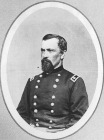
THE PRIVATE SOLDIER :

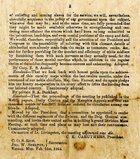
"In the fullest sense, any man in the military service who receives pay, whether sworn in or not, is a soldier, because he is subject to military law. Under this general head, laborers, teamsters, sutlers, chaplains, &c. are soldiers. In a more limited sense, a private soldier is a man enlisted in the military service to serve in the cavalry, artillery, or infantry. He is said to be enlisted when he has been examined, his duties of obedience explained to him, and after he has taken the prescribed oath."

General August Kautz's, USA,"Customs of Service, for Non-Commissioned Officers and Soldiers" (1864), page. 11

P488214.gif
 
It's important to distinguish between Union and Confederate forces when discussing cooks, because many (not all) of the cooks of Southern regiments were enslaved servants, which would result in a different percentage of soldiers detailed as cooks. The food provided to US and CSA troops was different, too.

I have an ancestor from somewhere in Pennsylvania I think who was a cook, but I can't remember who... I'll have to hunt through my tree and find him. If I remember correctly he was an overage man whose son was with the same company.
 
It's important to distinguish between Union and Confederate forces when discussing cooks, because many (not all) of the cooks of Southern regiments were enslaved servants, which would result in a different percentage of soldiers detailed as cooks. The food provided to US and CSA troops was different, too.

I have an ancestor from somewhere in Pennsylvania I think who was a cook, but I can't remember who... I'll have to hunt through my tree and find him. If I remember correctly he was an overage man whose son was with the same company.

Aren't there some stories about Forrest's cook (Catherine?) and a big cookstove carried in a wagon? (Diane or Nathanb would know...)
 
The regs for the Confederate Army, for what it's worth, say little about cooks, except as provided for military hospitals. It does seem that regular formations were left to figure out their arrangements for themselves.

Compiled Service Records for Confederate cooks are somewhat rare, and those that do exist are almost all from Federal records, of men who were swept up with surrendered units -- actual Confederate records for them don't exist, even though other records from those regiments' personnel are extensive.

Here's a excerpt from a piece I wrote on Confederate cooks in 2011:

But regulations are one thing; practice is often another. Anyone who's been part of a large organization knows that there's often a wide divergence between policy — what's supposed to be done — and what actually is done in the day-to-day operations of the group. Is there a way to get a rough estimate of how common it was for the Confederate Army to formally enlist cooks? Yes, there is.


The Data. The National Park Service developed its Civil War Soldiers & Sailors System (CWSSS), an online database, to include essential facts about servicemen who served on both sides during the war. It contains about 6.3 million names, which are themselves drawn from compiled service records (CSRs) held at the National Archives. CSRs are not regimental muster rolls, but are abstracted from them; long before they were transferred to NARA, file clerks at the War Department meticulously copied each man's name, on each roll, to a long card along with other information about him drawn from the rolls. These, along with other paperwork — hospitalization records, receipts, requisitions, discharge papers and the like, were combined and filed in small folders, one for each man. (These are the documents, microfilmed and digitized, that are now available via commercial services like Footnote.) Because any given man might have his name listed differently on several documents, and because the clerks doing the work had no practical way to sort them out, there many duplications of names, alternate spellings, and so on. The end result of all this is that, while the CSRs and NPS database derived from them are not "clean" data — due in large part to the duplication of names — the CWSSS is a relatively comprehensive database.


It's true that many contemporary records were lost, particularly Confederate unit records from the last months of the war, and so are not reflected in either the CSRs at the National Archives or the CWSSS. But while this poses a problem for researchers looking for a specific individual, it's less a concern for the simple analysis offered here, which focuses on extant records only, to see how often cooks are reflected in the muster rolls of Confederate units. The fields available in the CWSSS include "Soldier's Rank_In" and "Soldier's Rank_Out," which allow the researcher to quickly scroll through the names listed for each regiment, to identify men with the listing of "Cook" in either field.


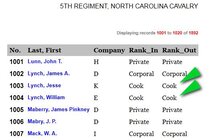
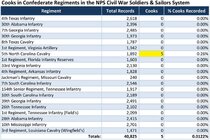
Methods. I selected twenty Confederate regiments to look for men who appear in the CWSSS as "Cook," either as their initial or final rank. Several regiments were ones that my own relatives had served in; others were suggested by readers of this blog. I tossed in a couple of other regiments on a whim, including the parent regiment of the famous companies of the (supposedly integrated) Richmond Howitzers, just for fun. I also included William Dove's 5th North Carolina Cavalry, which was the only unit I knew going into the project that had at least one entry for a cook — the number of cooks in the other nineteen regiments were unknown to me at the time I began going through the lists.

5thnorthcarolinacavalry.jpg

cooks-in-cs-regiments-11.jpg

Results. There are five entries for cooks, in 40,825 names total — one one-hundredth of one percent, as opposed to a figure between 3% and 5%, based on the organization outlined by army regs, at four cooks per company, or 40-45 cooks per infantry regiment at full strength. It's possible I missed a few cooks in skimming through the regiments listed here, but even a dozen more men would barely move the needle. But if this sampling is broadly indicative of the Confederate army as a whole — and I don't know why it wouldn't be — then the larger situation is clear, that cooks were almost never carried on the rolls as enlisted men. Certainly there are other examples than the five men in the 5th North Carolina Cavalry, but even if there are scores more, they much represent a very tiny fraction of the thousands of men who served as army cooks at one time or another during the war.


So why, in this sample of 20 regiments, are there only a handful of examples clustered in the 5th North Carolina Cavalry? The answer may lie in those five men's CSRs — four of the five were carried on the rolls of Company E of that regiment, and were placed there by Captain Thomas W. Harris. (The fifth man, like Hannibal Alexander, has a CSR that reflects only his parole from a Federal prison camp; his presence with the 5th North Carolina is not recorded.) Why did Captain Harris, in particular, formally enter these men on his company's rolls when the other officers of the regiment did not? It's apparent that these men were not themselves cavalry troopers; each one's CSR carries the notation, like William Dove's, "has no horse." Did he he misunderstand the regulations, or common practice, or was there a specific reason? Whatever the answer, Harris' decision to enter these men on the roster of Company E clearly stands in stark contrast to common practice; it's very much a one-off situation.

Allie is entirely correct in pointing out that any modern researcher has to distinguish between Union and Confederate forces when discussing the role and nature of military cooks. Union forces, on the whole, seem more likely to assign enlisted soldiers for duty as cooks, while the Confederate mostly used civilians -- almost always African American men, whether free or enslaved -- in that same role.
 
Last edited:
It's important to distinguish between Union and Confederate forces when discussing cooks, because many (not all) of the cooks of Southern regiments were enslaved servants, which would result in a different percentage of soldiers detailed as cooks. The food provided to US and CSA troops was different, too.

I have an ancestor from somewhere in Pennsylvania I think who was a cook, but I can't remember who... I'll have to hunt through my tree and find him. If I remember correctly he was an overage man whose son was with the same company.
Good point. While many cooks in the CSA army were enslaved servants, in my limited sample I have found several soldiers from the ranks who were so detailed, such as Pvt Samuel J. Haselden of F/8 FL, who cooked for his colonel in late '62 (per his CSR); Pvt Oliver P. Thrower of F/43 NC; and Pvt Granville W. Belcher of F/57 VA, who cooked for his whole company in Jul '63. In the Branscomb Family letters, a soldier in the 3 AL notes that in Aug '61 privates were paid $11 a month, and cooks $12, and that in Apr '62 when be became cook his comrades nicknamed him "Betsy."
 
I am confused: I know that there were "messes", in which soldiers would take turns cooking for the mess, and I understand that some officers had cooks.....I also know that troops were ordered to prepare a certain days' amount of rations for an impending march, etc (which they prepared themselves).....My confusion lies with the implication that there were cooks who prepared food en masse for the Armies.....Certainly, cooking en masse was to be tried early in the war, but transporting "kitchens" and necessary cookware DID become impractical as the war progressed (horses, wagons etc were needed for higher military priorities like hauling artillery, commissary goods,and the like and not for hauling baggage, pots and pans)......
Am I right, "half" right, or dead wrong??......Thanks!!
A good book to read is "A Taste of War: A Culinary History of the Blue and the Grey" by William C. Davis....I read it years ago, but don't recall what he said about cooking en masse, except for the part about a "Mess".....
 
I am confused: I know that there were "messes", in which soldiers would take turns cooking for the mess, and I understand that some officers had cooks.....I also know that troops were ordered to prepare a certain days' amount of rations for an impending march, etc (which they prepared themselves).....My confusion lies with the implication that there were cooks who prepared food en masse for the Armies.....Certainly, cooking en masse was to be tried early in the war, but transporting "kitchens" and necessary cookware DID become impractical as the war progressed (horses, wagons etc were needed for higher military priorities like hauling artillery, commissary goods,and the like and not for hauling baggage, pots and pans)......
Am I right, "half" right, or dead wrong??......Thanks!!
A good book to read is "A Taste of War: A Culinary History of the Blue and the Grey" by William C. Davis....I read it years ago, but don't recall what he said about cooking en masse, except for the part about a "Mess".....

An example I'm aware of, the Union 13th Tennessee Cavalry (east Tennessee,) had over 20 African-American members. The majority were "Cooks." (usually two, to a company) Several of these men drew pensions following the war. Some were captured, a couple transferred to the USCT.
 
An example I'm aware of, the Union 13th Tennessee Cavalry (east Tennessee,) had over 20 African-American members. The majority were "Cooks." (usually two, to a company) Several of these men drew pensions following the war. Some were captured, a couple transferred to the USCT.
Thanks for the info, but I am still confused....."the majority were Cooks".....How many is the majority, 10 or 18?..Of that number, were they strictly cooks for officers, or did they cook for Companies?...Of those receiving the pension, I understand that, as they were captured or transeffered, but once transferred, they served in combat roles?......I still think it is impractical to have wagons/horses being used to haul kitchen gear for large bodies of troops, when the horses were needed elsewhere.....

Again, I appreciate your input, and by no means do I think your information is in error......I am just trying to put it into perspective and understand it.
Thanks!!
 
I am confused: I know that there were "messes", in which soldiers would take turns cooking for the mess, and I understand that some officers had cooks.....I also know that troops were ordered to prepare a certain days' amount of rations for an impending march, etc (which they prepared themselves).....My confusion lies with the implication that there were cooks who prepared food en masse for the Armies.....Certainly, cooking en masse was to be tried early in the war, but transporting "kitchens" and necessary cookware DID become impractical as the war progressed (horses, wagons etc were needed for higher military priorities like hauling artillery, commissary goods,and the like and not for hauling baggage, pots and pans)......
Am I right, "half" right, or dead wrong??......Thanks!!
A good book to read is "A Taste of War: A Culinary History of the Blue and the Grey" by William C. Davis....I read it years ago, but don't recall what he said about cooking en masse, except for the part about a "Mess".....
Another good point. Cooks as a formal duty seem to have generally been dispensed with while on the march, when troops were left on their own to cook the rations they carried. But apparently not for all commands. John Coxe of the 2 SC writes that their cooks (enslaved servants?) brought up camp kettles of boiled beef in the evening of the second day at Gettysburg. During the same battle, in the 9 LA and 61 GA, details were sent back to cook up three days rations for the rest of the men, in essence taking a few soldiers off the front line for a time. As Andy Hall pointed out, every unit seems to have made their own arrangements. But because the wagon trains (carrying food and cooking utensils) departed first on the retreat, many Confederate soldiers went hungry for several days.
 
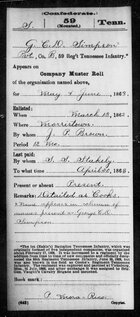
I pulled this record for someone the other day and noticed this Tennessee CSA soldier was a cook. As a matter of fact it appears his whole company were detailed as cooks, although I haven't located any other records from this company at this date to verify. At least in this case it appears someone on the rolls as a Confederate soldier was a cook.

image.jpg
 
Thanks for the info, but I am still confused....."the majority were Cooks".....How many is the majority, 10 or 18?..Of that number, were they strictly cooks for officers, or did they cook for Companies?...Of those receiving the pension, I understand that, as they were captured or transeffered, but once transferred, they served in combat roles?......I still think it is impractical to have wagons/horses being used to haul kitchen gear for large bodies of troops, when the horses were needed elsewhere.....

Again, I appreciate your input, and by no means do I think your information is in error......I am just trying to put it into perspective and understand it.
Thanks!!

Here's a little more detail ! I have to credit DixieRifles with the research at Fold 3. I furnished the names, he found their records. Very through research on his part !

13 Tennessee Cavalry (US)

Negro Cooks In The Union 13th Tenn (east Tennessee) Cavalry


Company A...........Aaron Woolfork (or Woodfork)E 5 pages

Aka: Woodfork,

[2] rank: under cook Afr css {illegible ?}

Born in Mass

Muster in April 16, 1864. Age 42 years.

Eyes: Blk Hair: Blk Complexion: Blk

[9-10] Enlistment Document. Header State of Kentucky Town of Burkville

Born in Mass

[11-12] Enlistment Document. Born in Md


Company B..............Alfred Irvin (under cook)

<1> Ervin, Alfred See Erwin. Under cook 1 page

<2> Erwin, Alfred 11 Pages

[2] U.C. Muster out Sept 5, 1865. Age 27

[4] Born Washington Co. Tenn Age 28

Enlisted Oct. 26, 1864 at Jonesboro,

Eyes: Blk Hair: Blk Complexion: Blk

Rem: Under cook of African Descent

[7 - 8] Enlistment Doc {Page 6 is duplicate of Page 7}

[9] Declaration of Recruitment {Page 10 is duplicate of page 9}

[11] Volunteer Enlistment document

Occupation: African undercook Height 5 ft- 8 in


Company C...............Aden & Clay Davis

Clay Davis 5 pages

[2] rank: under cook A. D. { A.D. may refer to African Descent }

Enlisted June 1, 1864. Age 20 years.

Eyes: Blk Hair: Blk Complexion: Blk

[3] Clay Davible Rem: Deserted Agt the 15" 1864.

[4] Charles Davibl Rem: Deserted Agt 15 1864

[5] Deserted Sept 15, 1864 at Bull Gap, Tenn. {Form has "African" written on it in 3 or 4 places}


Aden Davis 3 pages

[2] rank: under cook A. D.

Enlisted June 1, 1864. Age 18 years.

Eyes: Blk Hair: Blk Complexion: Blk

[3] Deserted Sept 15, 1864 at Bull Gap, Tenn.


Company D................George Bogus 5 pages

Boggos, Bagas, Bogens(?),

[2] Mustered as under cook. Mustered April 12, 1864

[3] Enrolled Feb 14, 1864 at Nashville. Age 18 years.

Deserted from Camp near Knoxville, Dec 5/ 1864.

There is nothing in these records to indicate he was Black.


Company E.................Richard Broyles "Dick" 8 pages

[2] Appears as rank of under cook Afri dec'd

Enlisted April 12, 1864 at Nashville. Enrolled April 16. Age 20 years.

Eyes: Blk Hair: Blk Complexion: Blk

[3]Colored - written in space for rank

[7] Col under cook - entered for rank and in Remarks


Company F...................Logan Goodpasture 7 pages

Enlisted Febry 1, 1864. Age 18 years.

[2] Eyes: Blk Hair: Blk Complexion: Blk

[7] Volunteer Papers 5 ft- 6 in Blk, Blk, Blk


Company G..................John Williams 11 pages

[2] Company G. Born Atlanta, Georgia Age 20

Enlisted Feb 14 1864.

Eyes: Blk Hair: Blk Complexion: Blk

[3] Rem: African Under Cook

[4] Rank: Coloured

[6] Age 22

[8- 9] Declaration of Recruit document {Page 10 – 11 are duplicates}


Company H..................William Taylor pages(Negro, drew a pension following the war, pictured in regiment reunion photo)


[2] Header for 12 Tenn Cavalry

Born Carter Co. Tenn Age 26

Enlisted October 1 1864. At Carter Station, Tenn.

Height 5 ft - 6 in

Eyes: Black Hair: Black Complexion: Black

Rem: As African under cook

[3] {Different form but same info as page 2}

Rem: Under Cook of African Descent.

[5] Muster Out Roll Knoxville Sept 5, 1865

[7- 8] Declaration of Recruit document {Page 9 – 10 are duplicates}


Company I.....................Bell Walker 7 pages

[2] Born Hawkins Co. Tenn Age 18

Enlisted December 1 1864. At Taylorville, Tenn. Height 5 ft - 6 in

Eyes: Blk Hair: Light Complexion: Blk

[6-7] Declaration of Recruit document


Company K....................Charles Staples Sr 19pages

[2] Born Fanquin(?) Co. Va Age 19 Page 13 reads Fockwire Co.

Enrolled March 1, 1864 at Nashville.

Residence Livingston Nastin(?) Co. Tenn

[4] March-April 1864 {Page 7 is a duplicate}

Rem: under cook of African descent

[8] dated July 8, 1865 Absent

Rem: Absent in hosp in Greenville, Tenn

[9] Roll dated Sept 5, 1865

Died at Greenville, Tenn June 15, 1865 by reason of chronic diarrhea

{12-13] Final Statement document

Final Statement has an error. Name at top is Charles Staples. Further down, it reads: "The said Charles Cook .." Looks like they confused his duty with his name.

[14-15] Inventory of Effects document

[16- 17] Declaration of Recruit document {Page 18 – 19 are duplicates}


Company L.....................Thomas Brown 9 pages

[2] Born Gaston Co. N. C. Age 21

Enlisted Oct 2, 1864

Eyes: Blk Hair: Dark Complexion: Dark

Height 5 ft – 8 in

Rem: under cook of African descent

[4] Muster-out Roll Sept 5, 1865 Age 22

[7-8] Enlistment doc {Page 9 is duplicate of page 7}


Company M.....................Alfred Young 11 pages

Alford Young, Alfus Young,

[2] Notation doc War Dept dated 1879

[3] Muster out Roll Sept 5, 1865 Age 25

Under Cook. Deserted Aug 31, 1865. Never paid.

[6] Roll Dec 6, 1864

Born Yancey Co. N. C.

Enlisted Aug 1, 1864 at Bulls Gap

Height 5 ft – 10 in

Eyes: Blk Hair: Blk Complexion: Blk

Under Cook of African Descent

[8-9] Recruitment document


Notes

Number of pages include the first "index" page and any duplicates.

[2] = Page number in file

[4] = Highlighted page number is page that was downloaded.

<1> = Indicates records or an index card filed under alternate spelling.
 
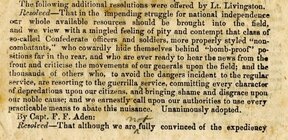
I found this by accident. It's from a pamphlet recording a meeting of the 7th TN Cav CSA in Verona MS in April of 1865. CSO Rice, a relative of mine, was the secretary at the meeting (although they misspelled his name.)

After the usual resolutions to fight bravely yadda yadda, Lt James Larkin Livingston made one about eliminating guerrillas, and then Capt FF Aden made one about their feelings on the subject of enlisting black men as soldiers. They suggested that instead black men could be enlisted as servants, taking the place of white men who were among other things assigned to cook. This is the first evidence I've seen that white men cooked anything for the 7th TN - Louis Napoleon Nelson, a slave of ER Oldham, was a cook, and both CSO Rice and another member of the 7th state that almost every private in this command had his own servant with him.

image.jpg
image.jpg
 
Last edited:

Learn About Us
About CivilWarTalk
Contact the Webmaster
Meet the Staff
Link to CivilWarTalk
Join Our Community
Register
Browse Forums
View Today's Discussions
Search the Forum
Get Help
FAQ
Student Guide
Forum Rules & Etiquette
Copyright / DMCA

     Contact Us CivilwarTalk on Facebook CivilWarTalk on YouTube CivilWarTalk on Twitter RSS Feed

Bringing the American Civil War and More to Life.
© 1999 - , CIVILWARTALK, LLC - Site Version 10.0

SlaveryTalk.com - SecessionTalk.com - CivilWarTalk.com - ReconstructionTalk.com
Back
Top