Soldier-made carved ring?

Strawfoot

Private
Joined
Sep 20, 2020
The little (shell? bone?) ring came as a bonus in a $10 odd & ends lot from Alabama. Under magnification I can see it is hand carved and bears the inked-in initials JM. I already happen to have a soldier-made shell ring (pictured here) with a strong provenance and documentation…does the JM one look like it might be another? I know soldier-made rings are usually bone or gutta percha, but this one, like my shell one, has some iridescence to it. Definitely not plastic. Thoughts? I don't guess there's really any way to know for sure.
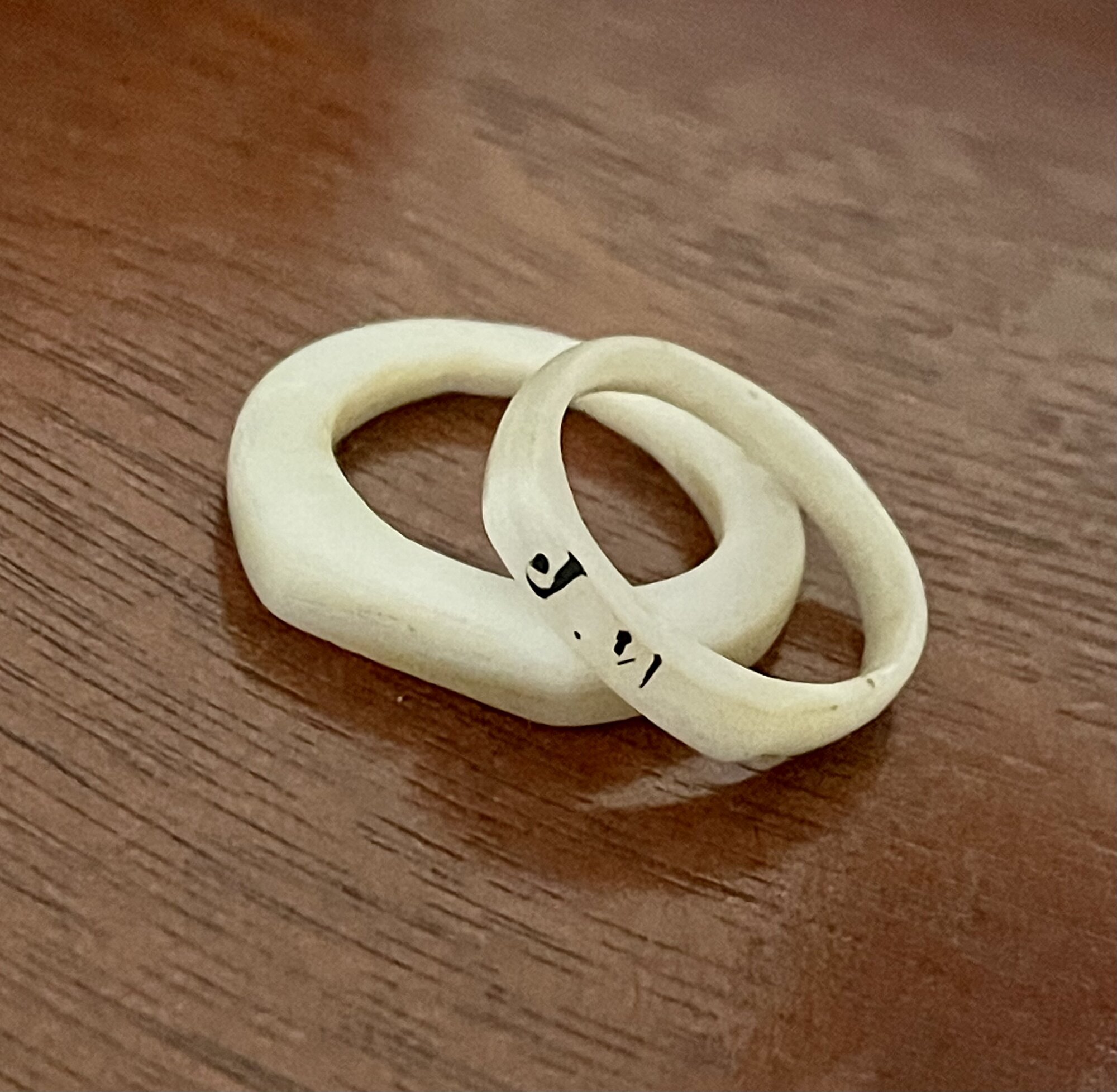
IMG_5279.jpeg
 
The little (shell? bone?) ring came as a bonus in a $10 odd & ends lot from Alabama. Under magnification I can see it is hand carved and bears the inked-in initials JM. I already happen to have a soldier-made shell ring (pictured here) with a strong provenance and documentation…does the JM one look like it might be another? I know soldier-made rings are usually bone or gutta percha, but this one, like my shell one, has some iridescence to it. Definitely not plastic. Thoughts? I don't guess there's really any way to know for sure.View attachment 481420
Carved pieces like these were common enough throughout the period. Soldiers and citizens alike would pass time carving things or inscribing coins with initials of loved ones, called love tokens. These rings or most carved pieces seem to be made of bovine remains, ivory and shell too if it was available. Most definitely gutta percha rings exist too and are nicely engraved in some.Yours share a resemblance to two that union drummer boy sold as POW rings. It's very possible they could be from a soldier but most I encounter have a patriotic motif, colored in by wax or have a name and company carved in. That's not to say they all are like that though. I would say it's period but who owned it could be a million different people without a provenance. I have two I can share with you if you'd like, they aren't rings but carvings with names and companies or regiments. I love the ones you have. Something about imagining the person sitting there crafting this thing for someone they were thinking about is very special.
 
Last edited:
Carved pieces like these were common enough throughout the period. Soldiers and citizens alike would pass time carving things or inscribing coins with initials of loved ones, called love tokens. These rings or most carved pieces seem to be made of bovine remains, ivory and shell too if it was available. Most definitely gutta percha rings exist too and are nicely engraved in some.Yours share a resemblance to two that union drummer boy sold as POW rings. It's very possible they could be from a soldier but most I encounter have a patriotic motif, colored in by wax or have a name and company carved in. That's not to say they all are like that though. I would say it's period but who owned it could be a million different people without a provenance. I have two I can share with you if you'd like, they aren't rings but carvings with names and companies or regiments. I love the ones you have. Something about imagining the person sitting there crafting this thing for someone they were thinking about is very special.
Yes, please share!
 
Are there any camel bone carvings from Douglas? I've read that quite a few rings were carved from Camel bones at Vicksburg.
:bounce:

No disrespect to Douglas the camel, but I was under the impression he ended up as the main course at a Confederate BBQ.
But I can see many bones would be left for carving rings, chess pieces and such.
Speaking of this devoted dromedary, I have to include a photo of his headstone.


R.jpg


520f34a527f4a7b8721aea2b951c70e2.jpg


One of the more interesting and scarcer relics that I have in my collection from the Fourth Michigan Infantry is a "bolo-slide" that was carved from a bone by Private James Gilmore Tuttle of Company F. It was carved sometime after Tuttle was taken prisoner at Falls Church, Virginia, on August 10, 1861. It may also be one of the earliest wartime prisoner carved bone relics as the number of POW's would obviously become much larger as the war continued. You can read about his life as a prisoner and see Tuttle's carved bone bolo-slide by visiting:
https://4thmichigan.wordpress.com/james-gilmour-tuttle/
The account gives a great personal perspective of an early war pow in my opinion. I'd would certainly like to hear what anyone may have to say about it, so be certain to reply.
 
One of the more interesting and scarcer relics that I have in my collection from the Fourth Michigan Infantry is a "bolo-slide" that was carved from a bone by Private James Gilmore Tuttle of Company F. It was carved sometime after Tuttle was taken prisoner at Falls Church, Virginia, on August 10, 1861. It may also be one of the earliest wartime prisoner carved bone relics as the number of POW's would obviously become much larger as the war continued. You can read about his life as a prisoner and see Tuttle's carved bone bolo-slide by visiting:
https://4thmichigan.wordpress.com/james-gilmour-tuttle/
The account gives a great personal perspective of an early war pow in my opinion. I'd would certainly like to hear what anyone may have to say about it, so be certain to reply.
Now that's nice!
 
The little (shell? bone?) ring came as a bonus in a $10 odd & ends lot from Alabama. Under magnification I can see it is hand carved and bears the inked-in initials JM. I already happen to have a soldier-made shell ring (pictured here) with a strong provenance and documentation…does the JM one look like it might be another? I know soldier-made rings are usually bone or gutta percha, but this one, like my shell one, has some iridescence to it. Definitely not plastic. Thoughts? I don't guess there's really any way to know for sure.View attachment 481420
Bone will have more of a matte surface and in cross section, you'd see pores. Shell will have an irridescent sheen. And they are sold thru and thru. Looks shell to me. There is a transluscence there. Bone has more of an "ivory" aspect to it. Hard to explain.
 
Bone will have more of a matte surface and in cross section, you'd see pores. Shell will have an irridescent sheen. And they are sold thru and thru. Looks shell to me. There is a transluscence there. Bone has more of an "ivory" aspect to it. Hard to explain.
Yes, I see everything you're saying! I really think this is another shell one. No real way of dating it (the odds that my first one came with such an airtight provenance is ridiculous) but I do love those fun little initials on it. My guess is that it's 19th century, at any rate . . . and it fits my finger PERFECTLY! :)
 
You can read about his life as a prisoner and see Tuttle's carved bone bolo-slide by visiting:
https://4thmichigan.wordpress.com/james-gilmour-tuttle/
The account gives a great personal perspective of an early war pow in my opinion. I'd would certainly like to hear what anyone may have to say about it, so be certain to reply.
Excellent account. Thank you for sharing the link. You really get a good idea of this man's personality from his story.
 

Learn About Us
About CivilWarTalk
Contact the Webmaster
Meet the Staff
Link to CivilWarTalk
Join Our Community
Register
Browse Forums
View Today's Discussions
Search the Forum
Get Help
FAQ
Student Guide
Forum Rules & Etiquette
Copyright / DMCA

     Contact Us CivilwarTalk on Facebook CivilWarTalk on YouTube CivilWarTalk on Twitter RSS Feed

Bringing the American Civil War and More to Life.
© 1999 - , CIVILWARTALK, LLC - Site Version 10.0

SlaveryTalk.com - SecessionTalk.com - CivilWarTalk.com - ReconstructionTalk.com
Back
Top