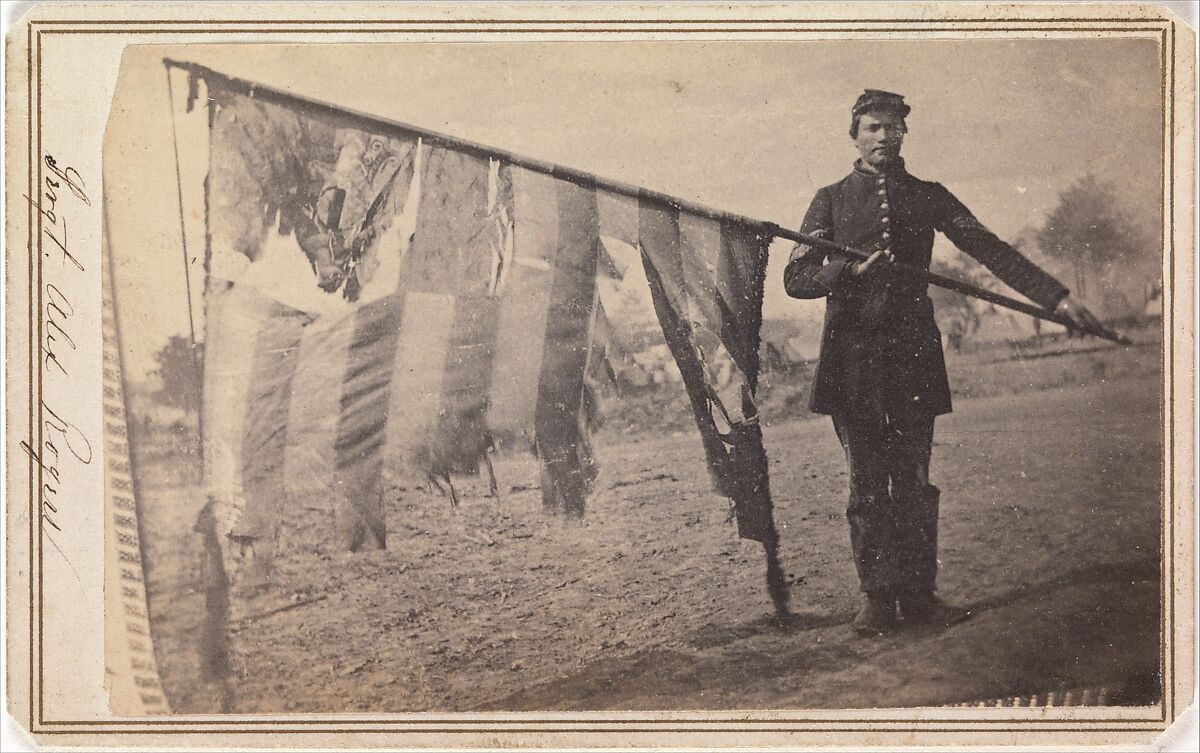
Sergeant Alex Rogers with Battle Flag

Mike Serpa

Lt. Colonel
Joined
Jan 24, 2013
Sergeant Alex Rogers with Battle Flag, Eighty-third Pennsylvania Volunteers, Third Brigade, First Division, Fifth Corps, Army of the Potomac

DP265026.jpg

"Sergeant Alex Rogers proudly posing for the camera holding the scarred colors, or flag, of the Eighty-third Pennsylvania Volunteers. He and his fellow soldiers fought on virtually every Eastern battlefield and suffered the second highest number of battle deaths of any Union regiment. As seen here, infantry flags were large—more than six feet in length—and affixed to staffs almost ten feet tall that made them easy to rally around during the mess of battle. Their size, however, also made them targets for enemy fire and contributed to the high mortality rate of color bearers."

Met Museum
 
View and read more about the surviving flags of the 83rd Pennsylvania Infantry.


IMG_0211.jpeg


"83rd Pennsylvania Infantry, Second State Color. Composed of men from Crawford, Erie, and Forest counties, the 83rd was organized on September 13, 1861. The second state color given to the 83rd was originally intended for the 157th, but was altered for the 83rd. The regiment received the flag sometime after May 16, 1863. It is highly probable that the regiment carried this color at the battle of Gettysburg. The 83rd was mustered out of service on June 28, 1865."
 
That is a battle worn flag the color bearer is holding in that photograph! It is large compared to some of the other battle flags I have seen. Were the Union battle flags larger than those borne by the Confederacy? Looking at that picture if that size is the standard for Union regiments, it appears their battle flags were larger.
They were larger, I don't remember the exact dimensions for each off the top of my head but I'm sure that could be found with an easy search.
 
Sergeant Alex Rogers with Battle Flag, Eighty-third Pennsylvania Volunteers, Third Brigade, First Division, Fifth Corps, Army of the Potomac

View attachment 477891
"Sergeant Alex Rogers proudly posing for the camera holding the scarred colors, or flag, of the Eighty-third Pennsylvania Volunteers. He and his fellow soldiers fought on virtually every Eastern battlefield and suffered the second highest number of battle deaths of any Union regiment. As seen here, infantry flags were large—more than six feet in length—and affixed to staffs almost ten feet tall that made them easy to rally around during the mess of battle. Their size, however, also made them targets for enemy fire and contributed to the high mortality rate of color bearers."

Met Museum
3352.jpg
 
Thought the battle wear that appeared on regimental battle flags had a much deeper meaning than any names of battles fought by the regiment that were stitched onto these colors.

Tattered flags, like the one displayed, were powerful testaments to the bravery and sacrifices of the members of the regiment that carried it into combat.
 
image.jpg


IMG_5194.jpeg

These are the flags of the 9th Kentucky US when encamped at Stones River NB.


IMG_5187.jpeg

An excellent indication of scale can be seen with the beautifully rendered reproduction of the 9th's regimental.

IMG_0503.jpeg

Confederate battle flags like this Hardee's Corps full moon pattern from the 6th & 7th Arkansas Consolidated Infantry Regiment were (+/-) 3-4 feet square.

Many CSA regiments carried a national as their battle flag (+/-) 4' hoist & 6' fly.

CSA regiments carried a single battle flag. Union regiments carried a national & regimental flag.

image.jpg


image.jpg

Commanding generals could designate a personal design as their HQ flag.
 
Sergeant Alex Rogers with Battle Flag, Eighty-third Pennsylvania Volunteers, Third Brigade, First Division, Fifth Corps, Army of the Potomac

"Sergeant Alex Rogers proudly posing for the camera holding the scarred colors, or flag, of the Eighty-third Pennsylvania Volunteers. He and his fellow soldiers fought on virtually every Eastern battlefield and suffered the second highest number of battle deaths of any Union regiment. As seen here, infantry flags were large—more than six feet in length—and affixed to staffs almost ten feet tall that made them easy to rally around during the mess of battle. Their size, however, also made them targets for enemy fire and contributed to the high mortality rate of color bearers."

Met Museum

There is a web site dedicated to the preservation of Pennsylvania Civil War Battle flags at http://www.pacivilwarflags.org/index.cfm (home page).

[ Update : I just now see message #3, above by Sowbelly and Hardtack, identifying the Pennsylvania flag preservation site ]

On the home page there is a link entitled, "List of Color Bearers" : http://www.pacivilwarflags.org/home/colorBearers.cfm

If you scroll down a few screen heights, there is a smaller carte-de-visite of Sergeant Alex Rogers and if you click on it, it will open the full carte-de-visite which also lists battles of the 83rd PA from Yorktown, 1862 thru Gettysburg, 1863 :

2007.070.jpg


I'll guess that these battle dates reflect the life of this flag remnant that Sgt. Rogers is holding.
 

Learn About Us
About CivilWarTalk
Contact the Webmaster
Meet the Staff
Link to CivilWarTalk
Join Our Community
Register
Browse Forums
View Today's Discussions
Search the Forum
Get Help
FAQ
Student Guide
Forum Rules & Etiquette
Copyright / DMCA

     Contact Us CivilwarTalk on Facebook CivilWarTalk on YouTube CivilWarTalk on Twitter RSS Feed

Bringing the American Civil War and More to Life.
© 1999 - , CIVILWARTALK, LLC - Site Version 10.0

SlaveryTalk.com - SecessionTalk.com - CivilWarTalk.com - ReconstructionTalk.com
Back
Top