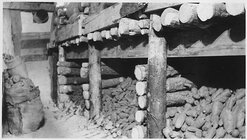
root cellars

Onions wouldn't be stored in a cellar. Too damp. They need to be kept dry with air circulating around them. That's why the classic way is to braid and hang them in the kitchen, but larger amounts could be kept in the attic. There absolutely would be onions in October. They keep all winter.
 
Depends on the food. Pickling was understood and canning was discovered in the early 19th century. Drying out fruits and vegetables for storage was also done. Folks ate "seasonally" for the most part back in the day, though.
 
We had a cellar when I was a kid. Yes. Taters and carrots would keep for a loong time (we kept them buried in sand). Everything else was "canned," that is, put up in jars and sealed by driving out the air in a hot-water bath. Cabbage would also "keep." I suspect that turnips and rutabagas would also keep, but we didn't grow them.
 
Onions wouldn't be stored in a cellar. Too damp. They need to be kept dry with air circulating around them. That's why the classic way is to braid and hang them in the kitchen, but larger amounts could be kept in the attic. There absolutely would be onions in October. They keep all winter.
This is correct. Onions get their leaves braided together. Then these long chains of braided onions get hung in the driest part of the driest building. Dark, too. It might be a cellar, but that's not a given. If everything goes well, in the spring these onions will be sprouting a few leaves out of the bulbs. I never re-planted at this stage, but I'm sure someone can tell us how to proceed from there. I always just ate them. Still later, when buying Vidalias, I put them in stockings, with a knot between each onion so they couldn't touch and rot one another. Then...same deal: Hang them in a cool, dark, dry place and eat them one at a time. If they start to sprout, eat them faster.
 
I should also say that, in my town, there are quite a number of vaulted ceiling wine cellars. Boonville, MO got to be known as the "Vineclad City" because of the myriad of grape vines grown here. Wine making was huge along the MO River corridor in the 1830s-through the start of prohibition. There are dozens of wine cellars under the old side yards and back yards all over town. Wine making is no longer an industry here, but it is still a hobby with some people. In the meantime, a lot of these wine cellars have shelves upon shelves of canned fruits and vegetables every year (or they formerly did). Think "root cellars", but much more extensive.

Dang good tornado shelter in the spring, too!
 
Go to youtube and look at the Jas Townsend and Son videos. They reverence all their videos. They show how to store eggs, and even how to pickle onions. Great entertainment besides being period correct. Careful watching his daughter doing the videos, she steals the scene.
 
When I think of salt pork, I think of bacon and ham. But then, the entire pig was salted and preserved. A barrel of salt pork might be two pigs. Shoulders, ribs, bacon, hams, ears, trotters. That was a revelation.
 
When I think of salt pork, I think of bacon and ham. But then, the entire pig was salted and preserved. A barrel of salt pork might be two pigs. Shoulders, ribs, bacon, hams, ears, trotters. That was a revelation.
The big difference is that bacon and ham, as we think of it usually (slab bacon and country ham) was salted then smoked. Salt pork was just salted. So those hams in a barrel of salt pork, along with all the rest of the pieces, would be different from the usual smoked hams even though they were the same cut of meat: moister, no smoke flavor, no outer rind.
 
Okay, some where on this forum, yesterday, I viewed a chart of fruits and vegetables that are grown by season, in VA. When seeing that, I thought, 'hey, this is cool, shows what was available in different seasons." This morning, I couldn't find it any where! LOL But, thanks to google, I did find it, sent an attachment on an email to the lads. We're going for an 'Authentic Campaigner' training weekend, in late October. So, I mentioned, jokingly, that no onions better be seen because according to the chart, onions weren't being farmed. Now, here's my question...do ya'll in VA, especially in areas where ANV was trampin' through, have root cellars? I ask this because the Cap'n came back with, "onions may have been available, stored down in root cellars...soooooo fact or fiction?
Any positive feedback would be most greatly appreciated.
Fact. Most older homes have the root cellars close by until refrigeration was on the market. Root cellars are use today to store cabbage and potatoes. Matter of fact, I saw a new root cellar just the other day someone had dug. The ones I like to see are the ones that have grass growing over the top! That is cool. Other garden Items were canned. Also, straw is used to cover the veggies in the root cellar. Then there are those that dug a hole in the ground, filled it with straw and put the above items in.
 
The history of Root Cellars is very interesting. The idea of storing food underground to preserve it goes back 1000s of years. The early Etruscans and Egyptians did this. It was not until 17th century in England that walk-in cellars were constructed. The early colonist brought the root cellar to America. In the Eastern U.S and Canada, thousands of old root cellars can be found.

An interesting book on root cellars is "Root Cellars in America, Their History, Design and Construction 1609-1920" by George Gage.

This thread would be nice if moved to the Food Forum. Maybe a Mod can move it.

Thanks.

Donna host of food forum
 
Last edited:
I'm in the Shenandoah Valley of Virginia. When I was a child "root cellars" were very common in the rural areas of the Valley. The ANV did not operate in this area, though Stonewall most certainly did operate here. I would have to say, based on my own local knowledge, that root cellars most certainly were used in the areas where the ANV primarily operated.
 
It pertains to the storage of foods. The food forum not only has recipes but how food prepared and stored and what vegetables and herbs, and meats were popular during this time period.

It seemed appropriate to have root cellars in Food Forum.

It is easy to find. Just go to search and put in root cellars.

Thanks so much for starting this thread. Like to have any interesting topics on foods and how foods produced and stored during this time period.

If you have any other food related topics please post. We are also always looking for old recipes from this era.
 
People talk about cellars to keep things cool, but it's also worth remembering they keep things from freezing. If potatoes, carrots, beets, etc. freeze, they die and get rotten. What cellars do is mimic the natural condition that root vegetables would survive in over the winter--humid, dark, underground, cool even temperature. Except you don't have to go out and dig them all winter from the garden, or worry about the ground freezing too deep and killing them. Parsnips are one of the few root vegetables not hurt by freezing, and I think maybe salsify, can't recall on that.
 
A book to check on is "Daily Life in the Civil War" by Dorothy and James Volo. On page 229 in book they refer to vegetables kept in the root cellar.

" Vegetables such as beets, cabbage, carrots, cauliflower, onions, parsnips, potatoes,radishes, rutabagas, sweet potatoes, turnips and winter squash were stored in root cellars where the climate allowed."

I remember my Granny's root cellar when I was very young. This was on farm in Lexington, Fayette County, Ky. The house and cellar been around for over a 100 years at that time. The structures would have dated back to about time of Civil war. She stored all kinds of vegetables in that root cellar plus her canning goods. I was always afraid to go in as were always spider webs. I hated spiders. I would stand by the entrance as she got what she wanted.
 
In the 17th and 18th centuries every farmstead had a root cellar. They were the first refrigerators. They used the insulating properties of the soil. Food stored in summer stayed cool and they reduced spoilage. In the winter the cellar kept foods from freezing.

Vegetables stored in the root cellars were potatoes, turnips and carrots. Other foods placed in cellar during winter months were beets, onions, preserves/jams, salt meat, salt, and salt fish. By the 19th century the cellars were used to store crops for market until the middle of winter when the crops would bring higher prices. Some root cellars were used to hide fugitive slaves as stops on the underground railroad.

From: "Historic Root Cellar Restoration Project" Maryland Agricultural Research Council.
 
There been discussion whether onions can be stored in root cellar. I have referred to two sources that say they can and were.

Onions in Root Cellars:

See "22 Foods You can Store in the Root Cellar" from HobbyFarm.com

One vegetable they discuss is onions. They say place harvested onions in newspaper, screen or hardware cloth, out of sunlight, in dry, well ventilated place and cure for 10 to 14 days, or until skins are papery and roots are dry. Cut off the tops about 1 inch above the onion. Store in ventilated container. You can use paper grocery sacks. Avoid any plastic bags. Dry conditions are crucial to the storage life of onions. Shelf life is 5 to 8 months.
 

Learn About Us
About CivilWarTalk
Contact the Webmaster
Meet the Staff
Link to CivilWarTalk
Join Our Community
Register
Browse Forums
View Today's Discussions
Search the Forum
Get Help
FAQ
Student Guide
Forum Rules & Etiquette
Copyright / DMCA

     Contact Us CivilwarTalk on Facebook CivilWarTalk on YouTube CivilWarTalk on Twitter RSS Feed

Bringing the American Civil War and More to Life.
© 1999 - , CIVILWARTALK, LLC - Site Version 10.0

SlaveryTalk.com - SecessionTalk.com - CivilWarTalk.com - ReconstructionTalk.com
Back
Top