
AndyHall
Colonel
- Joined
- Dec 13, 2011
This is a follow-on to an earlier thread here.
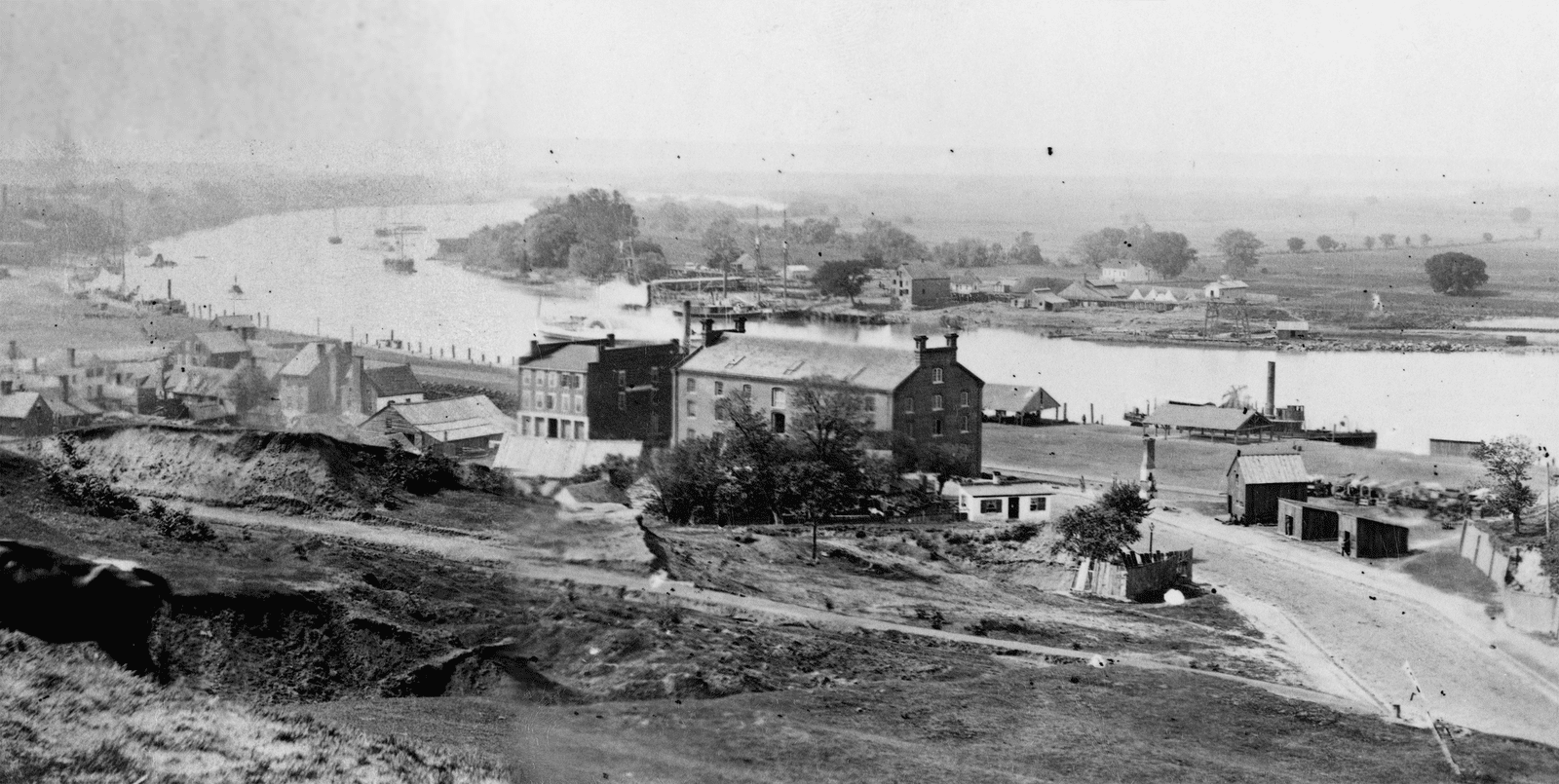
This is a composite image, made from LoC images here and here. It shows the area known as Rocketts, just below Richmond, at was the site of the Confederate Navy Yard during the war (foreground), with another construction yard across the James River. John Coski's Capital Navy reproduces part of the original image, with this cation:
FWIW, I think Coski's map (p. 17) showing the location of Rocketts is in error, showing the site closer to town than it was. Coski's map seems to be based on one published by the Richmond Civil War Centennial Committee in the early 1960s, while contemporary maps place it several hundred yards further downstream.
This is a composite image, made from LoC images here and here. It shows the area known as Rocketts, just below Richmond, at was the site of the Confederate Navy Yard during the war (foreground), with another construction yard across the James River. John Coski's Capital Navy reproduces part of the original image, with this cation:
A view of Rocketts from Libby Hill/ April 1865
The only Civil War-era photographs of the Confederate navy yards were taken -- by Mathew Brady or his assistant, or Levy & Cohen of Philadelphia -- after the Federal capture of the city. On the near (north) side of the James River is Rocketts. A few residences and businesses of the Rocketts neighborhood are visib1e in the left foreground. The Rocketts landing, with its permanent sheds or shelters, can be seen near the right edge of the photo. Visible in middle of the photo is the captured Confederate artillery shown on page xiii.
Across the river is the yard (usually called the "Yard opposite Rocketts") where the C.S.S. Virginia II was constructed. On the point of land to the left are ways used for constructing the wooden frame of vessels. The unfinished vessel on the ways was probably an unnamed ironclad warship designed by William A. Graves. On the beach directly across the river are additional ways where a smaller vessel (probably a torpedo boat) was under construction. Archaeologists have recently [1996] discovered the foundations of the substantial building near the right side of the photograph. To the right of that structure (just beyond the frame of the photograph) were buildings and tents which were probably used by the laborers at the southside yard.
The vessels in the river are Federal ships. The sunken ship visible at the far left of both photographs is probably the Confederate school ship Patrick Henry. Courtesy of the Library of Congress.
The only Civil War-era photographs of the Confederate navy yards were taken -- by Mathew Brady or his assistant, or Levy & Cohen of Philadelphia -- after the Federal capture of the city. On the near (north) side of the James River is Rocketts. A few residences and businesses of the Rocketts neighborhood are visib1e in the left foreground. The Rocketts landing, with its permanent sheds or shelters, can be seen near the right edge of the photo. Visible in middle of the photo is the captured Confederate artillery shown on page xiii.
Across the river is the yard (usually called the "Yard opposite Rocketts") where the C.S.S. Virginia II was constructed. On the point of land to the left are ways used for constructing the wooden frame of vessels. The unfinished vessel on the ways was probably an unnamed ironclad warship designed by William A. Graves. On the beach directly across the river are additional ways where a smaller vessel (probably a torpedo boat) was under construction. Archaeologists have recently [1996] discovered the foundations of the substantial building near the right side of the photograph. To the right of that structure (just beyond the frame of the photograph) were buildings and tents which were probably used by the laborers at the southside yard.
The vessels in the river are Federal ships. The sunken ship visible at the far left of both photographs is probably the Confederate school ship Patrick Henry. Courtesy of the Library of Congress.
FWIW, I think Coski's map (p. 17) showing the location of Rocketts is in error, showing the site closer to town than it was. Coski's map seems to be based on one published by the Richmond Civil War Centennial Committee in the early 1960s, while contemporary maps place it several hundred yards further downstream.


 Bringing the