
- Joined
- Feb 23, 2013
- Location
- East Texas
Continued from previous thread: http://civilwartalk.com/threads/first-manassas-a-visit-to-matthews-hill.116325/#post-1173474
Part I - The Federal Surge
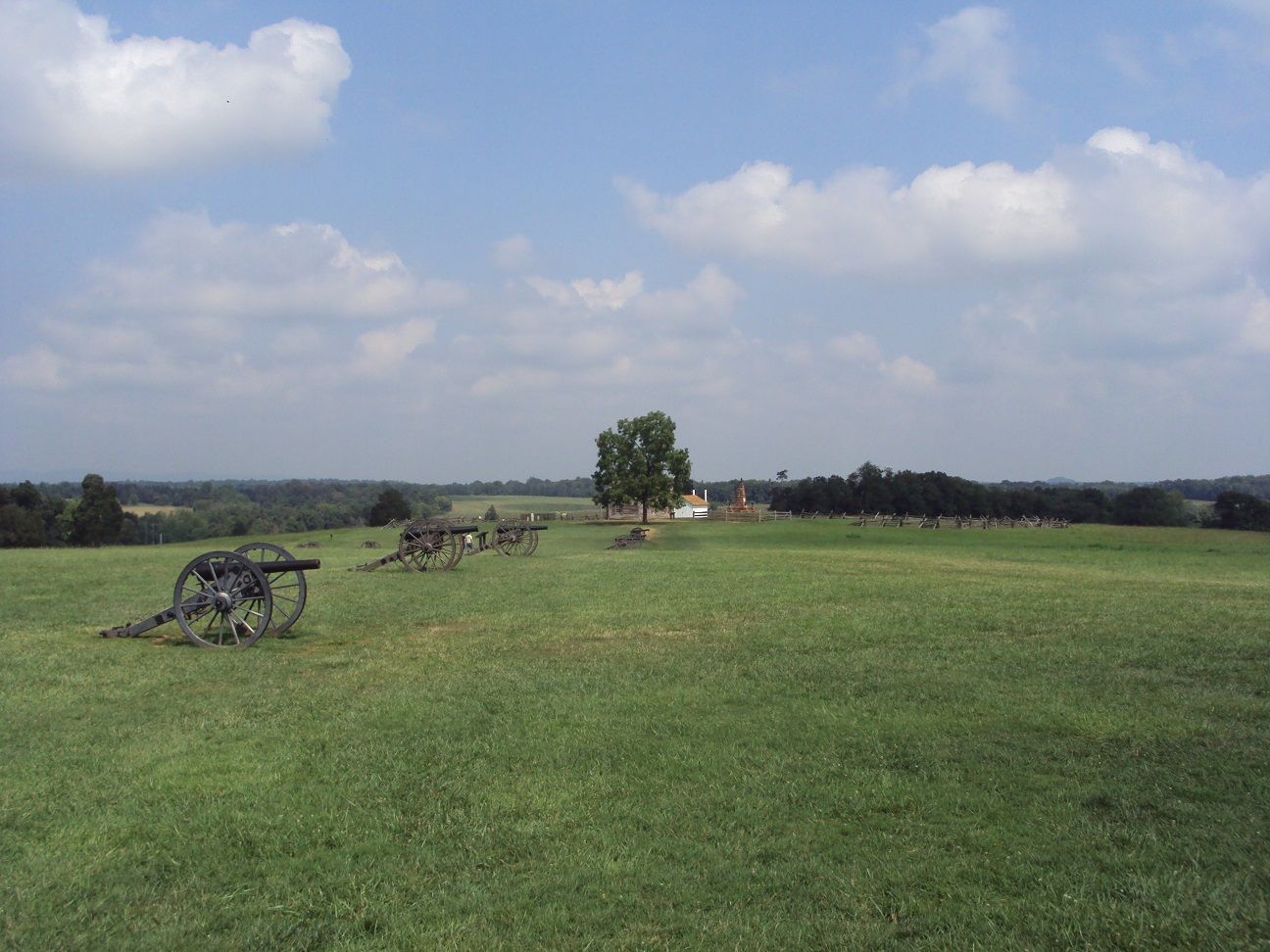
The broken remnants of the tiny Confederate force that began the battle on nearby Matthews Hill fell back to the open plateau around the house and farm of widow Judith Henry known as Henry House Hill, arriving mid-morning to find the recently-arrived Virginia brigade commanded by Brig. Gen. Thomas J. Jackson sheltering in the woods on the rearward slope. Brig. Gen. Barnard E. Bee is supposed to have said something to his men on the order of "There stands Jackson like a stone wall - rally on the Virginians!"

Today no one knows whether Bee's remark was meant to inspire or was made in reproach because of Jackson's failure to come to his support; when earlier he had told Jackson his men were being hard-pressed, his fellow brigadier's comment had been only "Sir, we'll give them the bayonet!" In any case, the name stuck, and ever after both Jackson and his brigade would be known as Stonewall.

The remnants of the brigades of Bee, Col. Francis Bartow, and Col. Nathan Evans reformed in the vicinity of Jackson's line and that of his supporting battery, the Rockbridge Artillery. Following a lull in which the Federal force pulled itself together, another advance brought it to Henry Hill. The U. S. Regular batteries of Captains Charles Griffin and James Ricketts brought a total of eleven guns of various calibers forward onto the crest of the hill and into action. Ricketts' six guns were positioned between the current visitor center and Widow Henry's house, marked by the line of 10-pounder Parrott rifled cannon above.
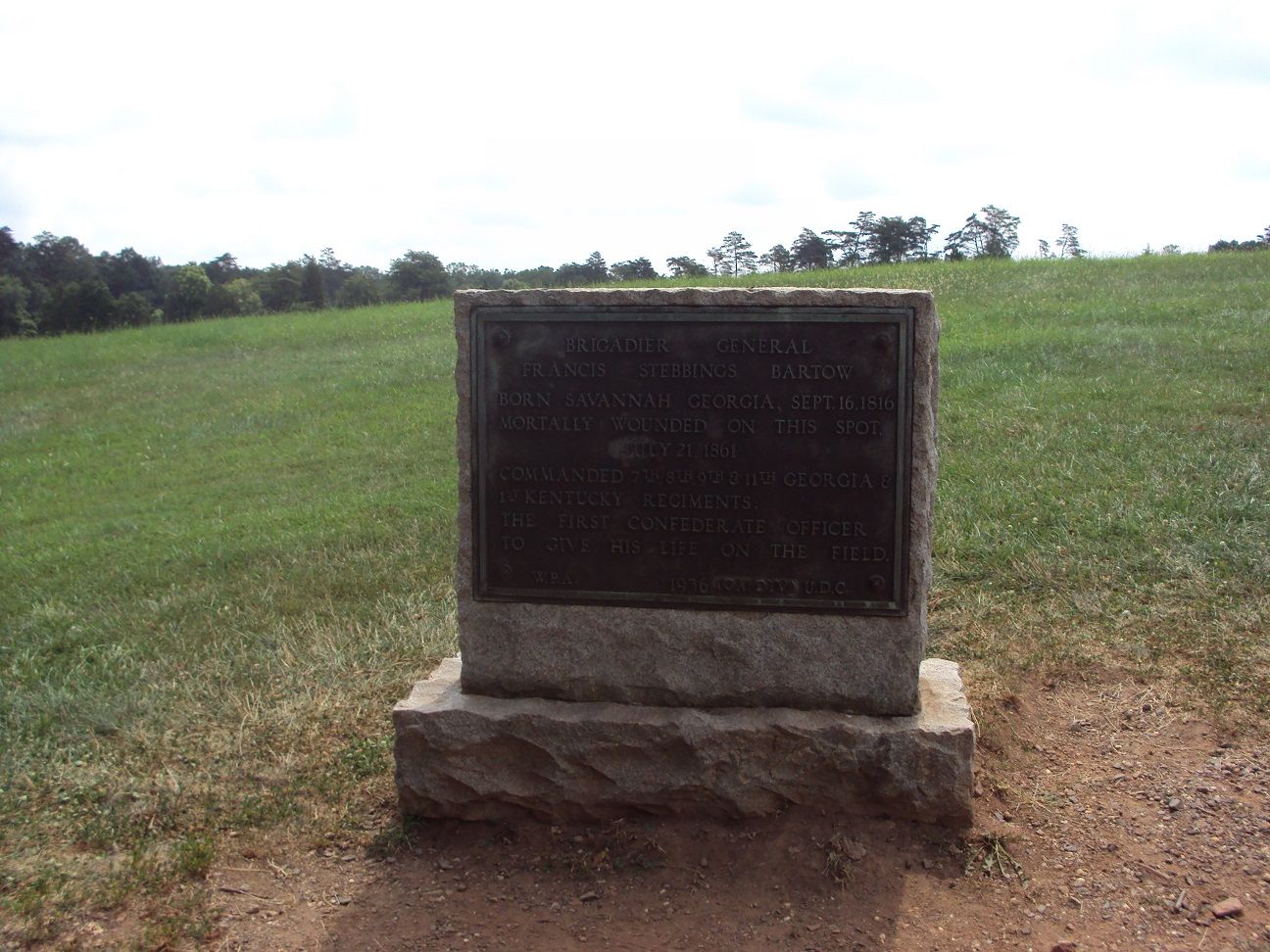
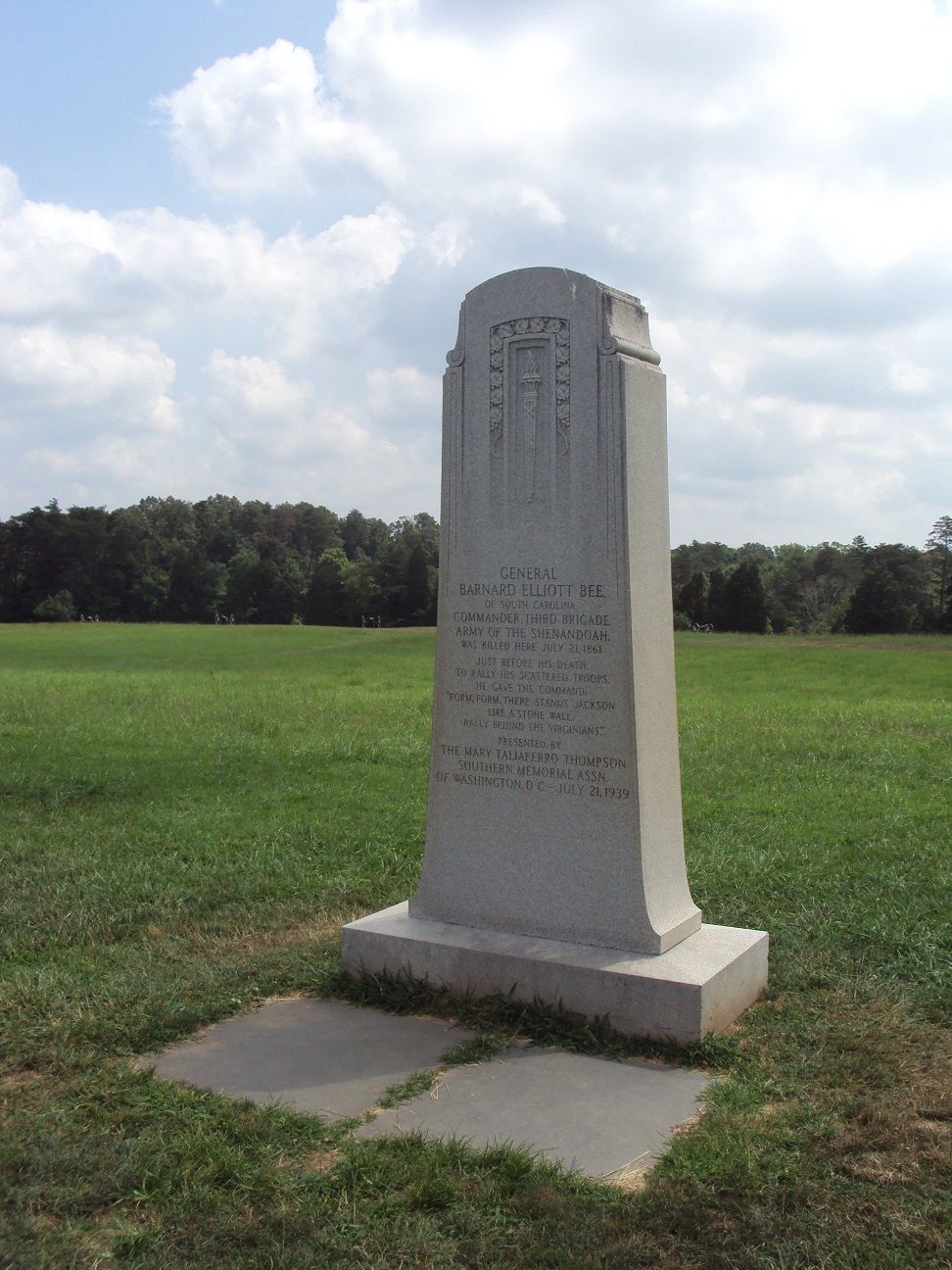
In the ensuing action here on Henry Hill, Confederate brigade commanders Bee and Bartow were both mortally wounded; Georgian Bartow's monument is above, that of Bee stands below near the statue of Jackson.
Other commanders also fell in the battle here: South Carolina planter Colonel Wade Hampton fell at the head of his Hampton Legion. Fortunately, he would recover and go on to command a brigade of Confederate cavalry, and after the death of J. E. B. Stuart, the Cavalry Corps of the Army of Northern Virginia before going to oppose William T. Sherman's march through his native state. His marker below is near the Henry House where he fell.

As the Federal Artillery of Ricketts and Griffin went into action virtually unsupported, Jackson planned a surprise for them. His brigade still remained largely unseen in the fringe of woods, but his artillery was exposed, banging away at the Federal artillery at close range. Union Capt. Griffin took a section of his two short-range guns, 12-lb. howitzers like those seen below, and moved them into this position on the Confederate's flank so as to enfilade or shoot down the length of Jackson's gun line. Little did he realize he had brought them dangerously near some of Jackson's waiting infantry!

Next, Jackson's attack.
Part I - The Federal Surge
The broken remnants of the tiny Confederate force that began the battle on nearby Matthews Hill fell back to the open plateau around the house and farm of widow Judith Henry known as Henry House Hill, arriving mid-morning to find the recently-arrived Virginia brigade commanded by Brig. Gen. Thomas J. Jackson sheltering in the woods on the rearward slope. Brig. Gen. Barnard E. Bee is supposed to have said something to his men on the order of "There stands Jackson like a stone wall - rally on the Virginians!"
Today no one knows whether Bee's remark was meant to inspire or was made in reproach because of Jackson's failure to come to his support; when earlier he had told Jackson his men were being hard-pressed, his fellow brigadier's comment had been only "Sir, we'll give them the bayonet!" In any case, the name stuck, and ever after both Jackson and his brigade would be known as Stonewall.
The remnants of the brigades of Bee, Col. Francis Bartow, and Col. Nathan Evans reformed in the vicinity of Jackson's line and that of his supporting battery, the Rockbridge Artillery. Following a lull in which the Federal force pulled itself together, another advance brought it to Henry Hill. The U. S. Regular batteries of Captains Charles Griffin and James Ricketts brought a total of eleven guns of various calibers forward onto the crest of the hill and into action. Ricketts' six guns were positioned between the current visitor center and Widow Henry's house, marked by the line of 10-pounder Parrott rifled cannon above.
In the ensuing action here on Henry Hill, Confederate brigade commanders Bee and Bartow were both mortally wounded; Georgian Bartow's monument is above, that of Bee stands below near the statue of Jackson.
Other commanders also fell in the battle here: South Carolina planter Colonel Wade Hampton fell at the head of his Hampton Legion. Fortunately, he would recover and go on to command a brigade of Confederate cavalry, and after the death of J. E. B. Stuart, the Cavalry Corps of the Army of Northern Virginia before going to oppose William T. Sherman's march through his native state. His marker below is near the Henry House where he fell.
As the Federal Artillery of Ricketts and Griffin went into action virtually unsupported, Jackson planned a surprise for them. His brigade still remained largely unseen in the fringe of woods, but his artillery was exposed, banging away at the Federal artillery at close range. Union Capt. Griffin took a section of his two short-range guns, 12-lb. howitzers like those seen below, and moved them into this position on the Confederate's flank so as to enfilade or shoot down the length of Jackson's gun line. Little did he realize he had brought them dangerously near some of Jackson's waiting infantry!
Next, Jackson's attack.
Last edited:


 Bringing the