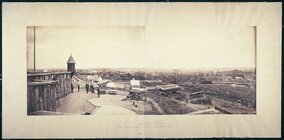
Remembering Nashville

33612v.jpg


U.S. Quartermaster's repair shops on Nashville Turnpike, Nashville, Tenn., March, 1864
 
From the Diary of John Berrien Lindsley, Nashville resident:

"15 Thur. Brisk musketry and artillery firing; waked me up about 2 A.M. At daylight soldiers filed into position behind the breastworks. A brigade of five regiments occupied our grounds. 142 Indiana immediately in front of our house. Sent Mrs. L. and children to Pa's.

"First day of the Battle of Nashville. At my house the heavy roar of artillery on the centre was heard all day.
"On the left skirmishing, off and on, through the day. … federal batteries occupied Love's and Foster's Hills.
"By night quiet. Soldiers slept in the trenches. Mild – damp, muddy.


http://www.midtneyewitnesses.com/eyewitness-book-series/nashville/civilian
 
From "A Chapter from the Life of a Little Girl of the Confederacy," by May Winston Caldwell (Mrs. James E.), 1936, a Nashville area resident.

"The location of this fort is superb; it overlooks everything from North to South for miles. …

"Before the Civil War the hill on which the fort was located was a beautiful wooded place known as St. Cloud Hill. It extended from the railroad to Eighth Avenue – old Spruce Street – about one hundred acres in all. We used to go with our nurse sometimes to have picnics in this wildwood.

"When Nashville fell into the hands of the Union forces, Fort Negley was soon underway, and the spoiler's ax could be heard as he cut down the monarchs of the forest, and our beautiful woods was no more.

"In its place there arose what, to our childish fancy, appeared to be a robber baron's castle. …


"My home having been located almost under the shadow of this fort, I naturally remember it very vividly."

ftneg.jpg


From Ft. Negley looking east, March 1864 (Barnard LoC)
 

Attachments

  • 6a00039v.jpg
    6a00039v.jpg
    71.3 KB · Views: 307
Last edited:
Text from the March 8, 1862 Harper's Weekly edition stated:

The commerce of Nashville is very large, being carried on by river and railroads, and by turnpike roads, to the construction of which the city has devoted a great deal of attention. The revenue of the port amounts to about $40,000 per annum; but the Government has not yet erected a Custom-house in the city. The average annual shipments are—30,000 bales of cotton, 6000 hogsheads of tobacco, 2,000,000 bushels of wheat, 6,000,000 bushels of Indian corn, 10,000 casks of bacon, 25,000 hogs, and 2500 tierces of lard. https://civilwargazette.wordpress.com/2006/12/12/nashville-tennessee-in-1862/

33384v.jpg


Bridge over Running Water Creek destroyed during the Civil War
 
From "A Chapter from the Life of a Little Girl of the Confederacy," by May Winston Caldwell (Mrs. James E.), 1936, a Nashville area resident.

"The location of this fort is superb; it overlooks everything from North to South for miles. …

"Before the Civil War the hill on which the fort was located was a beautiful wooded place known as St. Cloud Hill. It extended from the railroad to Eighth Avenue – old Spruce Street – about one hundred acres in all. We used to go with our nurse sometimes to have picnics in this wildwood.

"When Nashville fell into the hands of the Union forces, Fort Negley was soon underway, and the spoiler's ax could be heard as he cut down the monarchs of the forest, and our beautiful woods was no more.

"In its place there arose what, to our childish fancy, appeared to be a robber baron's castle. …


"My home having been located almost under the shadow of this fort, I naturally remember it very vividly."

View attachment 56812
View attachment 56813

From Ft. Negley looking east, March 1864 (Barnard LoC)

Flanking the fort today are a science museum/planetarium, a baseball diamond and a commuter parking lot for local train passengers.
 
Ed Buford, Sr. ca 1865.jpg


Ed Buford, Sr., Confederate veteran taken at Hall's Gallery at the end of the war. He went to work for his uncle as a clerk in 1865, and by 1885 owned his own business. The warehouse where he worked was right in with those depicted in one of the earlier photos. It would have been about where the photographer was standing. Ed's son, Eddie, was an unofficial Ace in WWI.

Ed fell off a moving train in NC toward the end of the war, after being exchanged from Rock Island. His injuries delayed his return home until July, and those injuries may account for why the hairline seems to have been (badly) retouched.
 
Last edited:
Can you briefly tell us the key significance of Nashville in the war? I always like to get the perspective of a native, who usually has a little different perspective that the rest of us may lack, as we haven't done quite the reading or visited all the venues. And thank you, if we get that way, we'll take you up on a tour.
 
02087v.jpg


Nashville, Tenn. Federal outer line, December 16, 1864. (Jacob Coonley LoC) Continuing his policy of the offensive at any cost, Gen. John B. Hood brought his reduced army before the defenses of Nashville, where it was overthrown by Gen. George H. Thomas on December 15-16, in the most complete victory of the war. If the date borne on this photograph is correct, it was taken in the course of the battle. (text by LoC)
 
Last edited:

Learn About Us
About CivilWarTalk
Contact the Webmaster
Meet the Staff
Link to CivilWarTalk
Join Our Community
Register
Browse Forums
View Today's Discussions
Search the Forum
Get Help
FAQ
Student Guide
Forum Rules & Etiquette
Copyright / DMCA

     Contact Us CivilwarTalk on Facebook CivilWarTalk on YouTube CivilWarTalk on Twitter RSS Feed

Bringing the American Civil War and More to Life.
© 1999 - , CIVILWARTALK, LLC - Site Version 10.0

SlaveryTalk.com - SecessionTalk.com - CivilWarTalk.com - ReconstructionTalk.com
Back
Top