Railroad Acronyms

G T & W
Gulf, Texas and Western
Get a Ticket and Wait
Get a Ticket and Walk

GULF, TEXAS AND WESTERN RAILROAD. The Gulf, Texas and Western Railroad Company was chartered on November 2, 1908, to build a line from Benjamin in Knox County to Burr's Ferry in Newton County, a distance of more than 400 miles; the company completed only ninety-eight miles of track, however. The capital was $500,000. The principal place of business was Dallas. The members of the first board of directors were Ben B. Cain and W. Frank Knox, both of Tyler; Oliver Loving of Graham; J. W. Pinson of Jacksboro; L. M. Dabney of Dallas; Roy C. Megargel of New York City; and J. J. Jermyn and R. B. Williams, both of Scranton, Pennsylvania. Construction began at Jacksboro and had progressed forty miles to Olney by October 1909. By June 1910 thirty-five additional miles of track had been laid to Seymour, but further construction was halted until August 1912. The line was then extended twenty-three miles and reached Salesville on March 26, 1913, but went no further. It used 22.2 miles of the Weatherford, Mineral Wells and Northwestern Railway for freight service from Salesville to Weatherford and 8.7 miles for passenger service between Salesville Junction and Mineral Wells.

The GT&W was financed by Joseph J. Jermyn of Scranton, Pennsylvania, who bought seventy miles of partially graded right-of-way that belonged to the Dallas and New Mexico Railway. Citizens on the line also donated about $65,000 in cash and land worth $93,000. For most of the time between 1910 and 1928 the company had an income deficit. In 1916 it reported passenger earnings of $43,000 and freight earnings of $143,000 and owned seven locomotives and 107 cars. The discovery of oil near the line increased both passenger and freight movement between 1924 and 1926 and briefly enabled the company to show a profit, but the oil industry in the area gradually declined in production and importance after 1926.

In 1930 the St. Louis-San Francisco purchased the capital stock of the GT&W. The principal sources of revenue for the line from 1933 to 1938 were freight (86 percent), passengers (2.3 percent), and mail (11.2 percent). The most important freight was cotton and cottonseed. The railroad also carried wheat, livestock, lumber, and road-building material. In its first year under St. Louis-San Francisco ownership, the GT&W earned a profit of $43,477, but it sustained an average annual loss of $330,418 between 1931 and 1938, partly because of increased competition from trucking. In 1928 the GT&W had handled 86 percent of the livestock shipped from the area, but by 1937 it was carrying only 21 percent. In 1939, because of the continued loss in revenue, the St. Louis-San Francisco decided to abandon the line. Despite state opposition, the Interstate Commerce Commission granted the application in June 1939. In 1940 the Chicago, Rock Island and Gulf Railway absorbed seventy-six miles of the abandoned Gulf, Texas and Western.

Elizabeth Lee Bass

https://tshaonline.org/handbook/online/articles/eqg27

1564493512793.png

https://www.ttarchive.com/library/Maps/Gulf-Texas-Western_1910_Proposed.jpg
4683

Cheers,
USS ALASKA
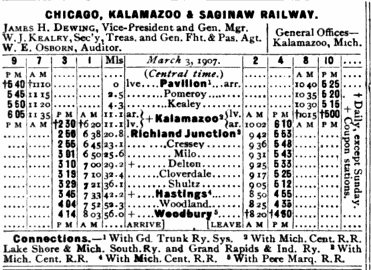
 
C K & S
Chicago, Kalamazoo and Saginaw
Cus Kick and Swear

The company incorporated on June 7, 1883, with the initial intent of constructing a 31-mile (50 km) line from Kalamazoo northeast to Hastings. On October 29, 1887, the company amended its articles, now calling for a line of 141 miles (227 km) connecting the Chicago and Grand Trunk Railway's line in northeastern Cass County to Saginaw. This grandiose vision never came to pass; the company's completed line stretched a mere 14 miles (23 km) beyond Hastings.

In 1906 the CK&S was leased by the Michigan Central Railroad–the Central took 60% control, while the Lake Shore and Michigan Southern Railway, itself owned by the New York Central Railroad, took 40%. In 1930 the New York Central, having merged with the LS&MS in 1915 and leased the Michigan Central in 1930, leased the CK&S. The New York Central continued to operate the CK&S under its own name until 1968, when Conrail bought the remaining properties.


1692909324655.png


Cheers,
USS ALASKA
 
C K & S
Chicago, Kalamazoo and Saginaw
Cus Kick and Swear

The company incorporated on June 7, 1883, with the initial intent of constructing a 31-mile (50 km) line from Kalamazoo northeast to Hastings. On October 29, 1887, the company amended its articles, now calling for a line of 141 miles (227 km) connecting the Chicago and Grand Trunk Railway's line in northeastern Cass County to Saginaw. This grandiose vision never came to pass; the company's completed line stretched a mere 14 miles (23 km) beyond Hastings.

In 1906 the CK&S was leased by the Michigan Central Railroad–the Central took 60% control, while the Lake Shore and Michigan Southern Railway, itself owned by the New York Central Railroad, took 40%. In 1930 the New York Central, having merged with the LS&MS in 1915 and leased the Michigan Central in 1930, leased the CK&S. The New York Central continued to operate the CK&S under its own name until 1968, when Conrail bought the remaining properties.


View attachment 481354


Cheers,
USS ALASKA
Okay, it's a British acronym but over here we had the 'Somerset and Dorset railway' the S&D otherwise known as the 'Slow and Dirty', my favourite has to be The 'Great Western Railway' the GWR or as the locals call it Gods Wonderful Railway.
 
In all the nicknames for the CSX, I don't believe anyone has mentioned "Chickens**t Express" (please pardon my French). All I can say in my defense is that my brother worked for a competitor. :D

One of my favorite slogans for the Union Pacific is "We Will Deliver." I so wanted to get the T-shirt with that on it. You see, I was working in-house in a hospital at the time. We had casual Fridays for charity where I could wear that shirt for a fee. I figured all the staff up in Labor and Delivery on the obstetrics and gynecology floor would want one. Unfortunately, the UP wasn't delivering and changed their slogan to "Building America" about that time. I do have that shirt. :smile:
 
In all the nicknames for the CSX, I don't believe anyone has mentioned "Chickens**t Express" (please pardon my French). All I can say in my defense is that my brother worked for a competitor. :D

One of my favorite slogans for the Union Pacific is "We Will Deliver." I so wanted to get the T-shirt with that on it. You see, I was working in-house in a hospital at the time. We had casual Fridays for charity where I could wear that shirt for a fee. I figured all the staff up in Labor and Delivery on the obstetrics and gynecology floor would want one. Unfortunately, the UP wasn't delivering and changed their slogan to "Building America" about that time. I do have that shirt. :smile:
The delivery of the next generation seems like it could fall under "Building America." 😉
 
One of the last 9 Class 1 Railroads in North America...

CP
Canadian Pacific
Calgary Pacific
Canadian Pathetic
Canuk Pacific
Cheapy Rail
Chinese Pacific
Crazy Polak Railway
Sleepy R
Sleepy Rail

Canadian Pacific Rail System
Crappy Pathetic Rail System
Crazy People Run this System

The Canadian Pacific Railway (French: Chemin de fer Canadien Pacifique) (reporting marks CP, CPAA, MILW, SOO), also known simply as CPR or Canadian Pacific and formerly as CP Rail (1968–1996), was a Canadian Class I railway incorporated in 1881. The railway was owned by Canadian Pacific Railway Limited, which began operations as legal owner in a corporate restructuring in 2001. Headquartered in Calgary, Alberta, the railway owned approximately 20,100 kilometres (12,500 mi) of track in seven provinces of Canada and into the United States, stretching from Montreal to Vancouver, and as far north as Edmonton. Its rail network also served Minneapolis–St. Paul, Milwaukee, Detroit, Chicago, and Albany, New York, in the United States.

Canadian_Pacific_System_Railmap.png


Cheers,
USS ALASKA
 
Sir - Owned...

Dakota, Minnesota and Eastern Railroad

Iowa, Chicago and Eastern Railroad

Soo Line

The Milwaukee Road

Indiana Harbor Belt Railroad

Kansas City Southern Railway

Minneapolis, Northfield and Southern Railway

Toronto, Hamilton and Buffalo Railway

Delaware and Hudson Railway

Central Maine and Quebec Railway

...and others.

Some of the above trackage was spun off to the Wisconsin Central which was sold to the Canadian National Railway

With the purchase the Kansas City Southern Railway, the CPKC became only railroad to directly serve Canada, Mexico and the United States.

CP_KCS_Overview_Map.jpg


Cheers,
USS ALASKA
 
Last edited:
NYO&W
O&W
New York Ontario and Western

Now Young, Out and Working
Old Woman
Old and Weary
Owen W.

The New York, Ontario and Western Railway, commonly known as the O&W or NYO&W, was a regional railroad founded in 1868. The last train ran from Norwich, New York to Middletown, New York in 1957, after which it was ordered liquidated by a U.S. bankruptcy judge. It was the first notable U.S. railroad with its mainline entirely abandoned. The railroad began life as the New York and Oswego Midland Railroad, organized by Dewitt C. Littlejohn of Oswego, NY in 1868. Its mainline extended from Weehawken, New Jersey, across the Hudson River from New York City, to Oswego, New York, a port city on Lake Ontario. It had branch lines to Kingston, Port Jervis, Monticello, Delhi, Utica and Rome, New York and Scranton, Pennsylvania. The part south of Cornwall, New York, was operated over the New York Central Railroad's West Shore Railroad via trackage rights.

In 1866, the New York and Oswego Midland Railroad was chartered under the direction of Dewitt C. Littlejohn, who envisioned a railroad serving a direct connection from the docks opposite New York City to Lake Ontario at Oswego. Construction on the line north of Middletown began in 1868 and was completed in 1873. Branches were also constructed to Ellenville, Delhi and New Berlin, New York; a branch was begun to Auburn from Norwich, but it only was constructed to Scipio Center before being sold to the Utica, Ithaca and Elmira Railroad in 1876. Access to New York City was provided by the Middletown, Unionville and Water Gap Railroad and the New Jersey Midland Railway beginning in 1872. On September 3, 1869, the NY&OM began using the Pennsylvania Railroad's station at Exchange Place in Jersey City, New Jersey, which provided its passengers with ferry access to the Cortlandt Street Ferry Depot in lower Manhattan and the Desbrosses Street Ferry. With the Panic of 1873, the company began to fold, and it severed its ties with the NJM and the MU&WG.

In 1880, O&W inherited the New York & Oswego Midland's lines. The O&W improved the main line by providing a new route to the New York City area from Middletown, New York which extended to Cornwall on the Hudson River and then to Weehawken Terminal. This development was made possible by negotiating trackage-rights from the New York, West Shore & Buffalo Railway, later part of the New York Central system.

In 1886, O&W acquired the operations of both the Utica, Clinton & Binghamton and the Rome & Clinton railroads from the Delaware & Hudson Canal Company. By acquisition of these assets and construction of a new line to Sylvan Beach on the east shore of Lake Oneida, the O&W extended its operations into new market areas, and the Sylvan Beach Loop became a seasonally-significant corridor by providing transportation to central New York's recreational resort area. By 1889, the O&W added two new branches, New Berlin to Edmeston, and Port Jervis to Monticello, connecting to the main line at Summitville, New York.

The most significant addition occurred in 1890, when the O&W constructed a 54-mile branch from Cadosia, New York, to Scranton, Pennsylvania, through the rich anthracite coal reserves in Pennsylvania's Lackawanna Valley. Revenues from this new Scranton Division strengthened O&W's revenues and provided the means for future improvements to the railroad. The railroad's W-in-O logo first appeared in 1892.


712xNxNYOWMap.jpg.pagespeed.ic.FJRjqMXqDR.jpg


Cheers,
USS ALASKA
 
I am just researching the US and CSA railroads for another thread and, since I am a UK railway fanatic, it is a steep learning curve as they are similar but so different. Railways/railroads develop in their own way for their own land and people. Canadian railways are much the same as US ones for that reason. BTW - railWAY, tramroad and railROAD were both used in Britain at the very start of public railways. The Stockton and Darlington was termed a rail way, but the competing Clarence Railway was described as a rail road in its plans.

1704187700849.jpeg


However Parliament decided they were railWAYS and they have remained that ever since. BTW - both were bult as FREIGHT lines with locomotive hauling for coal only. There were no passenger services initially and those that developed were by private companies using horse-drawn coaches similar to stage coaches.
1704187832829.jpeg
1704187910158.jpeg
 
I am just researching the US and CSA railroads for another thread and, since I am a UK railway fanatic, it is a steep learning curve as they are similar but so different. Railways/railroads develop in their own way for their own land and people. Canadian railways are much the same as US ones for that reason. BTW - railWAY, tramroad and railROAD were both used in Britain at the very start of public railways. The Stockton and Darlington was termed a rail way, but the competing Clarence Railway was described as a rail road in its plans.

View attachment 494226

However Parliament decided they were railWAYS and they have remained that ever since. BTW - both were bult as FREIGHT lines with locomotive hauling for coal only. There were no passenger services initially and those that developed were by private companies using horse-drawn coaches similar to stage coaches.
View attachment 494227View attachment 494228
My site can save you a lot of research -- Confederate Railroads --- www.csa-railroads.com.
 
D W & P
Duluth, Winnepeg, and Pacific
Drink Whiskey and Piddle
Drink Whiskey and Puke
Delivered With Pride
Dealing Weed and Pot

1711736766573.png


The Duluth, Virginia and Rainy Lake Railway (DV&RL) started construction at Virginia, Minnesota, in 1901, with the line extending north to Sand Lake, Minnesota, when the company was purchased by the Canadian Northern Railway (CNoR) who renamed it the Duluth, Rainy Lake and Winnipeg Railway (DRL&W). Construction continued through 1908 to extend the line north to Ranier, Minnesota, where it bridged the Rainy River on the Canada–United States border to cross into Fort Frances, Ontario, and an interchange with the CNoR mainline between Winnipeg, Manitoba, and Port Arthur, Ontario. In 1909, CNoR incorporated the Duluth, Winnipeg and Pacific Railway, and construction started to achieve access south from Virginia, Minnesota, to Duluth, Minnesota. Duluth was reached in 1912, providing interchange with several US railways. The DW&P mainline ran for 167 mi (269 km) from Duluth Junction at Fort Frances (CNoR interchange) to DW&P Junction (Northern Pacific Railway (U.S.)).

DWP began to play an increasingly important role for CN in the 1990s, following the implementation of the Canada-US Free Trade Agreement (FTA), and later the North American Free Trade Agreement (NAFTA), which contributed to increases in Canadian exports south and US imports north. The DWP provided the most direct connection from CN's western Canadian trackage to the major US interchanges at Chicago, Illinois, however unlike rival Canadian Pacific Railway which had its own Soo Line Railroad subsidiary trackage to use, CN was forced to interchange with US railroads at Duluth, such as Great Northern (later Burlington Northern Railroad, later Burlington Northern and Santa Fe Railway) or Wisconsin Central Ltd. In the mid-1990s, CN and WC entered into a formal agreement whereby WC agreed to haul CN trains to Chicago.

The mid-1990s also saw a major change in how US subsidiaries like DWP and GT fit into CN's corporate structure whereby in 1993–1994, CN changed the name of its entire system to "CN North America" (CNNA) and began a major locomotive and freight car repainting program which saw the GT and DWP logos and names disappear, with only the holding company "Grand Trunk Corporation" remaining on paper and legal documents. In 1995, the CNNA experiment ended and the name "Canadian National/Canadien National" with the CN acronym returned, only system-wide in both countries. On November 28, 1995, Canada's federal government privatized CN and its US subsidiaries.

In 2001, CN entered into an agreement to purchase WC entirely on October 21 of that year, providing CN with an "iron lariat" encircling the industrially-important Great Lakes Basin. The only gap in CN's Winnipeg–Fort Frances/International Falls–Chicago mainline route was a short 17-kilometre (11 mi) section in Duluth where CN had to operate on the Duluth, Missabe and Iron Range Railway to reach WC trackage from the end of DWP trackage. On May 10, 2004, CN purchased DMIR's parent company Great Lakes Transportation to give total control of the Winnipeg–Chicago corridor and remove the gap at Duluth between DWP and WC trackage.

In December 2011, the Duluth, Winnipeg and Pacific Railway was merged into Wisconsin Central Ltd., which is also controlled by Canadian National Railway. This merger was intended to increase efficiency.


en.wikipedia.org/wiki/Duluth,_Winnipeg_and_Pacific_Railway

Cheers,
USS ALASKA
 

Learn About Us
About CivilWarTalk
Contact the Webmaster
Meet the Staff
Link to CivilWarTalk
Join Our Community
Register
Browse Forums
View Today's Discussions
Search the Forum
Get Help
FAQ
Student Guide
Forum Rules & Etiquette
Copyright / DMCA

     Contact Us CivilwarTalk on Facebook CivilWarTalk on YouTube CivilWarTalk on Twitter RSS Feed

Bringing the American Civil War and More to Life.
© 1999 - , CIVILWARTALK, LLC - Site Version 10.0

SlaveryTalk.com - SecessionTalk.com - CivilWarTalk.com - ReconstructionTalk.com
Back
Top