Prices from the 1950's

Ralph Heinz

Corporal
Joined
Feb 14, 2016
Location
Pacific Northwest
In the 1950s there were basically two major eastern dealers who put out catalogs of thousands of items: Robert Abels in NYC and The Museum of Historical Arms in Miami. On vacations I was lucky to get to visit both along with a smaller dealer in Maine. Here is a page from Robert Abels catalog No. 30. It's undated but was from the mid-1950s. You'll note that you could buy a French pinfire for $22 or $25 whereas a Colt M1860 Army started at $75 for "good condition" and upwards in price depending on condition.

My aunt bought me several antique guns as Christmas presents over a period of years and since I wanted a Civil War revolver but realized that Colts were terribly expensive, I asked for one of those "French pinfires" instead. My aunt called Abels and he talked her into a fabulous fully engraved Lefaucheux in virtually unused condition and which had probably belonged to some wealthy French nobleman and had only recently come across the Atlantic. For what she spent I could have had fine M1860 Colt. At least Abels did not charge anything for postage -- it was so cheap in those days. I let go of that revolver decades ago.
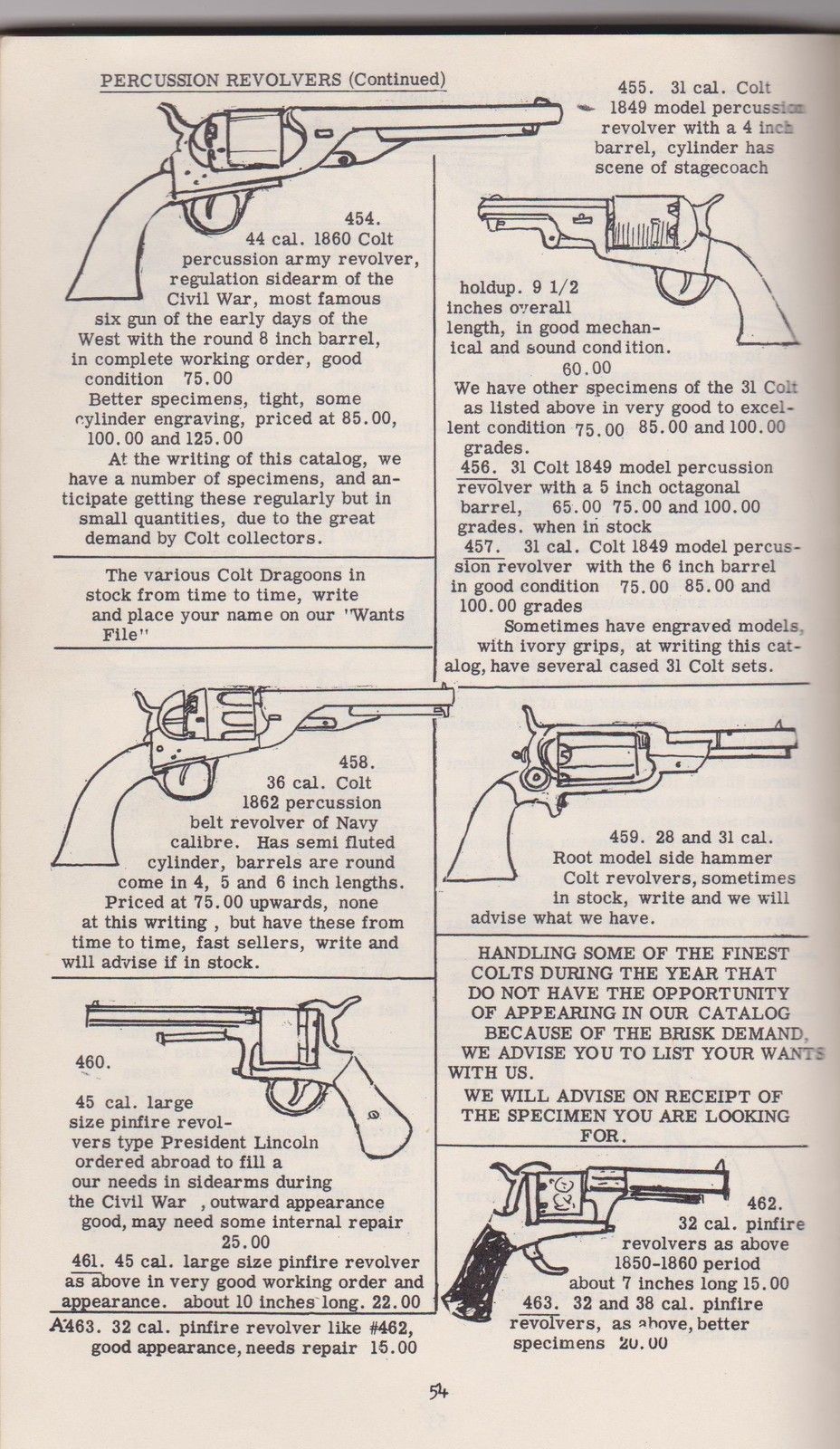
Robert Abels Colts.jpeg
 
Here is a page showing Starrs, Whitneys, and a Beaumont-Adams. Item #426, a cased .44 cal. Adams with a flask, etc. in an oak case was $75. I have a cased Beaumont-Adams marked with the retailer DEANE & SON LONDON BRIDGE but which has Birmingham proofs and at today's prices was considerably more expensive. Abels listed Henry rifles but the price would be quoted when he had one for sale. Incidentally, CW cavalry sabres were $17.50 and $20 grades and $10 if without the scabbard. I also have pages showing Enfields, Springfields and carbines if there is any interest in seeing these.
Robert Abels Adams.jpeg
 
And what was the minimum wage back then? The average worker's salary? I recall my brother getting out of the navy in the mid 1950's telling me he hoped to get a job that would pay him a hundred dollars a week and if so he would be the happiest person in the world.

Don't know about minimum wage but median household income for 1958 was right at $5,000 per year. So, an $85 gun was about two percent of the median yearly income. Today the median is about $52,000 so now that gun costs $850. So while it may seem ridiculously cheap to us today - and might still be a good deal with respect to today's antique firearm prices (don't know) - it wasn't cheap then.

Dang - I sound like those "when I was a kid I had to walk four miles to school through the snow uphill both ways" kind of things. But, hey, inflation is real.
 
As I recall, in the 1950s my father used to get both the Robert Abel and Martin Retting catalogs. I used my bean-picking earnings one summer to order a M1861 Springfield musket from one of those dealers, at the cost of $16.50. I'm not sure how many bags of beans I had to tote to the weigh station at the end of the row to earn the $16.50, but it was a batch! In the 1950s Oregon farmers didn't use migrants from Mexico to harvest their berries and beans, etc, but school kids out on summer vacation. School got out for the summer by Memorial Day, no later - the famers needed the kids to get the strawberry crop picked.
 
Don't know about minimum wage but median household income for 1958 was right at $5,000 per year. So, an $85 gun was about two percent of the median yearly income. Today the median is about $52,000 so now that gun costs $850. So while it may seem ridiculously cheap to us today - and might still be a good deal with respect to today's antique firearm prices (don't know) - it wasn't cheap then.

Dang - I sound like those "when I was a kid I had to walk four miles to school through the snow uphill both ways" kind of things. But, hey, inflation is real.

Yes, thank you. My late father told us his first job out of college in 1951 paid $50 per week. He got raises over the years, but looking at this stuff in bare numbers, without context, can make a person nuts.

Dad also said his first rented apartment was $9 per month, without hot running water. He boiled it and poured it into the bathtub, to get clean. That's not a bad deal, given age and percentage of income. Boiling bath water gets old, though and so he moved and paid much higher rent.

I'm sure the cost of muskets will follow the same path.
 
I bought my first antique military rifle in 1952 at the age of eight for $15 from an antique gun shop in Manitou Springs, Colorado. I saved money to do this and bought an antique gun every summer with money I had saved all year long -- paper route, mowing lawns, etc. By the time I was in high school, I knew of two other antique gun collectors my age in my area who had been collecting for years. As a teenager I collected WWII because it was a lot cheaper than CW items. I could make enough as a golf caddy in just one day to buy a WWII Japanese rifle. Today, with the prices guns bring, kids can't collect when a common WWII Japanese Arisaka rifle is $200. What high school kid can afford a $1500 CW musket if the money to buy it comes from their own pocket? What will collecting be in the next half century with interest in teaching American history fading in schools? I only know one young collector today.

At the age of ten, I bought a common US CW bayonet in an antique store in Mentor, Ohio for $2 and a Confederate cartridge box for $1.50. The leather was dried out -- it was all there including tins, but the shoulder strap ends had broken off. It had a piece of paper glued to the front (probably from a GAR display) with the message: Cartridge box taken from the body of a Rebel soldier by Q. H. Coons at the Battle of Rich Mountain. Decades later I gave it to a friend, Don Troiani, who had recommended me to the Army NG to do a large oil painting for the Army Natl. Guard Heritage Series. That painting of an Indian War battle in 1867 hangs in the Pentagon.

Also at the age of ten, a fellow fifth grader brought to class a Union four button sack coat, a bummer's cap, and a Springfield that had belonged to an ancestor. I was awe struck!
 
And what was the minimum wage back then? The average worker's salary? I recall my brother getting out of the navy in the mid 1950's telling me he hoped to get a job that would pay him a hundred dollars a week and if so he would be the happiest person in the world.

Minimum wage in 1950 was .75 per hour, in 1956 it went up to $1 per hour.
 
True, it is the money for one thing. I also believe there has become a lack of interest due to schools dropping American & World History other then a cursory glances. You see people on television being asked questions like who fought in the Civil War,WW2 or a photo of a past or current world leader and they have no clue. Also the culture of anything involving a gun is now to be considered taboo. The importance of instilling History in kids minds is upmost.
 
I bought my first CW Ames Cav sword in 1972 for $45 and they run into the $650 range now. My first CS plate was $400. In 1982 I bought my first CS Flag at $7500 and that almost caused a divorce but it was well worth it. :D
 
I bought my first CW Ames Cav sword in 1972 for $45 and they run into the $650 range now. My first CS plate was $400. In 1982 I bought my first CS Flag at $7500 and that almost caused a divorce but it was well worth it. :D
----------------------------
$7500 is a bargain for a divorce nowadays. I'm going shopping for a CBF today!
 
Minimum wage in 1950 was .75 per hour, in 1956 it went up to $1 per hour.
----------------
In 1964 it ballooned to $1.50/hr! I was in high cotton making that much $ as a high school junior $ senior. I was quoted in Look Magazine that a Saturday night date with my girlfriend would run me $7.50. That was about the same time that beer hit the unbelievable price of $1.00 a six pack & smokes cost .25/pack. Gold $32.00/oz until the government outlawed private ownership of it.
 
I beg to differ a bit on the wages. When I worked at a horse racing track in 1966 the Federal minimum wage was $1.25 an hour and that's exactly what they paid us. The next year, 1967, I went to work in a steel mill, minimum federal wage was $1.40, but the Liberal state I lived in at that time had added $0.10 to the Federal minimum, to make it $1.50 per hour, although as a Class 8 Millwright I got $2.50 an hour plus tonnage. By the time I paid my bills, car insurance, rent, utilities, food, etc., it didn't leave much to buy Civil War guns and swords!

JOHN42768 is absolutely spot on about history education today and the negative effect it has had on our youth. Of course it was different for us back then because we could actually relate to the ACW by having had not to distant family members who had been in the ACW, like Great-Granddad, or great uncle so-and-so. Today Great-granddad was a WW2 vet and Granddad was a Viet Nam vet! Sadly, our glorious past is becoming lost in the ever dimming mists of time.
J.
 
True, it is the money for one thing. I also believe there has become a lack of interest due to schools dropping American & World History other then a cursory glances. You see people on television being asked questions like who fought in the Civil War,WW2 or a photo of a past or current world leader and they have no clue. Also the culture of anything involving a gun is now to be considered taboo. The importance of instilling History in kids minds is upmost.
I agree with what you are saying.
 
I beg to differ a bit on the wages. When I worked at a horse racing track in 1966 the Federal minimum wage was $1.25 an hour and that's exactly what they paid us. The next year, 1967, I went to work in a steel mill, minimum federal wage was $1.40, but the Liberal state I lived in at that time had added $0.10 to the Federal minimum, to make it $1.50 per hour, although as a Class 8 Millwright I got $2.50 an hour plus tonnage. By the time I paid my bills, car insurance, rent, utilities, food, etc., it didn't leave much to buy Civil War guns and swords!

JOHN42768 is absolutely spot on about history education today and the negative effect it has had on our youth. Of course it was different for us back then because we could actually relate to the ACW by having had not to distant family members who had been in the ACW, like Great-Granddad, or great uncle so-and-so. Today Great-granddad was a WW2 vet and Granddad was a Viet Nam vet! Sadly, our glorious past is becoming lost in the ever dimming mists of time.
J.
Yes sadly it is being lost with time. I remember a great uncle that lived to be 107 his father was in the Civil War. I remember him telling story's his father had told about the war.
 
I made $1.48 an hour in 1971 as a bus boy/dishwasher at English's Chick n' Steak in Baltimore, MD. I was thrilled to be promoted to line cook with a raise to the princely sum of $1.55.
Gas was 29.9 cents a gallon and smokes were a quarter then. We could cruise up and down the strip all night on pocket change.
We old guys love talking about the prices of things back in the day. In the 1960s you could still buy WWII equipment at the military surplus store. I bet I went camping in a tent and drank from a canteen that were used in Europe. I remember my father talking about earning a nickel or quarter during the Great Depression. He used to laugh about the extra $5 a month combat pay he got in in WWII. Definitely not worth it!
 

Learn About Us
About CivilWarTalk
Contact the Webmaster
Meet the Staff
Link to CivilWarTalk
Join Our Community
Register
Browse Forums
View Today's Discussions
Search the Forum
Get Help
FAQ
Student Guide
Forum Rules & Etiquette
Copyright / DMCA

     Contact Us CivilwarTalk on Facebook CivilWarTalk on YouTube CivilWarTalk on Twitter RSS Feed

Bringing the American Civil War and More to Life.
© 1999 - , CIVILWARTALK, LLC - Site Version 10.0

SlaveryTalk.com - SecessionTalk.com - CivilWarTalk.com - ReconstructionTalk.com
Back
Top