POW missing from Ft. Delaware POW register

The States provided pensions to eligible Confederate veterans. The US Compilation of Confederate records includes in some files letters from State pension offices requesting records from the War Department regarding Confederate soldiers, in order to confirm eligibility for State pensions. It was long well known the War Department held the lion's share of original Confederate military records.


1755487644520.png


An Act of 1903 required Gen. Ainsworth to complete a compilation of Confederate soldiers from the 1861-65 records which survived to be so employed. The United Confederate Veterans approved the work, lamenting its necessary incompleteness given the destruction of much of the Confederate records, but approving the use of only "authentic" wartime records.

1755486689069.png

1755486725704.png


1755486819622.png


Ultimately the above data compiled by the War Department was "published" in the Compiled Service Records microfilms, and more recently on the internet.


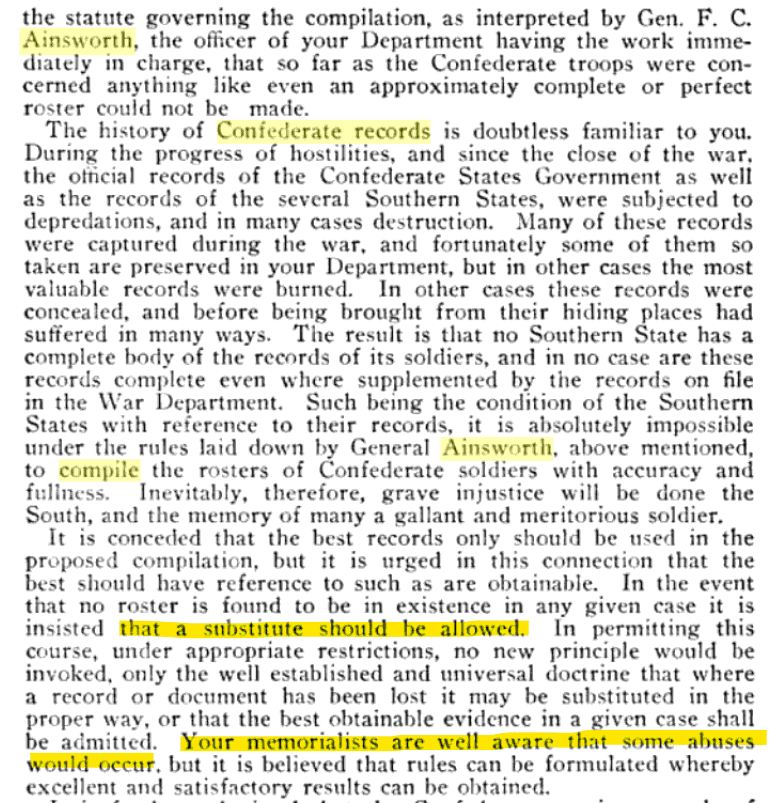
Several Southern States were somewhat offended in the compilation process by Gen. Ainsworth and his War Department clerks, as the Confederate records in the US hands, and they wanted post-1865 evidences/claims to be included in the War Department compilations, which didn't happen.

1755486398472.png

1755486452062.png


The Federal authorities declined to accept non-historical, or "re-created" rosters or records based on pension claims (there were fraudulent claims, as the complainants above admit). The War Department, in contrast, was fine with leaving the record incomplete, rather than give credence to possibly spurious post-war claims.

The records employed in the War Department compiled records are all authentic. The only negative is there was some mis-filing of records here and there, given the large number of duplicate names, etc.
 
They created the cards to determine who was entitled to a pension. That's the logic given.The pension app process was very involved, typically requiring men in their 60s to track down long lost comrades, get sworn statements, then endure hours of interrogatories. Some were too ill to go, so the commissioners interviewed them in situ. I've worked with these records quite a bit. Their memories were not always the best about their wartime experience. If there was some political ulterior motive you'll need to ferret that out from the scholarship. I found this on a quick search in JStor, Russell L. Johnson, ' "Great Injustice" ': Social Status and the Distribution of Military Pensions after the Civil War, The Journal of the Gilded Age and Progressive Era, Vol. 10, No. 2 (April 2011), pp. 137-160) https://www.jstor.org/stable/23045155 So you might have a look at it.

Peace,

A
This sounds like fascinating work you do, transcribing for NARA, plus the 25 year Colvin study, wow.

As well in the pension process (as I'm sure you know), were the widows who had to provide proof of their dead husband's service. Or prove, as widows, they hadn't gotten remarried, etc. Don't know a lot about that side of the pension process, but have run across a few instances of lengthy 'interrogations,' or interviews, where a widow (like my 2x Grandmother) provided witnesses and answered questions about a dead husband's service.

A case I ran across took an act of Congress pushed through for a widow of a surgeon Lincoln kicked out of the army (then let back in) to receive a pension. Decades after the night in question where events occurred that got him in trouble, the War Dept. brought forth men on the train from that night to rehash the whole thing to verify this surgeon wasn't at fault (my grandfather was his hospital steward) for his punitive discharge. Much political ulterior motive involving Stanton, Letterman, et al. This surgeon, in a terrible irony, was actually "United States Examining Surgeon in Pension Cases from 1865--1882."

I wrote about it a bit here if interested: https://jacksonsvalleycampaign.com/june-16/
 
This sounds like fascinating work you do, transcribing for NARA, plus the 25 year Colvin study, wow.

As well in the pension process (as I'm sure you know), were the widows who had to provide proof of their dead husband's service. Or prove, as widows, they hadn't gotten remarried, etc. Don't know a lot about that side of the pension process, but have run across a few instances of lengthy 'interrogations,' or interviews, where a widow (like my 2x Grandmother) provided witnesses and answered questions about a dead husband's service.

A case I ran across took an act of Congress pushed through for a widow of a surgeon Lincoln kicked out of the army (then let back in) to receive a pension. Decades after the night in question where events occurred that got him in trouble, the War Dept. brought forth men on the train from that night to rehash the whole thing to verify this surgeon wasn't at fault (my grandfather was his hospital steward) for his punitive discharge. Much political ulterior motive involving Stanton, Letterman, et al. This surgeon, in a terrible irony, was actually "United States Examining Surgeon in Pension Cases from 1865--1882."

I wrote about it a bit here if interested: https://jacksonsvalleycampaign.com/june-16/
My NARA work is voluntary. I wish I could do the transcriptions more often, but I also do them for smaller repositories, plus have essays to write for my website and other projects. It really is a great way to keep skills sharp and encounter interesting bits of history. Mine was the first transcription for NARA of the sale record of the rifle that was used to assassinate Kennedy. Oswald's wife, Maria, was trying to sell it, and the government wanted the sale stopped. My goal is always to complete a document with as few gaps as possible. I've become quite good at reading some very bad handwriting in the older records. ;) Peace.
You can see the digitized record here.
 
The States provided pensions to eligible Confederate veterans. The US Compilation of Confederate records includes in some files letters from State pension offices requesting records from the War Department regarding Confederate soldiers, in order to confirm eligibility for State pensions. It was long well known the War Department held the lion's share of original Confederate military records.


View attachment 557928

An Act of 1903 required Gen. Ainsworth to complete a compilation of Confederate soldiers from the 1861-65 records which survived to be so employed. The United Confederate Veterans approved the work, lamenting its necessary incompleteness given the destruction of much of the Confederate records, but approving the use of only "authentic" wartime records.

View attachment 557922
View attachment 557923

View attachment 557924

Ultimately the above data compiled by the War Department was "published" in the Compiled Service Records microfilms, and more recently on the internet.


Several Southern States were somewhat offended in the compilation process by Gen. Ainsworth and his War Department clerks, as the Confederate records in the US hands, and they wanted post-1865 evidences/claims to be included in the War Department compilations, which didn't happen.

View attachment 557920
View attachment 557921

The Federal authorities declined to accept non-historical, or "re-created" rosters or records based on pension claims (there were fraudulent claims, as the complainants above admit). The War Department, in contrast, was fine with leaving the record incomplete, rather than give credence to possibly spurious post-war claims.

The records employed in the War Department compiled records are all authentic. The only negative is there was some mis-filing of records here and there, given the large number of duplicate names, etc.
Sounds like you have the raw beginnings for what could make for a fascinating, well-cited essay on the topic. You might consider if that analysis has already been done and if so, is there a different approach? If nothing else, this seems to answer the question, why CSA records were included at all.

Peace,

A
 
My NARA work is voluntary. I wish I could do the transcriptions more often, but I also do them for smaller repositories, plus have essays to write for my website and other projects. It really is a great way to keep skills sharp and encounter interesting bits of history. Mine was the first transcription for NARA of the sale record of the rifle that was used to assassinate Kennedy. Oswald's wife, Maria, was trying to sell it, and the government wanted the sale stopped. My goal is always to complete a document with as few gaps as possible. I've become quite good at reading some very bad handwriting in the older records. :wink: Peace.
You can see the digitized record here.
Sure, I figured "citizen" equated to volunteer. I'd love to transcribe, but maybe later in life, as I'm needing paid work now. People often post here for help deciphering 18thc script, so you could be the new in-house Cursive Guy! Interesting about the rifle.

If you put your website in your signature people can check it out. I read your introduction. My mother's side was colonial VA as well, but we had no Colvins. Brewer was their name, owned part of The Stanley Hundred/Bruers Borough. I like how you characterize the Colvins as living quietly in the background, "eclipsed" by the seminal happenings in early U.S. history. That was the majority of us. Cheers
 
Hello again Red:
Also are you saying the clerks who labeled the IRC, "Roll of Prisoner of War" in 1893 mislabeled it, and they did not consult a POW roll or register? I've worked with IRCs for many years and seen many errors. I've not encountered that one.

The lone notice of his prisoner status is related to the May 18, 1865 parole.

1755524341297.png


There is no other record, demonstrating a date of capture, or any long term incarceration. The Confederate soldiers who Surrendered and received Paroles at Charlottesville became thereby "Prisoners of war."

For example, General Lee and the troops with him at Appomattox became "prisoners of war" upon surrender and parole at Appomattox courthouse, on April 9...

1755524521257.png


The terms of the surrender of Lee's army were that the paroled men return to their homes, and not take up arms against the United States, etc. etc.
 
If that's the only basis for looking for a POW record than he was probably not captured or a POW as we generally use the term. e may not even have been at Charlottesville - most of these lists were done by having an officer hand over a list of the men in his unit. There are numerous cases of men being listed as having surrendered at a certain locale when we know for a fact they were somewhere else.
 
I suspected something like that. I did several advanced-level courses on CW and RW while earning my History degree which focused on Southern Studies, and I know there was a good deal of desertion during the RW and am just learning there was a considerable amount also during the CW. Interesting.
I'm working on POWs held at Millen/Camp Lawton. I have come across the names of several men who were imprisoned at Andersonville then sent to to Millen. They were listed as AWOL by their regiments. I know that doesn't help with your particular query but is evidence that prisoners were sometimes listed as having deserted in error.
 
Sure, I figured "citizen" equated to volunteer. I'd love to transcribe, but maybe later in life, as I'm needing paid work now. People often post here for help deciphering 18thc script, so you could be the new in-house Cursive Guy! Interesting about the rifle.

If you put your website in your signature people can check it out. I read your introduction. My mother's side was colonial VA as well, but we had no Colvins. Brewer was their name, owned part of The Stanley Hundred/Bruers Borough. I like how you characterize the Colvins as living quietly in the background, "eclipsed" by the seminal happenings in early U.S. history. That was the majority of us. Cheers
Unless you were a major figure in the culture, you were in the background, a bit of a cog. Also, 18th century culture was highly stratified and most of those folks were and thought of themselves as subjects of the British crown. The only people who really had any real influence were the landed elite and gentry and the nobility. Everyone else was considered the "lower sort." Not even Washington could be an officer in the British Army (Regulars) because he had no pedigree. He was a large landholder, true, with many slaves and was agriculturally innovative, but he was never able to achieve the rank of officer, no matter how much he strove for it. That snobby system ultimately turned him against the British. Also thanks for the formatting tip. Very helpful. Peace. :smile:
 
Last edited:
Can you please share the record that is the basis of your belief that he was a POW?
See the image below. My understanding was the War Department clerks in 1893 consulted a POW "roll," which I presumed meant the registry of an actual POW camp. The Madison's case, Ft. Delaware, as many members of Co. L ended up there. But having reviewed several such registers, he's not listed on them. So either the IRC is wrong, or there was a system in place that allowed the use of the term "POW" when, in fact, the captive was merely a detainee of some kind, possibly by his own unit where he was held until paroled. I'm still unclear how that worked and am very interested in a sourced explanation. Peace.
 

Learn About Us
About CivilWarTalk
Contact the Webmaster
Meet the Staff
Link to CivilWarTalk
Join Our Community
Register
Browse Forums
View Today's Discussions
Search the Forum
Get Help
FAQ
Student Guide
Forum Rules & Etiquette
Copyright / DMCA

     Contact Us CivilwarTalk on Facebook CivilWarTalk on YouTube CivilWarTalk on Twitter RSS Feed

Bringing the American Civil War and More to Life.
© 1999 - , CIVILWARTALK, LLC - Site Version 10.0

SlaveryTalk.com - SecessionTalk.com - CivilWarTalk.com - ReconstructionTalk.com
Back
Top