Parole question

John Winn

Lt. Colonel
Joined
Mar 13, 2014
Location
State of Jefferson
I am wondering about the records for parole - i.e. would the record of a Confederate taken prisoner or paroled by the Union be part of his official record or would it be stored some other place ?

I wonder this because my great grandfather John Winn's record ends with his being returned to service from the hospital in Richmond on March 28, 1865. He did not surrender with his unit at Appomattox and his record says nothing about having been taken prisoner. I rather think when Lee pulled out John just decided he'd had enough or was perhaps just too sick to continue and so stayed in Richmond. However, he didn't have any support network (that I know of) and it seems to me he'd have been taken prisoner. There's nothing in his record about that though.

So, should I look some place other than his official record ? I know hospitalization records are not part of the military record and have to be searched separately and I just had a flash that maybe POW and parole records are similar. Anybody know ?
 
Hey, John:

Parole documents are usually found in an individual soldier's Compiled Service Record (Fold3). Medical records frequently are, as well. It's hard to say anything definitive in his case if the records aren't there, but if he was in the hospital until March 28, he may not have ever rejoined his unit, as they were on the move from April 2.
 
Hey, John:

Parole documents are usually found in an individual soldier's Compiled Service Record (Fold3). Medical records frequently are, as well. It's hard to say anything definitive in his case if the records aren't there, but if he was in the hospital until March 28, he may not have ever rejoined his unit, as they were on the move from April 2.

Thanks Andy. I had always assumed being taken prisoner and having been paroled would be in the CSR but for some reason just flashed that maybe that's not always true. In my g grandfather's case his medical records were separate and the researcher I hired to find them said hospital records were filed separately.

Yes, I doubt he returned to his unit. I think he was part of the convalescent corps that was slapped together just before Richmond was abandoned (it's discussed in the book Richmond Burning by Nelson Lankford). It just seems unlikely that he'd have been able to just walk away and not be captured.
 
It just seems unlikely that he'd have been able to just walk away and not be captured.

Something to consider is that when a unit in the field surrenders, you've got a provost and clerks filling out pre-printed forms (in duplicate), and sort of an organized process for the whole thing. And then the provost is left with a stack of parole documents that eventually get files and make their way first to the War Department, then into individual CSRs, and then ultimately to NARA.

It (might) be different for an unarmed Confederate straggler, detatched from his unit, who gets picked up on the side of the road on his way home. (Probably a lot of those wandering around Virginia at the time.) Whether he had to sign a formal parole or not, I don't know, but it's easy to imagine that if he did the document didn't end up where it was supposed to.
 
Something to consider is that when a unit in the field surrenders, you've got a provost and clerks filling out pre-printed forms (in duplicate), and sort of an organized process for the whole thing. And then the provost is left with a stack of parole documents that eventually get files and make their way first to the War Department, then into individual CSRs, and then ultimately to NARA.

It (might) be different for an unarmed Confederate straggler, detatched from his unit, who gets picked up on the side of the road on his way home. (Probably a lot of those wandering around Virginia at the time.) Whether he had to sign a formal parole or not, I don't know, but it's easy to imagine that if he did the document didn't end up where it was supposed to.

Yeah, I can imagine that scenario too. Oh well, it was worth putting out there. I guess I'll just never know.
 
Would a straggler behind the lines get much attention? As the front moved west and south from Richmond was there enough Union activity to have scooped him up?

Where was home? I would think that if he got separated from the ANV home would be his natural goal.

[I was watching Youtube vids of Germany in April and May '45. Individual soldier humped along the roads. If they had arms, the GIs took the weapons and the Germans went back to humping. In one telling shot, a tall young man in a field cap and with a backpack consulted the signs at an intersection before humping again. Home.]
 
Would a straggler behind the lines get much attention? As the front moved west and south from Richmond was there enough Union activity to have scooped him up?

Where was home? I would think that if he got separated from the ANV home would be his natural goal.

[I was watching Youtube vids of Germany in April and May '45. Individual soldier humped along the roads. If they had arms, the GIs took the weapons and the Germans went back to humping. In one telling shot, a tall young man in a field cap and with a backpack consulted the signs at an intersection before humping again. Home.]

He was from Charlottesville and, as far as I know (and I've researched it), he had no family in Richmond beyond a few very distant cousins I rather doubt he ever met. It's possible he developed a relationship with someone when he was hospitalized because he was moved to private quarters at one point (a common practice due to a shortage of hospital space).

So, he definitely couldn't have walked to Charlottesville as both armies were in his way. He must have stayed in Richmond, had some place to stay, and managed not to get rounded up. Maybe he did get rounded up and the paperwork just never got done or filed correctly like Andy speculated. Just seems odd to me.
 
Fold3 is awesome. It probably is getting more awesomer as time goes by. I used it a couple years ago and was blown away by their inventory. I could only be more impressed if they turned up with mug shots of every single soldier.

Spend the money.
 
Did he end up getting a pension? If so, what did it say about his discharge?

Union prisoner and parole records in my experience seem to be fairly complete and filed with the Combined service record. Union records in general are less likely to have been lost or not kept. You may be right that Confederate hospital records are separate; Union ones seem to be in the CSR.

I have an ancestor who was away from his unit when it surrendered, and ended up having to surrender as part of a different unit later. So try looking for records with other companies.
 
I am wondering about the records for parole - i.e. would the record of a Confederate taken prisoner or paroled by the Union be part of his official record or would it be stored some other place ?

I wonder this because my great grandfather John Winn's record ends with his being returned to service from the hospital in Richmond on March 28, 1865. He did not surrender with his unit at Appomattox and his record says nothing about having been taken prisoner. I rather think when Lee pulled out John just decided he'd had enough or was perhaps just too sick to continue and so stayed in Richmond. However, he didn't have any support network (that I know of) and it seems to me he'd have been taken prisoner. There's nothing in his record about that though.

So, should I look some place other than his official record ? I know hospitalization records are not part of the military record and have to be searched separately and I just had a flash that maybe POW and parole records are similar. Anybody know ?
Hi John Winn. I was looking at parole issues today and saw this. There is some confusion about medical records. Carded medical records are separately filed in the National Archives under soldier and military unit and are not on fold3. HOWEVER, often some of the medical records did wander into either the Carded Service Records or the Pension file when pensions were applied for and staff was vetting the application. When I'm researching a soldier, I always try to see if there are Carded Medical Records. I usually don't have time to do this, but I expect to be in the Archives next week and will look for your ancestor's Carded Medical Records (if any) if you give me his name and military unit. If I find any, I'll photograph them and we can have a conversation here about how to get them to you.
By the way, I'm not sure your ancestor could have been in a military hospital if paroled. He was probably removed from the field of battle sick or wounded and taken to a field hospital and then removed to Richmond hospital to recover.
 
Hi John Winn. I was looking at parole issues today and saw this. There is some confusion about medical records. Carded medical records are separately filed in the National Archives under soldier and military unit and are not on fold3. HOWEVER, often some of the medical records did wander into either the Carded Service Records or the Pension file when pensions were applied for and staff was vetting the application. When I'm researching a soldier, I always try to see if there are Carded Medical Records. I usually don't have time to do this, but I expect to be in the Archives next week and will look for your ancestor's Carded Medical Records (if any) if you give me his name and military unit. If I find any, I'll photograph them and we can have a conversation here about how to get them to you.
By the way, I'm not sure your ancestor could have been in a military hospital if paroled. He was probably removed from the field of battle sick or wounded and taken to a field hospital and then removed to Richmond hospital to recover.

First off, thank you so much for your generous offer to get his medical records. As it happens, I already have those but I do appreciate that you'd do that for a total stranger. And yes, his were not in his service record and had to be got separately.

Before Richmond was abandoned he was sick in a private residence where he had been sent from the hospital. During the retreat they put a number of sick men back on duty in town and apparently he was one of those as the last entry in his service record was just before the retreat through town. His first wife died in 1870 and neither he nor his second wife received a pension. That he is out of the army and not well is mentioned in a letter written in 1865 by one of his sisters to a cousin. As I said before, I can only speculate and wonder as to why there's no parole record. It really seems to me that if he were in Richmond when it was occupied he'd have been taken prisoner at least for a short time. All I can think is that either somebody hid him or all the associated paperwork was somehow lost. Very odd and I really would love to know what actually happened.
 
First off, thank you so much for your generous offer to get his medical records. As it happens, I already have those but I do appreciate that you'd do that for a total stranger. And yes, his were not in his service record and had to be got separately.

Before Richmond was abandoned he was sick in a private residence where he had been sent from the hospital. During the retreat they put a number of sick men back on duty in town and apparently he was one of those as the last entry in his service record was just before the retreat through town. His first wife died in 1870 and neither he nor his second wife received a pension. That he is out of the army and not well is mentioned in a letter written in 1865 by one of his sisters to a cousin. As I said before, I can only speculate and wonder as to why there's no parole record. It really seems to me that if he were in Richmond when it was occupied he'd have been taken prisoner at least for a short time. All I can think is that either somebody hid him or all the associated paperwork was somehow lost. Very odd and I really would love to know what actually happened.
What does his last service record entry say? That he was returned to duty? Then was he AWOL or a deserter? or just no records? The Union might not have bothered to take a sick man prisoner. In my experience they don't like to take anyone on who is going to burden their hospital/medical system, for example they won't muster in anyone who is sick or injured.
I have noticed that being sent to a hospital presents an excellent opportunity to desert. Some of my Winston Co. Alabama relatives were impressed into the Confederate Army on threat of their lives and that was their strategy. They were eventually listed as deserters. My deserter relatives never went home until the War was over, too dangerous. I don't really know what they did, but they probably stayed in Union held territory. Your relative could have stayed with the Union Army or had friends similarly situated. Not speaking of your family now, but there was a whole segment of residents in the Confederacy who were small farmers, many of Scots-Irish descent, who were pro-Union and didn't see any reason to support the slave holding Southern aristocracy at the cost of their lives. This type of Southerner was well known by the Union Army who sometimes enlisted them, but in any case was not in general hostile to them in Union-held territory because they were one less Confederate soldier to fight as long as they weren't with their regiment.

I sympathize, it's annoying not to know exactly what happened to him. But at least you do know he returned home. If he was sick then, he was probably sick the whole time and never recovered in Richmond.
 
Hey, John:

Parole documents are usually found in an individual soldier's Compiled Service Record (Fold3). Medical records frequently are, as well. It's hard to say anything definitive in his case if the records aren't there, but if he was in the hospital until March 28, he may not have ever rejoined his unit, as they were on the move from April 2.
When you say parole records in a soldiers CSR, it's just the cards that show that the soldier was paroled, not a copy of the parole. Am I correct? I don't have the resources for pay for fold3.
 
What does his last service record entry say? That he was returned to duty? Then was he AWOL or a deserter? or just no records? The Union might not have bothered to take a sick man prisoner. In my experience they don't like to take anyone on who is going to burden their hospital/medical system, for example they won't muster in anyone who is sick or injured.
I have noticed that being sent to a hospital presents an excellent opportunity to desert. Some of my Winston Co. Alabama relatives were impressed into the Confederate Army on threat of their lives and that was their strategy. They were eventually listed as deserters. My deserter relatives never went home until the War was over, too dangerous. I don't really know what they did, but they probably stayed in Union held territory. Your relative could have stayed with the Union Army or had friends similarly situated. Not speaking of your family now, but there was a whole segment of residents in the Confederacy who were small farmers, many of Scots-Irish descent, who were pro-Union and didn't see any reason to support the slave holding Southern aristocracy at the cost of their lives. This type of Southerner was well known by the Union Army who sometimes enlisted them, but in any case was not in general hostile to them in Union-held territory because they were one less Confederate soldier to fight as long as they weren't with their regiment.

I sympathize, it's annoying not to know exactly what happened to him. But at least you do know he returned home. If he was sick then, he was probably sick the whole time and never recovered in Richmond.

The last muster shown in his service record has him admitted to Chimborazo on 25 Sept 1864. His medical records show the same admission date and "duty" as Mch 28/65. There's also a notation that says "To P. Qrs. Oct. 3". And that's it.

And he was definitely not a Union sympathizer. His family were slave-owning plantation owners in Albemarle County and associates of Thomas Jefferson. His unit was formed just before the war in response to John Brown's raid by a Jefferson grandson. He enlisted with three cousins, also from slave-owning families.

I think he was too sick to do any real duty and somehow managed to find a place to hide - perhaps with whoever he was quartered with for such a long time. Not too long afterward the war was essentially over and by then they weren't taking prisoners so he was a free man. He shows up on the 1870 census in Richmond so it seems he didn't return to Charlottesville (his mother died in 1869 so he didn't have any family there by 1870). Just my guess as to what happened.
 
When you say parole records in a soldiers CSR, it's just the cards that show that the soldier was paroled, not a copy of the parole. Am I correct? I don't have the resources for pay for fold3.

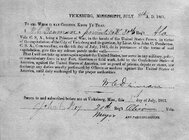
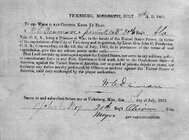
Sometimes the retained (government) copy of the parole document is there, as well. Here's my g-g-grandfather's from Vicksburg:

denmanparole1.jpg


And another g-g-grandfather, from the end of the war:

Page06.jpg


This last one showed me that James E. B. Hall, who had just turned 18, could not sign his name and had to make his mark instead. I'm pleased to know that he did learn to read and write before he died in 1883.
 

Attachments

  • denmanparole1.jpg
    denmanparole1.jpg
    97 KB · Views: 43
Last edited:

Learn About Us
About CivilWarTalk
Contact the Webmaster
Meet the Staff
Link to CivilWarTalk
Join Our Community
Register
Browse Forums
View Today's Discussions
Search the Forum
Get Help
FAQ
Student Guide
Forum Rules & Etiquette
Copyright / DMCA

     Contact Us CivilwarTalk on Facebook CivilWarTalk on YouTube CivilWarTalk on Twitter RSS Feed

Bringing the American Civil War and More to Life.
© 1999 - , CIVILWARTALK, LLC - Site Version 10.0

SlaveryTalk.com - SecessionTalk.com - CivilWarTalk.com - ReconstructionTalk.com
Back
Top