Nessler Bullets

yulzari

Private
Joined
Jul 25, 2017
Location
Plymouth and Basse Marche
I have noticed repeated references to round nosed smooth bore large calibre bullets/slugs as "Nessler" bullets.

This puzzles me as every photograph of ACW ones are clearly not of any Nessler pattern. Either they are flat based with a single cannelure or too long and heavy in the wall.

I am familiar with the French, Sardinian and Russian army issue Nessler bullets and these do not match the ACW ones. I dare say that all sorts of ammunition was acquired in haste but the Union Army specifically declined the Nessler ball after trials.

The origin being that of Captain Nessler of the Belgian Army and whose small arms were closely patterned on the French. Thus it was adopted by France which lead to the Sardinians adopting it and the Russians through their close links to the Belgian small arms trade at the time.

Claims at the time were that it preserved a smooth bore's 'accuracy' out to 400 yards. Modern trials seem to suggest that they were less accurate than the spherical ball out to 100 yards but did not become so unstable thereafter and by 200 yards were more accurate in comparison to the spherical ball.

Some ACW ones do bear a passing resemblance to the Nessler proper in having some cavity and a token nipple in the centre but are far too heavy walled to expand into the bore.

So, after all this preamble, why are they known as Nessler bullets when they are not?

The real Nessler was made into a paper cartridge in a similar fashion to say an Enfield cartridge or a French Tamisier whereby the bullet was base down at the front and the powder in a powder case behind and separate. The ball end being choked and dipped in wax. The cartridge was opened by tearing off the twisted or folded top end and poured into the barrel. The cartridge was then reversed and pushed into the muzzle bullet down until just the bullet was well in then the powder case snapped off and discarded. The waxed paper wrapped Nessler bullet was then rammed home. When fired it expanded to bore size and discarded the paper upon emerging. The walls of the cylindrical portion acted as drag stabilisers to keep the nose tangential to the arc of the bullet. The waxed paper having swept the bore clean and left a film of wax to keep the next fouling soft.
 
This is a year-old thread... So forgive me for resurrecting it if that "isn't done." Mark Hubbs of Eras Gone Bullets has a .680-562 NC Nessler mould of the pattern yulzari describes. I just acquired one to do some "experimental archaeology" of how these bullets functioned from a .69 smooth bore and maybe a 12-gauge muzzle-loading shotgun.

If one is interested in NC stuff, the mould is available, at least for now.
Has anyone encountered an intact smooth bore Nessler cartridge, or packet of cartridges from Raleigh?
Sure seems like one must have survived someplace...

Very respectfully, &c.
 
I have had a look at the 'Eras Gone' Nessler. It doubtless matches the original American issue bullet and looks well made. However it is one of the flat base conicals not a Nessler even if the original makers/users called it a Nessler.

I would expect it to be unstable in a smooth bore which is the role of Captain Nessler's design. If anyone uses the bullet in a smooth bore I should like to hear of it's utility. Probably adequate in a rifled weapon.
 
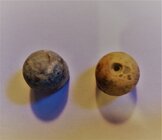
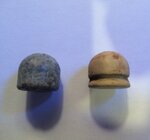
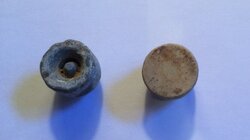
In a discussion of Nessler bullets, it is helpful to have illustrations of original bullets of the Civil War period.

Nessler Bullet 1.jpg Nessler Bullet 2.jpg Nessler Bullet 3.jpg


The greyish bullet on the left is an original Imperial French Army Nessler bullet from the Crimean War [1853-6] intended for that army's smoothbore muskets, and dug in the Crimea. The Imperial Russian Army used a very similar design Nessler bullet in its smoothbore muskets.

The brownish bullet on the right is a pulled North Carolina State compression Nessler variant dug near Culpeper, VA, and intended for use in .69 caliber smoothbore muskets. As with the System Lorenz bullet used with the Muster 1854 Austro-Hungarian Army rifled weapons, the groove in the base of the bullet is NOT a lubrication groove, but a compression groove.

Both bullets were wrapped in a paper cartridge, with the grease on the paper wrapper providing lubrication.

North Carolina manufactured a compression variation of the Nessler ball for use in .69 -- and probably .71 -- caliber smoothbore weapons. The origin of North Carolina's compression bullet designs is unclear, although they may have been copied from Cadmus M. Wilcox's Rifles and Rifle Practice, which had been published in 1859 and was widely disseminated in the U.S. Army before the Civil War. (Thomas, Confederate Arsenals, III, 844-5, 849-51, 853, and 857)

The dimensions of North Carolina compression bullets illustrated in Confederate Arsenals, Laboratories, and Ordnance Depots are as follows:

Type; Caliber; Weight; Diameter; Length.
North Carolina Rifle: .50: 407 to 413 grains/25.98 to 26.76 grams; .495 to .498 inches/12.573 mm to 24.892 mm; .94 to .95 inches/23.876 mm to 24.13 mm.
Mississippi Rifle Ball, "Wilkinson" Pattern: .54: 470 grains/30.46 grams; .530 inches/13.462 mm; .97 inches/24.63 mm.
New Austrian Pattern Ball: .58; 468 grains/30.33 grams; .568 inches/14.427 mm; .98 inches/24.892 mm.
Nesler Ball: .69; 314 to 473 grains/20.35 to 30.65 grams; .595 to .695 inches/15.113 to 17.693 mm; .57 to .63 inches/14.478 to 16.002 mm.
Nesler Ball: .71; 540 to 605 grains/34.99 to 39.2 grams; .714 to .754 inches/18.136 to 19.152 mm; .66 to .72 inches/16.764 to 18.288 mm.
(Thomas, Confederate Arsenals, III, 851 and 854) [Sorry. Charts don't copy well.]

Regards,
Don Dixon
 
Last edited:
Great Post, Thanks for sharing.
 
Thank you for the post Don. What we see is is period colloquial use of the term 'Nessler'. It was clearly popularly used for any short bullet for a smooth bore. Captain Nessler's design, as shown by the French example, involves an interior cavity with a central post to give a nose heavy drag stabilised bullet of reasonable weight. Both the centre of gravity and skirt drag stabilising the bullet even though it is not spun. The other, North Carolina, bullet is a simple solid flat base. Almost a round ball mould with the end ground to a flat. With a single cannalure. The only expansion of that bullet will be by inertial obturation as there is no allowance made for the design to compress otherwise. In a smooth bore and with a centre of gravity slightly to the rear I would expect it to tumble and the extra weight over a simple round ball would increase the recoil. I am open to correction by actual users of the design.

This is akin to the modern generic descriptions of things like household vacuum cleaners as 'Hoovers' or ball point pens as 'Biros'. The name 'Nessler' has been applied to any short flat base looking bullet for a smooth bore even if it lacks the subtleties of Captain Nessler's actual design. The Brenneke slug has similarities to the actual Nessler but improved with a lightweight attached cylindrical tail to improve the drag stabilisation and slight fins to pass through a modern choke.

My experiments with de-tailed Brenneke slugs suggest to me that even the proper Nessler is inferior to the round ball until one gets past 150-200 yards when it then begins to out perform it to 400 yards or so. The French, Russian and Sardinian armies all adopted and used the Nessler in Crimea in their smooth bores until they could issue rifled replacements/conversions. The British and Union armies looked at Nesslers and concluded that the ordinary musket was not going to be improved at musket ranges and beyond that the improvement was unlikely to be effective on the battlefield so looked to the rifle as the solution and kept the round ball in the meantime.

One likes to think that North Carolina trialled these before ordering them but I have a cynical suspicion that the actual purpose was to give their troops ammunition that looked like proper rifle ammunition even if they could only be given smooth bores. The advantage being more psychological than physical. En masse fired by the average ACW new recruit there was probably very little difference in their actual effect upon the enemy.
 
Yulzari,

Some of the N-SSA shooters have posted that they have purchased Eras Gone Nessler bullet moulds, but have not yet posted results from shooting them. We are only permitted to use round balls in smoothbore muskets in N-SSA matches.

Based on years of shooting System Lorenz compression bullets, I think that the original North Carolina design would compress better than you think, provided that you used an adequate powder charge. Forty-five grains of Swiss or 50 grains of GOEX FFFg powder works well with the Lorenz bullet. My impression from looking at photos of the Eras Gone bullet is that it would be somewhat more difficult to compress than the original North Carolina bullet design. But, I will have to defer judgement until someone I trust posts some test results.

Accuracy would, I think, depend on the balance of the bullet once it was compressed. If the balance is towards the nose it should fly straight. If it is towards the rear I suspect that it will tumble. I can't imagine that North Carolina issued them without some testing. But, a lot of things have surprised me in my Civil War ordnance research.

Regards,
Don Dixon
 
Actual trial will trump my opinion as one who has not used the Eras Gone Nessler of course Don but I can see no shape inbuilt to be compressed; unlike the excellent Lorenz Wilkinson system with which I am familiar.

It seems to be a simple flat base short round nose 'conical' with a single groove cut into it. The shape can work well in a rifle and I use the functionally similar xringservices short flat base conical in my Snider Enfield rifle but that is spun by the rifling. We await user reports in smooth bores.
 
North Carolina infantry regiments (CSA) known to have used .69 cal. smooth bore muskets

4th North Carolina Infantry – ANV "The Bloody Fourth" 1861—central and western NC—April 1865

13th North Carolina Infantry – ANV May 1861— mostly Piedmont and some eastern NC—April 1865

22nd North Carolina Infantry – ANV Raleigh July 1861—Piedmont and western NC—April 1865

38th North Carolina Infantry – ANV Raleigh Jan. 1862—Piedmont and eastern NC—April 1865

Source: Earl J. Coates and Dean S. Thomas, An Introduction to Civil War Small Arms (Gettysburg, PA: Thomas Publications, 1990), 86 and NPS Battle Unit Details online.
 
J. Corréard, ed. Journal des armes spéciales et de l'etat-major (Paris: Librairie Militaire, Maritime et Polytechnique, 1866), pp. 271-73:

Model 1857 (rifle musket) Minié 32 gram/ 493-grain bullet backed by 4grams powder (approximately 60 grains, like the U.S. service charge). This rifle musket caliber measured 17.8mm/.71 caliber, a bit like the British Crimean War-era Pattern 1851 .702-in. rifle musket, which immediately preceded issue of the smaller caliber .577-in. Pattern 1853 Enfield.

1. Smooth bore (i.e. Mle. 1842 .70): Spherical 16.7mm/ .66 caliber lead ball, weight 27gram/ 415gr., powder charge 9grams/ 1/3rd of an ounce, or about 140 grains (U.S. flintlock muskets employed a charge of 120grains of coarse musket powder, part of which was used to prime the pan. Adoption of the percussion ignition system led to a reduction of the charge to 110grains).

2. Nessler conical ball for smooth bore arms, 16.7mm/ .66 caliber bullet weighing 30grams/ 464grains propelled by a 6gram/ 90grain powder charge. [Perhaps the charge for the North Carolina "Nesler" was similar, e.g. 100 grains, give or take, or perhaps it was reduced to 60 or 65 grains like the rifle musket charge? Certainly the compression on firing would seal the internal windage of the bore, increase the velocity, and scrape away some of the fouling?)Compared to the spherical ball of the infantry musket, that designed by M. Nessler for smooth bore arms displayed great superiority; see table below:

All shots taken with Voltigeur Mle. 1842 (e.g. 4ft. 8-in. long, 9lbs. 9oz., 17.8mm/.70 caliber)
At 200 meters, shooting at a 2m x 1m target, spherical ball scored 35% hits, while the original French Nessler scored 60% hits. The Model 1857 minnie was reportedly 78.33% at that range.
Another 100 meters out, using the same target, the spherical ball had 25% hits, while the Nessler (the one yulzari shows with the hollow base) was at 43.33% hits, and the minnie at 63.33%. At 400 meters, and a bigger target, 2m x 2m square,no record at all for the spherical ball, and 38.33% for the Nessler ball. The source lists 43.33% hits for the minnie at this range, but I think this is mistaken, and is an error where the number for the Nessler from the preceding column was that number. At 500 meters the minnie was still 51.67% and all the way out to 550m on a 2m x 3m target, the French test concluded 40% for the minnie.

3. Mle. 1854 Imperial Guard rifle musket—17.8mm/.70 cal. (1.42m/4ft. 7-in. long, with a 1.03m/3ft 4-1/2-in. barrel rifled with four progressive-depth grooves, typically loaded with 4.5grams/69 grains of powder backing a skirted 36gram/554-grain Minié ball).

I've got some lead and I'm ready to start casting some of the replica "Type II" NC state so-called "Neslers" I'll have to try different powder charges. My understanding is that the service charge for the .69 cal. conical bullet was 70 grains of powder, while the undersized .65 cal. spherical ball used 110 grains.
 
I would illustrate my point with drawings but the forum only supports images held on third party sites.
I look forward to the results of your trials Frederick and thank you for the reference which I have downloaded from
https://archive.org/details/journaldesarmes12unkngoog

Yes the Nessler beats the spherical ball beyond 200 metres but the weapon needs new sights to make use of these extra ranges over the common musket ball and massed infantry will lose sight of the target through smoke from their own fire unless they and their officers are exceedingly well trained and disciplined in volley firing. An analogy, if not a direct example, is the Russian Luttich rifle (Belgian copy of the British Brunswick) when they moved on from the belted ball to a winged conical. The latter hugely improved the accuracy and range but required complete (and complex) sights to 'lob' the heavy ball at a distance. These were issued to Jager units and not line infantry. A musket with a Nessler ball also will need new sights to make use of the benefits of the Nessler ball. What actually happened with the Russians, Sardinians and French in the Crimea was that they gave them out to the ordinary line muskets which negated the potential of the Nessler.

However, we know that North Carolina issued muskets. We know that they issued the Eras Gone style bullets for these muskets. We remain to see if they worked better than the common ball in them. I remain doubtful but hopefully we shall see. I expect them to be unstable.
 
I'll try them in an original un-sighted Model 1842 U.S. percussion musket, and when the relining process is finished, a rifled and sighted .69 cal. barrel.

Does anyone have actual cartridges for these conical smooth-bore slugs? I've seen photographs much like what Dixon posted of both a Type I and a Type II.

Speculatively, they may have been intended for .69 cal. smoothbores and as shotgun slugs. They may have been intended for either .69 smoothbores and/or .69 rifled muskets? Although I'm not sure how many of those were available to North Carolina during the war versus relatively ample supplies of Model 1816s converted to percussion, Model 1840 percussion conversions, and Model 1842s. A good many troops in eastern Tennessee had flintlock .69 caliber smoothbores when the states seceded, so perhaps the same was true of parts of North Carolina? I don't know.

I would like to see any cartridges that may have survived, which I've never seen, unlike most of the other cartridges.
The claim is made that these flat-based conical bullets were like Enfield cartridges, and that after the powder charge was dumped down the bore, the cartridge was inverted, the paper and ball inserted in the muzzle and then snapped off before being seated atop the charge with the rammer? I suppose I'll have to try both ways...
 
I'll try them in an original un-sighted Model 1842 U.S. percussion musket, and when the relining process is finished, a rifled and sighted .69 cal. barrel.

Does anyone have actual cartridges for these conical smooth-bore slugs? I've seen photographs much like what Dixon posted of both a Type I and a Type II.

Speculatively, they may have been intended for .69 cal. smoothbores and as shotgun slugs. They may have been intended for either .69 smoothbores and/or .69 rifled muskets? Although I'm not sure how many of those were available to North Carolina during the war versus relatively ample supplies of Model 1816s converted to percussion, Model 1840 percussion conversions, and Model 1842s. A good many troops in eastern Tennessee had flintlock .69 caliber smoothbores when the states seceded, so perhaps the same was true of parts of North Carolina? I don't know.

I would like to see any cartridges that may have survived, which I've never seen, unlike most of the other cartridges.
The claim is made that these flat-based conical bullets were like Enfield cartridges, and that after the powder charge was dumped down the bore, the cartridge was inverted, the paper and ball inserted in the muzzle and then snapped off before being seated atop the charge with the rammer? I suppose I'll have to try both ways...
We await your results!:smile coffee:

Kevin Dally
 
From Mr. Hubbs' website for the mould:

"North Carolina ordered molds from the firm of Voss & Smethurst. The bullets and cartridges were produced at the North Carolina Institute for the Deaf & Dumb and the Blind. Instead of having a hollow base as the European version, the North Carolina Nessler was solid based and worked on the compression system similar to the wilkinson bullet. Our mold will cast that later version of this bullet that weighed in at about 562 grains. The original powder charge is not known as no original cartridges for the North Carolina Nessler have survived. It is estimated that the charge was about 110 grains of musket (2F) powder."

Shucks. From 70 grains of powder in the 730 grain Minié/Burton bullet in the rifled versions to 110 grains in the .65 cal. musket ball/ spherical projectile... The math from the French source might help narrow it down? Also, there are some German-language evaluations of conicals in smooth bores too. I'd better get to casting....
 
That's great! We can compare notes, if you'd like. My Model 1842 is "good to go" with the smooth bore. I'm having the sighted and rifled barrel relined at the moment.

While the service charge for the round ball was 110-gr. of powder, and the charge for the 730-gr. conical-ogival bullet was 70 grains, I think I'll start at 55 grains of FFg and work up from there. I've got some German language stuff and British stuff to go through research-wise, and I'll have to wait a bit longer for my casting furnace thermometer to arrive in the meantime.

I was privileged to attend a shoot with the 6th TX the other day, and shot some model 1861 .58 paper cartridges for the Model 1840/1845 "Mississoli" I've got with the revolving Colt rifle sight added, as well as some model 1863 cartridges sans flax cord, and some Pritchett bullet Enfield-type cartridges too.

Very respectfully, &c.
 

Learn About Us
About CivilWarTalk
Contact the Webmaster
Meet the Staff
Link to CivilWarTalk
Join Our Community
Register
Browse Forums
View Today's Discussions
Search the Forum
Get Help
FAQ
Student Guide
Forum Rules & Etiquette
Copyright / DMCA

     Contact Us CivilwarTalk on Facebook CivilWarTalk on YouTube CivilWarTalk on Twitter RSS Feed

Bringing the American Civil War and More to Life.
© 1999 - , CIVILWARTALK, LLC - Site Version 10.0

SlaveryTalk.com - SecessionTalk.com - CivilWarTalk.com - ReconstructionTalk.com
Back
Top