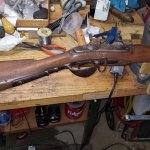
Need HELP identifying

MCordoves

Cadet
Joined
Sep 11, 2016
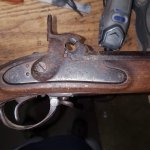
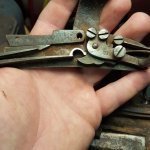
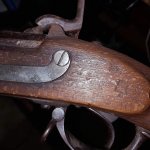
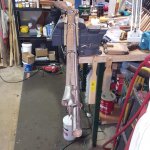
I recently acquired this and am almost certain it is a M1842 Lorenz. It is a smoothbore, and has several visible markings, but can't find the proof marks. The cartouche reads "JB". Any help is appreciated!
 

Attachments

  • received_10153711661726510.jpeg
    received_10153711661726510.jpeg
    252.8 KB · Views: 210
  • received_10153711663336510.jpeg
    received_10153711663336510.jpeg
    230.1 KB · Views: 191
  • received_10153711662191510.jpeg
    received_10153711662191510.jpeg
    289.1 KB · Views: 159
  • received_10153711661506510.jpeg
    received_10153711661506510.jpeg
    241.9 KB · Views: 158
  • received_10153711661211510.jpeg
    received_10153711661211510.jpeg
    298.2 KB · Views: 186
You have a converted Austrian Muster 1842 System Augustin musket. As originally designed by Baron von Augustin, it was manufactured as a tubelock smoothbore. Ritter von Lorenz had nothing to do with its design. When it was sold out of Austro-Hungarian Army (k.k. Army) service following the adoption of the Muster 1854 System Lorenz percussion rifle, it was converted from tubelock to percussion in Liege, Belgium, before it was sold to American military forces -- probably the Federals -- at the beginning of the American Civil War. In addition to being converted to percussion in Liege, large nubmers of them were also rifled. Considerable numbers of Muster 1842s were carried by Federal forces during the first two years of the war -- particularly in the western armies -- and by the Veteran Reserve Corps in the last year of he war.

The numbers and other marks on the breech of the barrel are proof and assembly markings. Unfortunately I have been unable to find a crib sheet for them. The Austro-Hungarian government did not adopt empire wide proof standards and marks until the 1880s, so there will be no standard proof marks. The Belgian government did not require proofing of converted military arms that had been originally manufactured outside of Belgiam until 1864, following damage to the reputation of the Belgian gun trade due to shoddy conversion work done in Leige early in the Civil War.

Regards,
Don Dixon
 
Last edited:
Welcome From THE Heart Of Dixie.
FORREST-002.jpg
 
Don is most likely correct on his ID. When these weapons were redone by the Belgians they often put a Liege Arsenal mark on the barrel (top, near the nipple). Your pictures do not show this part of your gun but look for such a mark. It will usually be an oval with some rendition of L and G. Just about every arm produced by every country in Europe from the late 18th Century on up into the 20th Century was copied, sometimes under license, sometimes as a free lance operation. Depending on the manufacturer they were sometimes as good as the originals. Anyway, look for the Liege mark.
 
Don is most likely correct on his ID. When these weapons were redone by the Belgians they often put a Liege Arsenal mark on the barrel (top, near the nipple). Your pictures do not show this part of your gun but look for such a mark. It will usually be an oval with some rendition of L and G. Just about every arm produced by every country in Europe from the late 18th Century on up into the 20th Century was copied, sometimes under license, sometimes as a free lance operation. Depending on the manufacturer they were sometimes as good as the originals. Anyway, look for the Liege mark.

Unfortunately, I am not able to find the marking by the vent just yet. This particular musket was found between the walls of a very old home in Wisconsin just last month. The markings I have been able to locate are as follows:

Buttplate "7"
Trigger Guard "H" front and rear
Lock plate "DPR" and Austrian eagle
Opposite Lockplate "UW"
Bottom band "22"
Internals (Lock) "33"

This is an original piece, but wish I knew more about the markings. Thank you all!
Find me on FB and I can send better photos.
Matt Cordoves
 
It looks to me like the hammer is from a US cone-in-barrel conversion. Probably a period repair.
 
You will only find the Liege proof mark on a weapon if it was manufactured in Liege, or if it was converted in Liege after 1864. The Liege gunmakers would build anything that the purchaser had the money to pay for. They manufactured a wide variety of military and civilian arms, including Pattern 1853 Enfield rifle muskets for the British Army, and almost all of the French and Piedmontese pattern arms imported during the Civil War were manufactured in Liege, not France. To the best of my knowledge they did not manufacture any System Augustin or System Lorenz arms for the Austro-Hungarian Army (k.k. Army), although that would not have precluded them from copying those models for someone else. I purchased what was supposed to be a Muster 1842 k.k. Army musket at auction. It turned out to be a Hamburg Bürgergewehr musket manufactured in Liege. Very similar in appearance. There is no record of the Hamburg guns being imported during the Civil War, but it has clear "OHIO" markings demonstrating Civil War provenance. The Liege gunmakers did, however, convert thousands of surplus k.k. Army arms for the American Civil War and the African trade.

Regards,
Don Dixon
 

Learn About Us
About CivilWarTalk
Contact the Webmaster
Meet the Staff
Link to CivilWarTalk
Join Our Community
Register
Browse Forums
View Today's Discussions
Search the Forum
Get Help
FAQ
Student Guide
Forum Rules & Etiquette
Copyright / DMCA

     Contact Us CivilwarTalk on Facebook CivilWarTalk on YouTube CivilWarTalk on Twitter RSS Feed

Bringing the American Civil War and More to Life.
© 1999 - , CIVILWARTALK, LLC - Site Version 10.0

SlaveryTalk.com - SecessionTalk.com - CivilWarTalk.com - ReconstructionTalk.com
Back
Top