Mud! Mud!! Mud!!!

tony_gunter

2nd Lieutenant
Joined
Feb 19, 2011
Location
Mississippi
Subtitle: The Hand of God in the Vicksburg Campaign

Anyone who lives on the Mississippi River knows the yearly routine. Winter snows fall in the Rocky and Appalachian Mountains, early spring begins the thaw, by mid spring the river is swollen with runoff, and by late May the river drops dramatically. The chart below is a little more complicated than necessary, but gives a rough timeline for the average rise and fall of the river.

IMG_5360.jpeg


Unusual weather patterns can shift this rise and fall significantly. In 1863, for example, Grant landed at Young's Point in January with the river already swollen, the river crested in March, and by mid April the river stage began a dramatic fall.

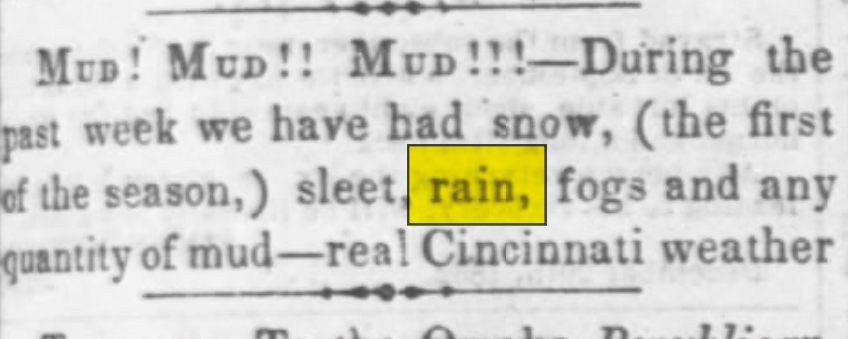
I was just scanning for news that would explain some of this, and saw this article in the January 24th edition of the Nebraska Advertiser that suggested some heavy rains mixed with sleet and some snow (the first of the season) had transformed Nebraska into a sea of mud.
IMG_5359.jpeg


How unusual was it that Nebraska would get its first snow in late January? Anyone else have reports of unusual weather in winter 1863?
 
Last edited:
The winter of 1863-64 was like none other. That El Niño was muy macho.

Link:


.

If anyone is unaware of Mother Mary Bickerdyke's battle to save her patients in Chattanooga December, 1863 you are in for an eyeful. There was an arctic front of unprecedented power. Like nothing anybody had ever seen it bull dozed into the South, literally flattening buildings. The Mississippi River froze over SOUTH of Memphis.

Mother Mary's charred dress from Chattanooga was displayed like a religious relic at Sanitary Fairs.

 
The winter of 1863-64 was like none other. That El Niño was muy macho.

Link:


.

If anyone is unaware of Mother Mary Bickerdyke's battle to save her patients in Chattanooga December, 1863 you are in for an eyeful. There was an arctic front of unprecedented power. Like nothing anybody had ever seen it bull dozed into the South, literally flattening buildings. The Mississippi River froze over SOUTH of Memphis.

Mother Mary's charred dress from Chattanooga was displayed like a religious relic at Sanitary Fairs.

What about the previous winter? Anything unusual in your neck of the woods? Haven't gotten to scanning the Cumberland region.

I did stumble upon an account of a stage journey to Denver from Nebraska that turned eventful when the coach tried to navigate the Colorado foothills in the mud, but I've lost the article now. Apparently the inclement weather inflicted mud on a pretty large area out west.
 
During the winter of 1863-64, the temperature at Rock Island, Illinois, fell to as low at -32F (roughly -36C). This is actual air temperature, not wind chill. While winter can be a bear in Northern Illinois, this is extreme, even for us. And yes, the Mississippi was definitely frozen over at Rock Island.
That would be the first winter after they opened up the Rock Island Prisoner of War camp. The prisoners taken from Chattanooga were sent there, including three of my ancestors who fought at the Battle of Lookout Mountain. What made life in those PW barracks even more unbearable was the green lumber used to build the barracks shrunk, leaving gaps between the joints.
I've heard this claim but I don't know if there are any real statistics to back it up. It said the death rate at Rock Island was higher than it ever was at Andersonville, which would imply for one specific period of time.
 
Anyone who lives on the Mississippi River knows the yearly routine. Winter snows fall in the Rocky and Appalachian Mountains, early spring begins the thaw, by mid spring the river is swollen with runoff, and by late May the river drops dramatically. The chart below is a little more complicated than necessary, but gives a rough timeline for the average rise and fall of the river.
I'm still slowly going through Dr. Timothy Smith's "Bayou Battles for Vicksburg---The Swamp and River Expeditions, Jan 1, 1863 - April 30, 1863". Tim Smith hometown was at Carrolton that is in the bluffs, bordering the Mississippi Delta. He describes a lot of detail of the Federal troops fighting the rain and mud in trying to dig the canal to bypass Vicksburg. The Mississippi River flooded its banks so they had to stop work on the canal. Most of the flood was caused by the Union's plan that included blowing a hole in the Mississippi River bluffs and flooding most of the Delta. This prevented any chance for a land assault on Fort Pemberton.
 
What about the previous winter? Anything unusual in your neck of the woods? Haven't gotten to scanning the Cumberland region.

I did stumble upon an account of a stage journey to Denver from Nebraska that turned eventful when the coach tried to navigate the Colorado foothills in the mud, but I've lost the article now. Apparently the inclement weather inflicted mud on a pretty large area out west.

Sidebar: I lived in Watertown SD in 1966. Believe you me, I have something to gage cold weather with. We experienced the WORST BLIZZARD IN RECORDED SOUTH DAKOTA HISTORY. The Cole Bros, Clyde Bailey Circus was performing in our high school gym / convention center. As a result, we had lions, tigers, elephants, clowns, trapeze artists, you name it moved inside. Gym class consisted of sitting in the bleachers ogling & boggling.

We never had a snow day.


On topic:

Extreme weather in 1862 / 1863 / 1864 was a determining factor in the Civil War in the Western Theater. It was an El Niño time. When Bragg crossed over the mountains into Kentucky in 1862 Morgan, et al, hadn't noticed or reported that corn had died knee high. Kentucky pastures were nothing but brown stubble. Bragg's horses dropped dead in the traces from starvation & thirst.

During December 1862 Middle Tennessee weather was its usual awful self. The Stones River Campaign was a misery for one & all.

A drought in the spring of 1863 ended on June 23rd as the Army of the Cumberland commanders ordered forward march for the Tullahoma Campaign. It was an absolute frog strangler that lasted a full month. TVA rates it as 500 year rain event. It was the same system that probably saved the Army of Northern Virginia during its withdrawal from Gettysburg.

The descriptions of the bitterly cold weather front washing over the top of Lookout Mountain & howling down slope into Chattanooga are impossible to exaggerate. Had Grant been foolish enough to pursue Bragg into Northern Georgia the misery would have been indescribable.

The ice storm that paralyzed all movement at Nashville in December 1864 is the final extreme weather event to inflict misery on soldiers in Middle Tennessee.

The war in Middle Tennessee is, as everyone knows, my particular interest. The weather extremes defy exaggeration.

Link:

 
Last edited:
Awful as in frozen, or awful as in rain and mud?

Depends on the day of the week. Nashville lies on the sheer where the Gulf & Northern weather systems meet. A professional weather man explained it to me… my explanation is a layman's version.

It is common for weather to stop between Nashville & Murfreesboro at (+/-) I-840. You drive out of rain or snow into something else. It isn't subtle.

It can be freezing all week & (+/-) 70 degrees on the weekend. I lived for years roughly on the equator in the mountains. Compared with that Middle Tennessee is a weather madhouse.
 
It is really interesting to consider just how badly the 1862 drought crippled the Army of Tennessee's horse-drawn transportation owing to the extensive distances covered from Tupelo to Tennessee to Kentucky and back without adequate forage and water.
 
It is really interesting to consider just how badly the 1862 drought crippled the Army of Tennessee's horse-drawn transportation owing to the extensive distances covered from Tupelo to Tennessee to Kentucky and back without adequate forage and water.
And across the country was inundated from California to down to Sonora, Mexico, The Great Flood of 1862. I'd never heard of this catastrophe till I began looking into 1862....

Details from the below article: after a 20 year drought, the Great Flood of 1862 hit from November, 1861 through the end of January, 1862 & it was biblical, a once in 500 to 1000 year megaflood. Worst in history, inundating states like CA, NV, UT, AZ, ID, NM, OR, plus Sonora, Mexico. Early December the Sierra Nevadas had 10-15 foot snows which then washed away entire towns. Many thousands of farms went under the water, & thousands & thousands drowned. A quarter of the 800k cattle drowned. One third of California's property got destroyed, equaling 1 home in 8. Sacramento? Under 10 feet of water with people boating down new canals that had been city streets, & the State Capitol forced to move to SFO. Los Angeles went under water in the megaflood, too, 66 inches of rain for up to 6 months, & in 4x the normal amount of rain, "a great sheet of brown rippling water" even moved out into the Mojave Desert.... And an inland sea 300 miles long & 20 miles wide covering 5-6000 square miles formed in the Central Valley.... Then 30 feet of water submerged telegraph poles that had just been put up between SFO and NYC. According to Wikipedia, the $100 million damage in 1861 bucks would be $3.117 billion in 2021. The flood even led to the Owens Valley Indian War: the Paiutes, Shoshone, & Kawaiisu versus cattlemen settlers, which continued into 1863, with hostilities concluding in 1867. Note, too, as far as unusual weather events: the 1/9/1857 Fort Tejon earthquake, a 7.9 that split the southern part of the San Andreas Fault in CA. wider by 225 miles.

Sidenote: Growing up in PA., the Johnstown Flood we heard about in the '60s--70s, still very much in public consciousness, the Great Flood of 1889, 2,208 lives lost end of May into June, when the South Fork Dam failed. Terrible 😞. Clara Barton helped with relief.

 
Last edited:
And across the country was inundated from California to down to Sonora, Mexico, The Great Flood of 1862. I'd never heard of this catastrophe till I began looking into 1862....

Details from the below article: after a 20 year drought, the Great Flood of 1862 hit from November, 1861 through the end of January, 1862 & it was biblical, a once in 500 to 1000 year megaflood. Worst in history, inundating states like CA, NV, UT, AZ, ID, NM, OR, plus Sonora, Mexico. Early December the Sierra Nevadas had 10-15 foot snows which then washed away entire towns. Many thousands of farms went under the water, & thousands & thousands drowned. A quarter of the 800k cattle drowned. One third of California's property got destroyed, equaling 1 home in 8. Sacramento? Under 10 feet of water with people boating down new canals that had been city streets, & the State Capitol forced to move to SFO. Los Angeles went under water in the megaflood, too, 66 inches of rain for up to 6 months, & in 4x the normal amount of rain, "a great sheet of brown rippling water" even moved out into the Mojave Desert.... And an inland sea 300 miles long & 20 miles wide covering 5-6000 square miles formed in the Central Valley.... Then 30 feet of water submerged telegraph poles that had just been put up between SFO and NYC. According to Wikipedia, the $100 million damage in 1861 bucks would be $3.117 billion in 2021. The flood even led to the Owens Valley Indian War: the Paiutes, Shoshone, & Kawaiisu versus cattlemen settlers, which continued into 1863, with hostilities concluding in 1867. Note, too, as far as unusual weather events: the 1/9/1857 Fort Tejon earthquake, a 7.9 that split the southern part of the San Andreas Fault in CA. wider by 225 miles.

Sidenote: Growing up in PA., the Johnstown Flood we heard about in the '60s--70s, still very much in public consciousness, the Great Flood of 1889, 2,208 lives lost end of May into June, when the South Fork Dam failed. Terrible 😞. Clara Barton helped with relief.


I suppose this inundation explains why there was no secessionist movement in California. It was physically impossible.
 
Here is a well reviewed book about weather during the Civil War. "The Howling Storm" is a great title in any case.

Link:


Because the weather played such an important part here in the West, I have ordered the book. Looking forward to being a know it all.
 
Last edited:
Here is a well reviewed book about weather during the Civil War. "The Howling Storm" is a great title in any case.

Link:


Because the weather played such an important part here in the West, I have ordered the book. Looking forward to being a know it all.
I have the book, but I don't remember this topic being discussed in it.
 
I've heard this claim but I don't know if there are any real statistics to back it up. It said the death rate at Rock Island was higher than it ever was at Andersonville, which would imply for one specific period of time.
1735600166150.png

Rock Island data come from A Short History of the Rock Island Prison Barracks (Revised Edition) (Rock Island, Illinois: Historical Office, U.S. Army Armament, Munitions and Chemical Command, 1985). Andersonville data come from p. 321 of John McElroy's Andersonville: A Story of Rebel Military Prisons (Toledo: D. R. Locke, 1879). The author of the article where I found this graph said that the easiest way to summarize it is to say that more men died at Andersonville than were imprisoned at Rock Island during its entire time as a Civil War prison camp.

You can see that most deaths at Rock Island occurred in the first few months of operation. The camp wasn't fully completed when the first prisoners arrived, including there being no hospital; there was a smallpox outbreak (infected prisoners were probably sent from Chattanooga, but nobody thought to mention it) and the winter of 1863-64 was a real bear. There were 600-700 deaths in those first few months, but the death rate fell rapidly once the camp was completed and prisoners were vaccinated. One calculation I've seen says that the death rate at Andersonville was around 30%; the death rate from disease in the Confederate army in the field was around 18% and the death rate at Rock Island was around 16%. Ashley Wilkes would have been marginally better off at Rock Island (though as an officer he wouldn't have been sent there) than in his own army. And yes, Gone with the Wind is where Rock Island gets its bad reputation. Well that and from the Copperhead editor of the Rock Island Argus who had a real personality clash with the commandant of the prison.

I would highly recommend the book Rebels at Rock Island: The Story of a Civil War Prison by Benton McAdams.


I haven't seen The Rock Island Civil War Prison: Andersonville of the North?, but I will probably see if my interlibrary loan librarian can get me a copy. I know the Rock Island Library has at least one, but I don't know if it circulates.


Here is another article that might be of interest.

 
There were 600-700 deaths in those first few months, but the death rate fell rapidly once the camp was completed and prisoners were vaccinated. One calculation I've seen says that the death rate at Andersonville was around 30%; the death rate from disease in the Confederate army in the field was around 18% and the death rate at Rock Island was around 16%. Ashley Wilkes would have been marginally better off at Rock Island (though as an officer he wouldn't have been sent there) than in his own army. And yes, Gone with the Wind is where Rock Island gets its bad reputation.
Thanks for posting the data. I dont have any real resources. The local paper in Jackson, Mississippi, printed an article in ~1970's that listed all the Mississippi soldiers who died there. However, i didnt print their unit.

I recently watched Gone with the Wind and I didnt catch the reference to Rock Island PW Camp. I've always wished I could make a trip to see the area and the cemetery.
 

Learn About Us
About CivilWarTalk
Contact the Webmaster
Meet the Staff
Link to CivilWarTalk
Join Our Community
Register
Browse Forums
View Today's Discussions
Search the Forum
Get Help
FAQ
Student Guide
Forum Rules & Etiquette
Copyright / DMCA

     Contact Us CivilwarTalk on Facebook CivilWarTalk on YouTube CivilWarTalk on Twitter RSS Feed

Bringing the American Civil War and More to Life.
© 1999 - , CIVILWARTALK, LLC - Site Version 10.0

SlaveryTalk.com - SecessionTalk.com - CivilWarTalk.com - ReconstructionTalk.com
Back
Top