
rebelatsea
Captain
- Joined
- Mar 30, 2013
- Location
- Kent ,England.
"A proposed vessel mounting one gun protected by a hemispherical shield which rotated with the gun."
Received wisdom tells that this was a home-grown proposal by a resident of the South. In fact, neither is true.
Josiah Jones was a British citizen and a founder of Jones, Quiggin & Co. of Liverpool England, early exponents of iron shipbuilding and the constructors of fast ferries and packets which either became, or the design of which became the basis of several blockade runners.
Overshadowed by the designs of Captain Cowper Coles, what is little known is that Josiah Jones proposed in 1859 – 60 warships with sloping sides. Offering a harbour and coast defence vessel to the Admiralty at a time when they were looking at proposals for armoured sea going ships as an answer to the French La Gloire.
Jones initial thoughts were for iron vessels with armoured side sloping at 40 degrees, but after a trial with a 3.5" solid plate angled at 45 degrees which resisted shot from a 112cwt 68pdr at 200 yards, he came up with a vessel similar to but smaller than the Erebus class floating batteries.
The important difference was that this vessel mounted one 112cwt 68pdr smoothbore gun on the upper deck, mounted under a revolving shield, rather than a broadside battery in the hull, and was to be constructed of iron.
The shield differed from those proposed by Coles in that his were of smaller diameter and intended for Armstrong's 110pdr breechloading rifled guns. Both types were shaped like truncated cones in the part that visibly protruded through the deck.
The Admiralty weren't interested in either Jones' or Coles' ideas; Jones' on the grounds that his vessel couldn't fight La Gloire, wasn't properly sea-going, and that in both cases the angled sides would not allow for a wide enough upper deck for the necessary rigging on a masted ironclad, this despite the fact that Jones' plan was for a harbour and coast defence vessel without sailing rig, and Cole's vessel quite clearly showed the sloped armour inside a conventional hull.
Jones' subsequently modified plan was offered to Secretary Mallory at the same time the Virginia conversion was under way. It would appear that Cdr James D. Bulloch knew nothing about it, or at least it is not mentioned in his writings. There remains the possibility that Josiah Jones' himself. was the agent of its transmission.
With John L Porter engaged with the Virginia, Lt Catesby Ap R Jones and Constructor William Graves reported favourably on the vessel for construction at Richmond Va,
The plan below, by the author is an approximate reconstruction of Jones' vessel.
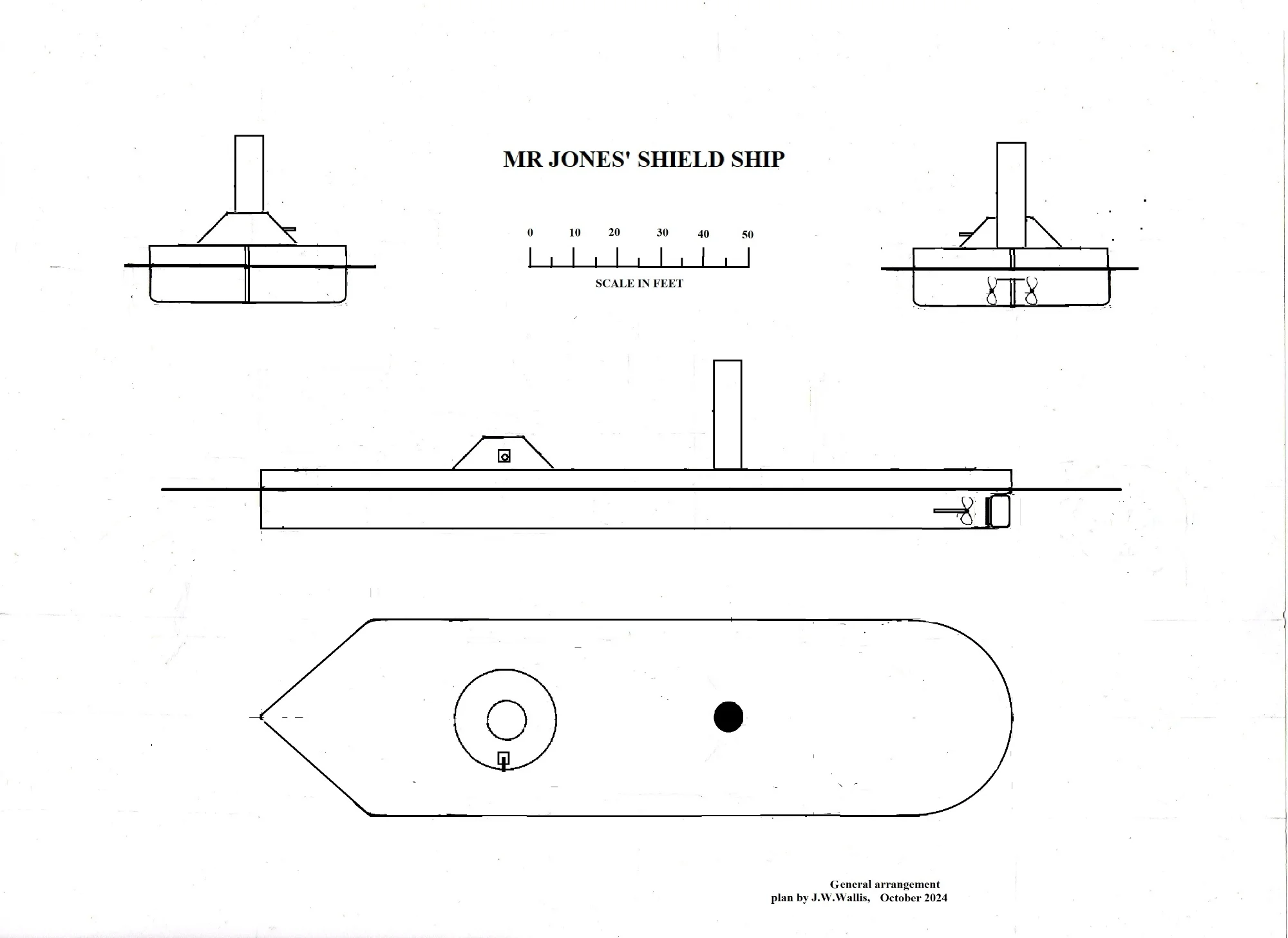
Based on the plan of the British Crimean floating batteries, cut down to the height of the gundeck and modified for the CSN to be built of wood instead of Jones' original iron proposal to the Admiralty.
It measured 172ft OA x 45ft EX x 9ft D, 995 tons, twin screwed, 7 -8 knots intended speed
The gun muzzle was to be not less than 10ft above the waterline, giving an approximate freeboard of 7ft to the weather deck.
Armour was to 4" (2x2") plate, vertical on the hull sides angled at 45 degrees on the shield, backing unknown, but 24" timber if CSN standard.
Gun: 1 – 112cwt 68pdr smoothbore. This was 10ft 10inches in length overall, so the revolving shield should have been able to accept a large smoothbore or 7" Brooke rifle.
Received wisdom tells that this was a home-grown proposal by a resident of the South. In fact, neither is true.
Josiah Jones was a British citizen and a founder of Jones, Quiggin & Co. of Liverpool England, early exponents of iron shipbuilding and the constructors of fast ferries and packets which either became, or the design of which became the basis of several blockade runners.
Overshadowed by the designs of Captain Cowper Coles, what is little known is that Josiah Jones proposed in 1859 – 60 warships with sloping sides. Offering a harbour and coast defence vessel to the Admiralty at a time when they were looking at proposals for armoured sea going ships as an answer to the French La Gloire.
Jones initial thoughts were for iron vessels with armoured side sloping at 40 degrees, but after a trial with a 3.5" solid plate angled at 45 degrees which resisted shot from a 112cwt 68pdr at 200 yards, he came up with a vessel similar to but smaller than the Erebus class floating batteries.
The important difference was that this vessel mounted one 112cwt 68pdr smoothbore gun on the upper deck, mounted under a revolving shield, rather than a broadside battery in the hull, and was to be constructed of iron.
The shield differed from those proposed by Coles in that his were of smaller diameter and intended for Armstrong's 110pdr breechloading rifled guns. Both types were shaped like truncated cones in the part that visibly protruded through the deck.
The Admiralty weren't interested in either Jones' or Coles' ideas; Jones' on the grounds that his vessel couldn't fight La Gloire, wasn't properly sea-going, and that in both cases the angled sides would not allow for a wide enough upper deck for the necessary rigging on a masted ironclad, this despite the fact that Jones' plan was for a harbour and coast defence vessel without sailing rig, and Cole's vessel quite clearly showed the sloped armour inside a conventional hull.
Jones' subsequently modified plan was offered to Secretary Mallory at the same time the Virginia conversion was under way. It would appear that Cdr James D. Bulloch knew nothing about it, or at least it is not mentioned in his writings. There remains the possibility that Josiah Jones' himself. was the agent of its transmission.
With John L Porter engaged with the Virginia, Lt Catesby Ap R Jones and Constructor William Graves reported favourably on the vessel for construction at Richmond Va,
The plan below, by the author is an approximate reconstruction of Jones' vessel.
Based on the plan of the British Crimean floating batteries, cut down to the height of the gundeck and modified for the CSN to be built of wood instead of Jones' original iron proposal to the Admiralty.
It measured 172ft OA x 45ft EX x 9ft D, 995 tons, twin screwed, 7 -8 knots intended speed
The gun muzzle was to be not less than 10ft above the waterline, giving an approximate freeboard of 7ft to the weather deck.
Armour was to 4" (2x2") plate, vertical on the hull sides angled at 45 degrees on the shield, backing unknown, but 24" timber if CSN standard.
Gun: 1 – 112cwt 68pdr smoothbore. This was 10ft 10inches in length overall, so the revolving shield should have been able to accept a large smoothbore or 7" Brooke rifle.


 Bringing the