Today I am reading Michigan at Antietam by Dempsey and Finney. So having just finished the chapter about South Mountain I had to ask myself about the 17th Michigan Infantry earning it's nickname, the Stonewall Regiment. Just who gets to confer a nickname on a regiment? I am not so sure I would have wanted the nickname as my regiment might be accused of supporting General Stonewall Jackson.
A battalion I served in was sometimes called the Have Gun Will Travel Battalion and I did not much care for our nickname. Who should have the right to confer a nickname on on some unit?
Perhaps no other Michigan regiment had such a serious test
of its patriotism, courage and soldierly qualities so soon
after arriving in the field as the Seventeenth. Scarcely two
weeks from the time it left the state it participated in one of
the severest battles of the war, considering the numbers
engaged.
September 14th the Seventeenth, with the Ninth Corps,
engaged the enemy at South Mountain, Md., where the corps
attempted to cross the mountain through Turner's Gap and drive
the confederates from the summit, where they had taken
advantage of securing their position behind stone fences and
other obstructions, and from commanding points had planted
their artillery to sweep the narrow roads over which the Union
troops must pass.
The Seventeenth had been so recently organized and was so
inexperienced in actual warfare that the men did not realize
the desperate task they were assigned until the enemy's shot
and shell were crashing through their ranks.
Almost at a moment's notice the regiment was plunged into
the horrible realities of a pitched battle. On the crest of
the mountain,
behind stone walls, the enemy awaited the advance
of the Union forces. The orders came for the Seventeenth to
charge, when with wild cheers the regiment rushed through a
storm of lead and drove the enemy from his stone defences, and
sent him retreating down the slope of the mountain.
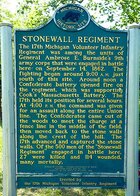
In this charge the Seventeenth secured the title of the
"Stonewall Regiment," which clung to it as an honorable
distinction during the war. The regiment carried approximately
500 men into this engagement and lost 140 in killed and
wounded.
The battle of South Mountain was fought Sept. 14, and
Sept. 17 the regiment was desperately engaged at Antietam, Md.,
and participated in the bloody and useless charges at
"Burnside's Bridge," where the Union troops were massed in the
attempts to carry the bridge, when the small stream of water
could have been easily forded above or below it. Although the
regiment succeeded in gaining the opposite heights occupied by
the enemy, it was at a fearful cost in killed and wounded.
The Seventeenth was in Virginia and Maryland until March,
1863, when with the Ninth Corps it was transported to
Louisville, Ky., and occupied a number of places in the state
of Kentucky by continuous marching, until it was ordered to
General Grant, then at Vicksburg, Miss. The regiment was
engaged with the enemy at Jackson, Miss., but soon returned to
Kentucky and arrived at Crab Orchard Aug. 24.
From this point commenced the long and tedious march
across the Cumberland Mountains to Knoxville, Tenn. After
occupying a number of places in East Tennessee, where the
regiment suffered the hardship and privations for want of
clothing and rations that were incident to that campaign, it
returned to Knoxville and was sent to Lenoir Station west of
Knoxville, to contest the advance of General Longstreet's
troops, then marching upon Knoxville.
As the Union troops fell back slowly upon Knoxville, the
Seventeenth acted as rear guard and fought a severe engagement
with Longstreet's forces at Campbell Station Sept. 16. During
the night and the next day the Union troops fell back to
Knoxville, where they occupied the entrenchments and Fort
Saunders, a strong earthwork, thrown up to resist the attack of
the confederates. Under cover of darkness the Seventeenth made
a brilliant sortie and burned a house between the lines
occupied by rebel sharpshooters, but the light of the burning
house revealed the regiment to the foe, who opened a furious
cannonade, which caused the death of Lieutenant Billingsly.
The Seventeenth occupied Fort Saunders during the siege
and helped to repel the desperate charges of the enemy.
After General Longstreet marched by Knoxville and into
East Tennessee, the Seventeenth followed him and occupied a
number of positions, marching continuously, all the time nearly
destitute of supplies, having to depend for the scanty rations
obtained upon the country through which the regiment marched.
The weather was cold, with frequent sleet and snow storms, and
the men of the Seventeenth, with their comrades of the
campaign, endured these hardships cheerfully, though at times
confronted by starvation or chilled with cold, their threadbare
uniforms offered but slight protection against the rigors of
such a climate.
On the 22d of March, 1864, the regiment commenced its
return march across the Cumberland Mountains to Nicholasville,
Ky., a distance of nearly 200 miles. When it arrived orders
were received for it to proceed to Annapolis, Md., where the
Ninth Corps proceeded to join the Army of the Potomac. It
crossed the Rapidan at Germania Ford, and on the 6th day of May
was engaged in the desperate battle of the Wilderness. The
regiment was actively engaged in this campaign, and in a daring
charge upon the enemy's works on the 12th of May, the
Seventeenth was surrounded in dense woods by the heavy lines of
the enemy and practically annihilated by the loss of nearly l00
killed and wounded and the same number taken prisoners.
After this sanguinary engagement the Seventeenth
practically lost its position in the brigade for want of
numbers and regimental organization, and the few who survived
were detailed in the engineer corps and at headquarters. These
survivors served with the army in the positions assigned them,
and took part in the assault before Petersburg, where that
stronghold fell into the hands of the Union troops.
After General Lee's surrender, the Seventeenth embarked at
City Point for Alexandria, Va., and participated in the grand
review at Washington on the 23d of May.
The regiment started for Michigan by rail on the 4th of
June and arrived at Detroit June 7th, 1865, where it was paid
off and disbanded.
Total enrollment...........................................1224
Killed in action.............................................84
Died of wounds...............................................48
Died in confederate prisons..................................54
Discharged for disability (wounds and disease)..............249
Died of disease..............................................84
Source: Record of Service of Michigan Volunteers 1861-65
 Forum Host




 Bringing the