Little Round Top

W. Richardson

Captain
Joined
Jun 29, 2011
Location
Mt. Gilead, North Carolina
I have read a great bit on the Battle of Gettysburg, heard experts speak on it, have visited Gettysburg 5 times. I have read and heard that LRT was the Key to the battle, have heard it was not the Key to the battle.................

What says you?.......................Was it the Key to the battle?


Respectfully,
William
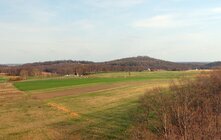
Little round top & Big round top.JPG
 
I think Cemetery Hill was the key to the battle, and most everything else on July 1, 2, & 3 was done to either seize or defend Cemetery Hill. That includes the attack & defense of Little Round Top.

That said, if the Confederates had seized & held Little Round Top, I believe the Army of the Potomac would have been in a precarious position and Meade probably would have ordered his army to fall back to a new position. I have my doubts that the Confederates could have held Little Round Top even if they had seized it though.
 
Buford and Chamberlain were both great men and performed super human acts at Gettysburg....but without Buford there either wouldn't have been a battle, or if there were....I think it would have gone even worse for the Army of the Potomac.


Oh I am in agreement with you about Buford's actions as to if not for him there would have been no Gettysburg, and if so it would have been worse for the AoTP, but once there was a field and a battle, what was the Key to the battle and winning it?

Until recently, I was back and forth on LRT being the Key or not being the Key....................

Last night I was reading The Union Generals Speak: The Meade Hearings on the Battle of Gettysburg edited by Bill Hyde, and on page 108...........Here is what Meade said.........

"At the same time that they threw these immense masses against General Sickles a heavy column was thrown upon the Round Top mountain, which was the key-point of my whole position. If they had succeeded in occupying that, it would have prevented me from holding any of the ground which I subsequently held to the last. "

I am not sure if I can argue against the commander of the AoTP, and winner of the battle of Gettysburg after that.

Respectfully,
William
George Gordon Meade - 1.JPG
 
Oh I am in agreement with you about Buford's actions as to if not for him there would have been no Gettysburg, and if so it would have been worse for the AoTP, but once there was a field and a battle, what was the Key to the battle and winning it?
I don't believe there was a key in the sense you are looking for (after there was a battle)....but the closest thing to it in my opinion is hands down, Pop Greene's defense of Culp's Hill on July 2....that makes what happened on Little Round Top ALMOST irrelevant.
 
This battle had several "keys" and Little Round Top was certainly one of them. I would be very interested to hear the argument that one particular action or topography was the ultimate "key" to this rather wide ranging and complex three day conflict.
 
This battle had several "keys" and Little Round Top was certainly one of them. I would be very interested to hear the argument that one particular action or topography was the ultimate "key" to this rather wide ranging and complex three day conflict.
I agree with you that there can really be know one "key position" on a battlefield as big as the one at Gettysburg. There were several key points -- but I don't think LRT was as key as some of the others, like Cemetery Hill or Culp's Hill. Still, if the Army of the Potomac had lost possession of Little Round Top permanently (like I said before, I don't think the Confederates could have held it if they had taken it) it would have put Meade in a precarious position and probably would have prompted a retreat from Gettysburg.
 
I believe Meade is using a bit of hindsight in his testimony here. After all, if it was the key to his position (and it was important, particularly since the Taneytown Road ran almost at the bottom of the eastern slope), shouldn't he be criticized for committing a grand total of 0 fighting men to that position?

Ryan
 
I believe Meade is using a bit of hindsight in his testimony here. After all, if it was the key to his position (and it was important, particularly since the Taneytown Road ran almost at the bottom of the eastern slope), shouldn't he be criticized for committing a grand total of 0 fighting men to that position?

Ryan
Actuality he did assign a corp there--Sickles' 3rd and Sickles abandoned it to move out to the Peach Orchard and the Emmitsburg Road. In any case, there were two more corps, the Fifth and Sixth coming up--more than enough to hold the hill--it only took approximately a brigade sized force, with a section of artillery to do the job.
 
Actuality he did assign a corp there--Sickles' 3rd and Sickles abandoned it to move out to the Peach Orchard and the Emmitsburg Road. In any case, there were two more corps, the Fifth and Sixth coming up--more than enough to hold the hill--it only took approximately a brigade sized force, with a section of artillery to do the job.

Sickles position was supposed to be anchored near LRT, probably at Munshower's Knoll but it's not clear whether or not he was supposed to occupy the hill.

As for the Fifth and Sixth Corps, if it wasn't for some quick thinking and actions by subordinate officers, those troops wouldn't have been on LRT either. By most accounts, Meade spent much of July 2nd concerned with his right to the detriment of his left. According to Major Tremain of Sickles' staff, he visited Meade several times on the 2nd but got the brush off when he communicated Sickles' concerns. Finally, Meade sent General Hunt but that didn't help Sickles' belief that his concerns were not being taken seriously, which led him to decide to move forward. Meade is not entirely without fault in this regard.

Ryan
 
Meade spent much of July 2nd concerned with his right to the detriment of his left.
Given what Meade could see and hear on the Union right his concern might well be justified. There were few Confederates on his left most of day two. But, I quibble, I understand what you are claiming and understand why.
 
Last edited:
I agree with you that there can really be know one "key position" on a battlefield as big as the one at Gettysburg. There were several key points -- but I don't think LRT was as key as some of the others, like Cemetery Hill or Culp's Hill. Still, if the Army of the Potomac had lost possession of Little Round Top permanently (like I said before, I don't think the Confederates could have held it if they had taken it) it would have put Meade in a precarious position and probably would have prompted a retreat from Gettysburg.

Good points made. I'm with you in that I don't think the Confederates could hold LRT as there weren't any reinforcements on the way, whereas the Union had the Fifth and Sixth Corps coming up and would be able to drive off any Rebels on the hill. This series on Gettysburg Daily really changed my mind about the importance of LRT:
https://www.gettysburgdaily.com/?page_id=7161

In particular, even if the Confederates had been able to hold the hill, they wouldn't have been able to bring any artillery of significance to bear on Cemetery Ridge to enfilade the Union position. Historically, the Union batteries on LRT couldn't follow PPT's charge past the Emmitsburg Road (or maybe only one gun was able to do so).
The loss of LRT may have been a concern to Meade but I don't think it would have driven off the Federals by itself.
 
I'm currently reading Pfanz's book "Culp's Hill and Cemetery Hill." It seems to me that had Ewell's corps successfully taken those positions when assaulted late on July 2nd, the AOTP would have been in deep trouble. Cemetery Hill in confederate possession would have provided an excellent artillery platform from which to enfilade the federal line down Cemetery Ridge and would probably have allowed Pickett to successfully overcome the federal 2nd Corps line on July 3rd, assuming they would even have maintained their position on the Ridge by that time.

So I guess I would consider LRT perhaps less key?
 
I think a small group of signalmen observing and waving flags from the summit did more to win the battle than most. Their impact on Longstreet's march and subsequent countermarch cost the Confederates precious time, especially since the latter arrived at the base of the hill only a few minutes after the Federals (Vincent's brigade) had secured it.

Likewise, the arrival of the 7th Indiana on Culp's Hill late on July 1, just in time to disrupt a Confederate scouting party that otherwise would have reported this key height unoccupied, and which then might have prompted its occupation in force by Johnson's division.

But basically I agree with others that there were a lot of keys within this battle that could have affected the final outcome, or at least drastically altered the way it developed and was fought. Several near successes by the Confederates were largely due to the Federals depleting a portion of their lines to reinforce other parts. This happened in a few places on Cemetery Ridge, as well as on Culp's Hill and Cemetery Hill.
 
I think a small group of signalmen observing and waving flags from the summit did more to win the battle than most. Their impact on Longstreet's march and subsequent countermarch cost the Confederates precious time, especially since the latter arrived at the base of the hill only a few minutes after the Federals (Vincent's brigade) had secured it.

Likewise, the arrival of the 7th Indiana on Culp's Hill late on July 1, just in time to disrupt a Confederate scouting party that otherwise would have reported this key height unoccupied, and which then might have prompted its occupation in force by Johnson's division.

But basically I agree with others that there were a lot of keys within this battle that could have affected the final outcome, or at least drastically altered the way it developed and was fought. Several near successes by the Confederates were largely due to the Federals depleting a portion of their lines to reinforce other parts. This happened in a few places on Cemetery Ridge, as well as on Culp's Hill and Cemetery Hill.
Great observation Tom. One most important "Key" to this battle was how Meade, with some subordinates used their interior line advantage to put out fires as needed. I'm sure this aspect of the battle has been well documented but perhaps without enough recognition/appreciation of how well these moves were made.
 

Learn About Us
About CivilWarTalk
Contact the Webmaster
Meet the Staff
Link to CivilWarTalk
Join Our Community
Register
Browse Forums
View Today's Discussions
Search the Forum
Get Help
FAQ
Student Guide
Forum Rules & Etiquette
Copyright / DMCA

     Contact Us CivilwarTalk on Facebook CivilWarTalk on YouTube CivilWarTalk on Twitter RSS Feed

Bringing the American Civil War and More to Life.
© 1999 - , CIVILWARTALK, LLC - Site Version 10.0

SlaveryTalk.com - SecessionTalk.com - CivilWarTalk.com - ReconstructionTalk.com
Back
Top