Lincoln Lincoln's Airborne Scouts

frontrank2

Major
Forum Host
Joined
Oct 10, 2012
Location
Mt. Jackson, Va
On June 16, 1861, Thaddeus Lowe climbed into the basket of his hot air balloon named Enterprise, and ascended 500 feet above Washington D.C. He was hoping to demonstrate to President Lincoln the potential of using balloons for gathering intelligence on Civil War battlefields. The balloon was tethered to the ground by ropes and a telegraph wire. Lowe then transmitted a telegraph message to Lincoln saying, "I have the pleasure in sending you this first dispatch ever telegraphed from an aerial station." He also reported to the president that he could see 50 miles in every direction. Lincoln, standing below, believed that this high-altitude technology could be valuable in the war effort. Lincoln, standing below, believed that this high-altitude technology could be valuable in the war effort. Always open to new technologies, Lincoln appointed Lowe as the chief aeronaut for the Union Army's newly formed Balloon Corps. Lowe, a self-educated scientist and inventor, had also developed portable hydrogen gas generators, which allowed quick deployment wherever aerial surveillance was needed to observe enemy troop movements and positions. Balloon spotters could communicate with commanders on the ground using signal flags and direct artillery fire. Lowe assembled an outfit of seven giant balloons made of silk and manufactured by a crew of 30 Philadelphia seamstresses. These military balloons were used in the First Battle of Bull Run in 1861; the 1862 Peninsula Campaign battles of Seven Pines, Williamsburg, and Gaines Mill; the Battle of Fredericksburg in 1862; and the Battle of Chancellorsville in 1863, among others.

Lowe and his balloon at the Battle of Seven Pines ( Fair Oaks )
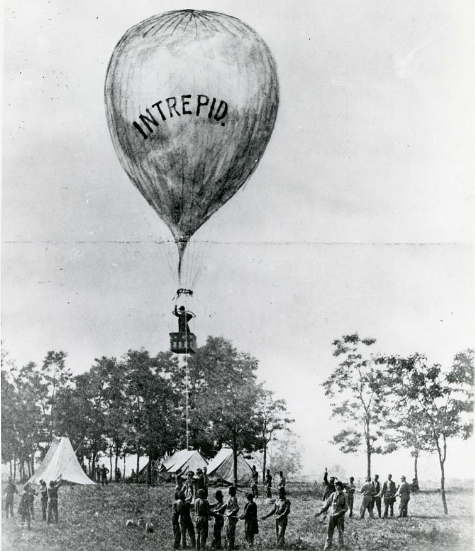
Thaddeus_Lowe_balloon_test.jpg
 
There was one battle out west, Island #10 I think, where an observation balloon was used. Was this one of the seven from the Balloon Corps? How was it transported out west?I'm guessing balloons would have been used more often out west but the "inflation wagons" couldn't make the trip.
A Professor Steiner , I think. Was he connected to the Corps or just an enthusiast who did it on his own?
 
Always open to new technologies, Lincoln appointed Lowe as the chief aeronaut for the Union Army's newly formed Balloon Corps.
To be historically correct President Lincoln told Lowe to take is ideas to the War Department. As many times as he tried, Lowe couldn't get past "Go away son. You bother us." Lowe returned to Lincoln who a little over a month later on 25 July - wrote the following note:

Will Lieu Gen. Scott lease see Professor Lowe, over more about his balloon? A Lincoln July 25, 1861

Lincoln Note to General Scott.jpg


Even with President Lincoln's note Lowe could not get past the gate keepers. Lincoln had enough when Lowe returned to him a third time and personally escorted Lowe to the War Department and ordered General Scott to use balloons for aerial observation.

There were two other Aeronauts in Washington at that time besides Lowe: John Wise, America's oldest and most prominent balloonist, and James Allen, who came to specifically support his brother's unit from Rhode Island -- it is from Allen's balloon that we have this drawing of the US Capitol featured in Harpers Weekly

Balloon View of DC from James Allen's Basket.jpg


John Wise underbid Lowe, was given the first contract to provide Aerial Support for the Army of the Potomac, and ordered to take his balloon to Manassas.

Major Albert J Myer and 20 men from the 26 Pennsylvania Volunteers were detailed to support Wise. Stopping Lowe mid inflation, they inflated Wise's balloon at the City Gas Works (located on the National Mall where the American Indian Museum is now), attached it to a wagon and started towards Manassas. Myer, knowing time was of the essence, moved his detail faster than recommended by Wise and by the time they got to Manassas - a day after the battle - the balloon was no longer airworthy because bouncing off tree branches and telegraph poles poked holes in the fabric allowing gas to escape.

It wasn't until August that Lowe was made Chief Aeronaut - still a "Civilian Contractor" - and was ordered to build 5 balloons. Lowe built his balloons double walled - a balloon inside of a balloon, knowing they would be used in a "field environment", and the rest, as they say is history.
 
There was one battle out west, Island #10 I think, where an observation balloon was used. Was this one of the seven from the Balloon Corps? How was it transported out west?I'm guessing balloons would have been used more often out west but the "inflation wagons" couldn't make the trip.
John Steiner - who spoke more German than English - was one of nine Aeronauts hired by Lowe to operate a balloon. Steiner took one of the two smallest balloons - The Eagle - and one of the portable hydrogen generators to Cairo Illinois to support Western Theater Operations. Local Commanders, unaware of the attached support, and challenged by Steiner's broken English followed the War Departments initial reaction to the idea of balloons providing aerial observation and responded "Go away son. You bother me."

Having put so much effort to get there Stiner did not give up eventually linking up with Naval Commanders who used and were grateful for his support.

Island No 10 d.jpg
 
There was one battle out west, Island #10 I think, where an observation balloon was used. Was this one of the seven from the Balloon Corps? How was it transported out west?I'm guessing balloons would have been used more often out west but the "inflation wagons" couldn't make the trip.

@Polloco, I do remember reading some time ago that the Union used naval vessels to transport and deploy the balloons, thus becoming the first "aircraft carriers" in American military history.
 
I do remember reading some time ago that the Union used naval vessels to transport and deploy the balloons, thus becoming the first "aircraft carriers" in American military history.

While the US Navy recognizes the George Washington Parke Curtis, refitted as designed by Chief Aeronaut Thaddeus Lowe, as their first aircraft carrier . . . John LaMountain, who contracted privately with MG Buttler to provide aerial observation specifically in support of Fortress Monroe, was historically the first to tether a balloon from a sea going vessel - the USS Fanny - on August 3, 1861.

Respectfully Submitted,

TSC Lowe, Aeronaut
Civil War Balloon Corps Living History

452DB183-1A94-40B8-AB7E-32F60F3A4C43.jpeg


52EEB1AE-2E1F-4D6C-B91E-1BC38169B0F1.jpeg
 
@Polloco, I do remember reading some time ago that the Union used naval vessels to transport and deploy the balloons, thus becoming the first "aircraft carriers" in American military history.
I agree on "air craft carriers". Water transport was indeed used in the Eastern Theater, you can even throw in the Teaser. But I was asking specifically about the use of balloons in the Western Theater.How were they transported?
 
On June 16, 1861, Thaddeus Lowe climbed into the basket of his hot air balloon named Enterprise, and ascended 500 feet above Washington D.C. He was hoping to demonstrate to President Lincoln the potential of using balloons for gathering intelligence on Civil War battlefields. The balloon was tethered to the ground by ropes and a telegraph wire. Lowe then transmitted a telegraph message to Lincoln saying, "I have the pleasure in sending you this first dispatch ever telegraphed from an aerial station." He also reported to the president that he could see 50 miles in every direction. Lincoln, standing below, believed that this high-altitude technology could be valuable in the war effort. Lincoln, standing below, believed that this high-altitude technology could be valuable in the war effort. Always open to new technologies, Lincoln appointed Lowe as the chief aeronaut for the Union Army's newly formed Balloon Corps. Lowe, a self-educated scientist and inventor, had also developed portable hydrogen gas generators, which allowed quick deployment wherever aerial surveillance was needed to observe enemy troop movements and positions. Balloon spotters could communicate with commanders on the ground using signal flags and direct artillery fire. Lowe assembled an outfit of seven giant balloons made of silk and manufactured by a crew of 30 Philadelphia seamstresses. These military balloons were used in the First Battle of Bull Run in 1861; the 1862 Peninsula Campaign battles of Seven Pines, Williamsburg, and Gaines Mill; the Battle of Fredericksburg in 1862; and the Battle of Chancellorsville in 1863, among others.

Lowe and his balloon at the Battle of Seven Pines ( Fair Oaks )

View attachment 449162
Interesting but also interesting is that the Union did not fair too well in the battles listed here. Guess they did not make good use of the Balloon!
 
I agree on "air craft carriers". WatI was asking specifically about the use of balloons in the Western Theater. How were they transported?
The balloon, Aeronaut, and associated equipment traveled by train to the Western Theater.

p. 386 - 388 of Military Ballooning During the Early Civil War by F. Stansbury Haydon

" . . . General McClellan again decided to extend the operations of the balloon service to still another theater of the war. On February 4, (1862) he ordered Colonel Macomb to send a balloon train and aeronaut to Cairo, Illinois, for service with the Army of the Mississippi."

"By February 13, all the appendages, generator, cordage, and auxiliary equipment had been packed for equipment and turned over to the Quartermaster Department for delivery."

"By the 21st, all details for Steiner's replacement at his station with Stone were completed, and Lowe ordered him to proceed at once to Cairo" . . . . "Steiner left for the West on the following day." "He arrived in Cairo three days later, and reported for duty to Brigadier General George W. Cullum . . . . "

"In the five months that he spent in the Western Department, Steiner was permitted to conduct ascensions for barely a week, and these operations were made possible only through the independent initiative of a naval officer to whom the balloonist had not been officially assigned to duty."

Respectfully Submitted,

TSC Lowe, Aeronaut
Civil War Balloon Corps Living History
 
Guess they did not make good use of the Balloon!
You are correct in stating they (Union Leadership) did not make good use of the Balloon! Remember this was new technology forced upon General Scott by President Lincoln. McClellan and his subordinates used the balloons frequently at the beginning of the war; Generals who followed were more focused on fighting the war and keeping their jobs than they were in using this new technology operated by "civilians".

Respectfully Submitted,

TSC Lowe, Aeronaut
Civil War Balloon Corps Living History
 
I'm guessing balloons would have been used more often out west but the "inflation wagons" couldn't make the trip
McClellan sent a balloon to both the Southern and Western Departments without the local Commander's knowledge. When they arrived with full kit including supplies and an inflation wagon, the Aeronauts were treated with indifference, distain, ridicule, and contempt. To make things worse for the Aeronaut sent to the West, Steiner was Prussian and spoke broken English. "In the five months that he spent with the western department, Steiner was permitted to conduct ascensions for barely a week, and these operations were made possible only through the independent initiative of a naval officer to whom the balloonist had not been officially assigned to duty. Although the result of his observations in this one instance was successful and proved the value of his services, he was not allowed to perform further duty of any kind, but was compelled to spend months in idleness waiting for orders that were never issued."

Respectfully Submitted,

TSC Lowe, Aeronaut
Civil War Balloon Corps Living History
 

Learn About Us
About CivilWarTalk
Contact the Webmaster
Meet the Staff
Link to CivilWarTalk
Join Our Community
Register
Browse Forums
View Today's Discussions
Search the Forum
Get Help
FAQ
Student Guide
Forum Rules & Etiquette
Copyright / DMCA

     Contact Us CivilwarTalk on Facebook CivilWarTalk on YouTube CivilWarTalk on Twitter RSS Feed

Bringing the American Civil War and More to Life.
© 1999 - , CIVILWARTALK, LLC - Site Version 10.0

SlaveryTalk.com - SecessionTalk.com - CivilWarTalk.com - ReconstructionTalk.com
Back
Top