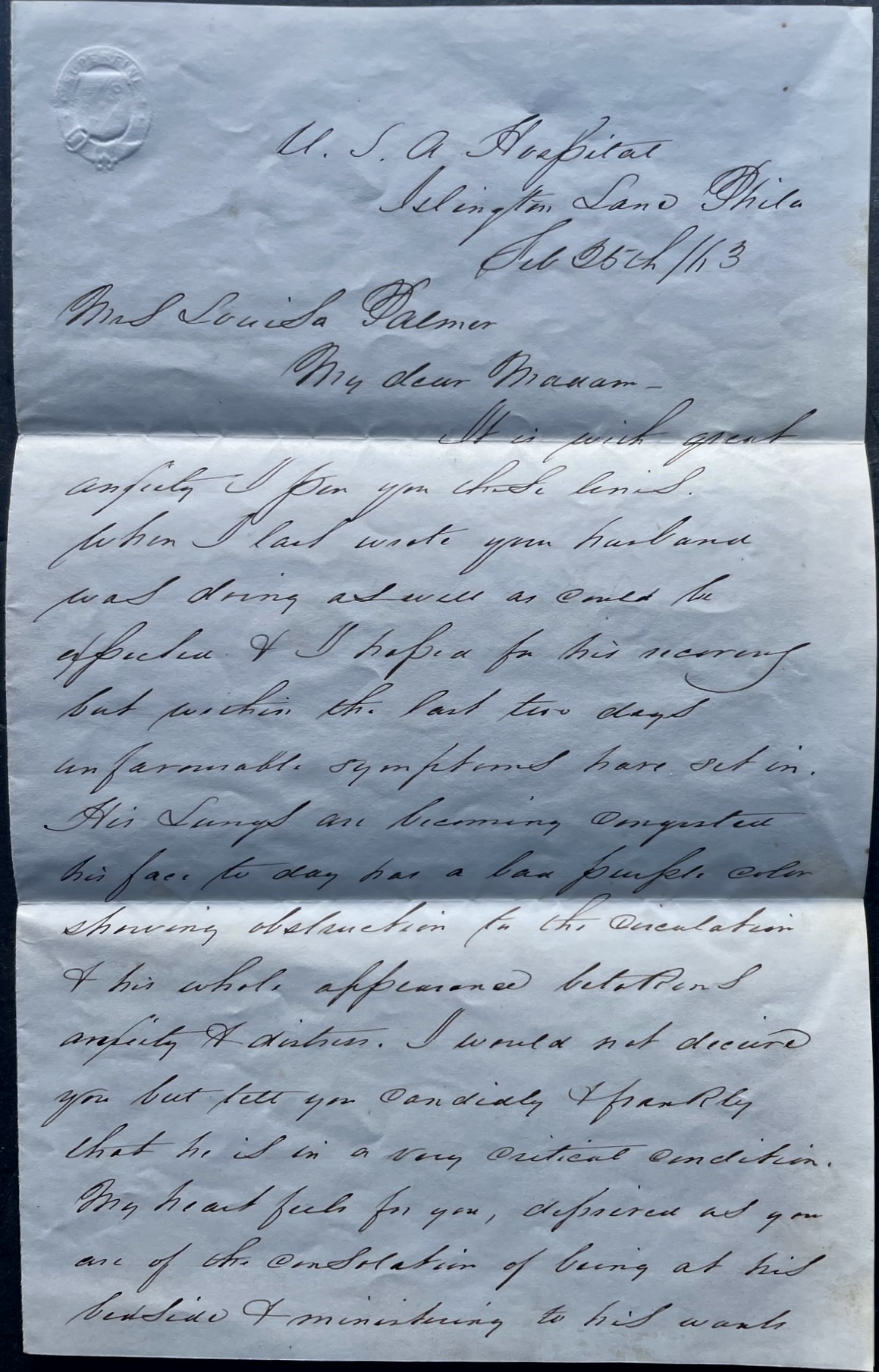
Letter from physician to widow

NH Civil War Gal

Major
* OFFICIAL *
CWT PRESENTER
Forum Host
Regtl. Quartermaster Antietam 2021
Joined
Feb 5, 2017

Please read these three letters from a doctor to the wife of George Palmer of the 19th Massachusetts Infantry.

George is in a smallpox hospital, thought he survives Antietam. I have never, ever seen such compassion or personal concern and thoroughness shown from a physician during the Civil War to a widow.
 

Please read these three letters from a doctor to the wife of George Palmer of the 19th Massachusetts Infantry.

George is in a smallpox hospital, thought he survives Antietam. I have never, ever seen such compassion or personal concern and thoroughness shown from a physician during the Civil War to a widow.
Will Griffing is amazing when it comes to transcribing letters. He's able to do it so fast too. I gave him my letters and it was probably two days before he had them all posted.
 
Will Griffing is amazing when it comes to transcribing letters. He's able to do it so fast too. I gave him my letters and it was probably two days before he had them all posted.
He helped me with one and did it in *minutes*! I don't know how he does it so fast!
 
So many of the letters written back to the family of a deceased soldier--both by the officer who had that sad responsibility and by comrades of the deceased--are so very touching. They must have been a source of comfort. It is remarkable that, with all that was going on soldiers found the time.

In my own family, it was the letters written home to Norway that fill in gaps of official records.
 
"Islington Lane" was a name unfamiliar to me, so off I went. According to one composite source, it had only 60 beds.

For those who need footnotes -
Specification of workmanship and materials necessary for the erection of a hospital and picket fence at Camp Cadwalader, on Islington Lane, Philadelphia, for the accommodation of U.S. soldiers.

The necessity for a permanent point of assemblage within the city, properly barracked and enclosed, where recruits might be housed and regiments formed, resulted in Camp Cadwalder. This camp was the most important military rendezvous in the city. It consisted of an extensive group of barracks and other buildings enclosed by a high fence and was located upon Islington Lane, east of Ridge Road. It faced the line of Twenty-second Street, the rear being toward Twentieth Street and the south side toward the German Hospital at Twentieth and Norris Streets.
 

Learn About Us
About CivilWarTalk
Contact the Webmaster
Meet the Staff
Link to CivilWarTalk
Join Our Community
Register
Browse Forums
View Today's Discussions
Search the Forum
Get Help
FAQ
Student Guide
Forum Rules & Etiquette
Copyright / DMCA

     Contact Us CivilwarTalk on Facebook CivilWarTalk on YouTube CivilWarTalk on Twitter RSS Feed

Bringing the American Civil War and More to Life.
© 1999 - , CIVILWARTALK, LLC - Site Version 10.0

SlaveryTalk.com - SecessionTalk.com - CivilWarTalk.com - ReconstructionTalk.com
Back
Top