
JPK Huson 1863
Brev. Brig. Gen'l
- Joined
- Feb 14, 2012
- Location
- Central Pennsylvania
Among the plethora of stories of astonishing women lies one who shines like a bright coin begging to be picked up, examined, marveled over and paid in memoriam in order the next generations never forget. Forget what? What these women were MADE of. If there had been an autopsy, sheer muscle and granite dust, some softening agent around the heart They're our sisters, after all.
Loyalty of Dogs brought up Kitty Payne in another thread, the ex-enslaved woman from Virginia whose futures ( she had a couple ) depended so much on a white man's whim and an apparent streak of cruelty. Her story runs like so many through Gettysburg, which means through our Great Story of continuance as a country. Flattens me, how so, so many threads entangled themselves there only to smooth themselves out and stretch variously up to 2014. Hers is just one thread to be sure. it's a good one.
"
Catherine "Kitty" Payne was a slave, born to her owner, Samuel Maddox of Rappahannock County, Virginia, and one of his slaves. She married Robert Payne, a free black, in 1836, and they had four children. When Maddox died in 1837, she and her children were left to Maddox's wife Mary who emancipated them in 1843. Mary Maddox then moved with them to Gettysburg, Pennsylvania where Robert Payne died. Maddox's nephew, however, did not recognize Mary's right to free the Payne family and so hired a band of "slave catchers" to kidnap the Payne family and return them to slavery in Virginia.
Kitty Payne fought the nephew in court, and after a year of complex proceedings, re-won her family's freedom. The Paynes then returned to Gettysburg where Kitty remarried. Kitty Payne died in 1851, but Eliza Jane, one of Kitty's daughters, was still living in Gettysburg when the Union and Confederate armies collided there in July 1863. Eliza recalled hiding during the battle, not only from shot and shell but also from Confederates roaming the town in search of blacks to abduct. Another of Kitty's children, James Arthur Payne, would later enlist in the 27th U.S. Colored Troops and fight at the Battle of the Crater. "
http://www.nps.gov/resources/person.htm?id=21
Now, here's an article which appears to leave Kitty and her children at a point in History where there is no hope, and things seem awful. Since the rest of the story is known, I'm unsure as to why there are a few websites where this is the case? One actually says " Tragically, it is unknown whether or not Kitty and her children ever had a happy life." I wonder why, when there is information out there tracking her later life, showing she did indeed over come an awful lot- at massive odds.
"The Plight of Kitty Payne and Her Children
The 1845 kidnapping of Kitty Payne, a freed Virginia slave living in Pennsylvania with her children, offers evidence of why the War Between the States had to be fought. Early one morning, five men entered the family's cabin on Bear Mountain, forced them into a wagon at knifepoint, and fled to Virginia. There Kitty languished in jail while Adams County friends and neighbors struggled to regain her freedom in the Virginia and Pennsylvania courts. After long imprisonment, Kitty and her children were freed, but because Kitty by then lacked the means to care for them, her children were separated from her and from each other, and sent to live with other Adams County families."
http://www.gettysburghistories.com/category/histories-tours/
This is a very cool article, still sans the entrance on the seen of Abraham Brian though. It DOES feature the heroism of local people resolved to end this barbarism- gives you chills reading of their solid refusal to have kidnappers just swiping people out of their shoes on their watch.
"A great great granddaughter of Kitty PAYNE published a book in 1987 about the kidnapping, Guide My Feet, Hold My Hand. The book notes, "There is no superior race of people, but there are superior people in every race." The kidnapping happened around midnight July 24, 1845, when Kitty and three children were seized, bound, gagged, and thrown into a covered wagon. The kidnappers stopped at "Myers Tavern" in Bendersville on their way south, and Charles MYERS heard the children crying in the back of the wagon. Over the next few weeks Jesse COOK, Cyrus GRIEST and William H. WRIGHT (for unknown reasons William H. Wright was not included in the account, although there is proof he was the third Quaker) gathered whatever provisions they would need for a ride to Virginia to free Kitty and her children. On their way they stopped for the night at a tavern in a place called "Little Washington". Inside they were confronted by a group of armed pro-slavery men. They were hassled, called names, and eventually forced back outside to their wagon where the men began going through their supplies. Someone shouted "Kill the Abolitionist." Cyrus Griest immediately began talking to the men trying to calm the situation. The men brushed Cyrus aside and pulled everything out of their wagon and either stole it or destroyed it. They took everything but the horses and the wagon, including the legal paperwork to prove Kitty and her children's manumission. The three Quakers were forced to turn around and return to Adams County, empty-handed. In George WILSON's journal dated August 24, 1845 (a month after the kidnapping) he wrote "J. Cook came home without the negros."
Kitty and her children were not left in the clutches of Mary Maddox's nephew. Finnegan was identified as the one who had kidnapped a family of free colored persons and carried them into slavery. A warrant was issued for his arrest in Pennsylvania, and the Payne family was taken into custody in Virginia for safekeeping. Cyrus Griest, along with fellow Quakers and African American neighbors, gave testimony at Finnegan's trial in Pennsylvania in August 1845 and also gave testimony during Kitty Payne's trial in Virginia. Charles MYERS also testified at the 1846 trial against Thomas FINNEGAN for kidnapping. Griest was involved in raising money among Adams Countians for her trial in Virginia. The trials were lengthy and well publicized. Finnegan was convicted and the Payne family was escorted once again to Pennsylvania.[The data about Kitty Payne is from Mary Goins Gandy, Guide My Feet, Hold My Hand, 11; and Mary Holton Robare, "As Truth May Direct: The Quaker Valley Quilt", in Blanket Statements, the newsletter of the American Quilt Study Group (AQSG), Gaye Ingram, ed., Lincoln, Neb. no. 91 (2008), 1-5.]"
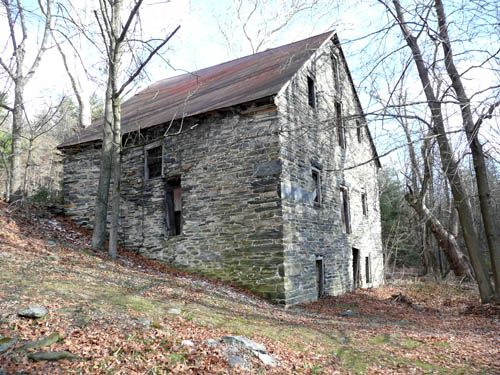
The house of Jesse Cook (1801-1855), son of Henry and Mary (Way) Cook, another active conductor and member of Menallen Meeting, is still standing. The two photos to the left provide then and now views of Cook's Mill on Possom Creek north of Bendersville, in Menallen Township. The black and white photo is from the original glass plate negative taken by William H. Tipton of Gettysburg, who worked between 1867 and 1920. The mill was part of Jesse's station on the underground railroad. Two of Jesse's daughters, 19 year old Sallie A. Cook and Elmira Jane Cook got a ride to Gettysburg, shook hands with President Lincoln, then sat on the platform and heard him give his short but powerful speech dedicating the battlefield. Sallie later married John Toner Myers and was the mother of historian Albert Cook Myers. There are many members of the Cook family interred in the Warrington Friends Meeting Burial Ground in Wellsville, York County.
Cooks Mill
Sometime after the Payne family's rescue a quilt was created with 73 signatures, including the names of some of the people involved, such as Mary Ann Griest, Jane Wright (daughter of John), and Kitty's daughter Mary Payne (1840-1928). The so-called Quaker Valley Quilt was found in a Maryland antique shop, purchased, and presented to Menallen Meeting in 2007."
http://freepages.genealogy.rootsweb.ancestry.com/~paxson/ugrr/ugrr.html
I think I found it!!
" The Quaker Valley Quilt, which was purchased in honor of William and Roseanna Wright in early 2000's, has come home to Menallen Meeting. The signature quilt was made circa 1850 and has seventy-six names, which have been researched by Menallen members Deb McCauslin and Judy Pyle. They found that most persons whose names are inscribed on the blocks had local origins, although over half had moved west, to Ohio, Indiana and Iowa. Only twenty-five of the persons actually lived in Adams County. Hiram A. Thomas, whose name appears in the middle of the quilt, married Rebecca Wright, whose name is in the lower left corner, in 1854. They moved to West Liberty, Iowa where Rebecca continued to teach school.
Of special interest is the name of Mary Payne, who was the daughter of Kitty Pain. Kitty was a freed slave living near Bendersville in July, 1845, when she and her children, including Mary, were abducted by slave-catchers and taken to Virginia, where they were kept for a year while Adams County Quakers fought in court for her freedom. When they were finally freed, they returned to Adams County and Mary went to live with the Joel and Ruth Wright family. Other names of interest on the quilt are those of Louisa Steer and Elizabeth Stone, abolitionists from Loudon Co., VA. Louisa's name appears in the Women's Meeting minutes in July 1851, saying that she had visited Menallen with a "religious concern". "
http://www.menallenfriends.org/Quaker-Valley-Quilt.php

I still have to find information about Kitty Payne becoming Kitty Payne Brian- back later!
Another longer, more in-depth article
https://scholarworks.iupui.edu/bits...ve to Freewoman and Back Again.pdf?sequence=1
Loyalty of Dogs brought up Kitty Payne in another thread, the ex-enslaved woman from Virginia whose futures ( she had a couple ) depended so much on a white man's whim and an apparent streak of cruelty. Her story runs like so many through Gettysburg, which means through our Great Story of continuance as a country. Flattens me, how so, so many threads entangled themselves there only to smooth themselves out and stretch variously up to 2014. Hers is just one thread to be sure. it's a good one.
"
Catherine "Kitty" Payne was a slave, born to her owner, Samuel Maddox of Rappahannock County, Virginia, and one of his slaves. She married Robert Payne, a free black, in 1836, and they had four children. When Maddox died in 1837, she and her children were left to Maddox's wife Mary who emancipated them in 1843. Mary Maddox then moved with them to Gettysburg, Pennsylvania where Robert Payne died. Maddox's nephew, however, did not recognize Mary's right to free the Payne family and so hired a band of "slave catchers" to kidnap the Payne family and return them to slavery in Virginia.
Kitty Payne fought the nephew in court, and after a year of complex proceedings, re-won her family's freedom. The Paynes then returned to Gettysburg where Kitty remarried. Kitty Payne died in 1851, but Eliza Jane, one of Kitty's daughters, was still living in Gettysburg when the Union and Confederate armies collided there in July 1863. Eliza recalled hiding during the battle, not only from shot and shell but also from Confederates roaming the town in search of blacks to abduct. Another of Kitty's children, James Arthur Payne, would later enlist in the 27th U.S. Colored Troops and fight at the Battle of the Crater. "
http://www.nps.gov/resources/person.htm?id=21
Now, here's an article which appears to leave Kitty and her children at a point in History where there is no hope, and things seem awful. Since the rest of the story is known, I'm unsure as to why there are a few websites where this is the case? One actually says " Tragically, it is unknown whether or not Kitty and her children ever had a happy life." I wonder why, when there is information out there tracking her later life, showing she did indeed over come an awful lot- at massive odds.
"The Plight of Kitty Payne and Her Children
The 1845 kidnapping of Kitty Payne, a freed Virginia slave living in Pennsylvania with her children, offers evidence of why the War Between the States had to be fought. Early one morning, five men entered the family's cabin on Bear Mountain, forced them into a wagon at knifepoint, and fled to Virginia. There Kitty languished in jail while Adams County friends and neighbors struggled to regain her freedom in the Virginia and Pennsylvania courts. After long imprisonment, Kitty and her children were freed, but because Kitty by then lacked the means to care for them, her children were separated from her and from each other, and sent to live with other Adams County families."
http://www.gettysburghistories.com/category/histories-tours/
This is a very cool article, still sans the entrance on the seen of Abraham Brian though. It DOES feature the heroism of local people resolved to end this barbarism- gives you chills reading of their solid refusal to have kidnappers just swiping people out of their shoes on their watch.
"A great great granddaughter of Kitty PAYNE published a book in 1987 about the kidnapping, Guide My Feet, Hold My Hand. The book notes, "There is no superior race of people, but there are superior people in every race." The kidnapping happened around midnight July 24, 1845, when Kitty and three children were seized, bound, gagged, and thrown into a covered wagon. The kidnappers stopped at "Myers Tavern" in Bendersville on their way south, and Charles MYERS heard the children crying in the back of the wagon. Over the next few weeks Jesse COOK, Cyrus GRIEST and William H. WRIGHT (for unknown reasons William H. Wright was not included in the account, although there is proof he was the third Quaker) gathered whatever provisions they would need for a ride to Virginia to free Kitty and her children. On their way they stopped for the night at a tavern in a place called "Little Washington". Inside they were confronted by a group of armed pro-slavery men. They were hassled, called names, and eventually forced back outside to their wagon where the men began going through their supplies. Someone shouted "Kill the Abolitionist." Cyrus Griest immediately began talking to the men trying to calm the situation. The men brushed Cyrus aside and pulled everything out of their wagon and either stole it or destroyed it. They took everything but the horses and the wagon, including the legal paperwork to prove Kitty and her children's manumission. The three Quakers were forced to turn around and return to Adams County, empty-handed. In George WILSON's journal dated August 24, 1845 (a month after the kidnapping) he wrote "J. Cook came home without the negros."
Kitty and her children were not left in the clutches of Mary Maddox's nephew. Finnegan was identified as the one who had kidnapped a family of free colored persons and carried them into slavery. A warrant was issued for his arrest in Pennsylvania, and the Payne family was taken into custody in Virginia for safekeeping. Cyrus Griest, along with fellow Quakers and African American neighbors, gave testimony at Finnegan's trial in Pennsylvania in August 1845 and also gave testimony during Kitty Payne's trial in Virginia. Charles MYERS also testified at the 1846 trial against Thomas FINNEGAN for kidnapping. Griest was involved in raising money among Adams Countians for her trial in Virginia. The trials were lengthy and well publicized. Finnegan was convicted and the Payne family was escorted once again to Pennsylvania.[The data about Kitty Payne is from Mary Goins Gandy, Guide My Feet, Hold My Hand, 11; and Mary Holton Robare, "As Truth May Direct: The Quaker Valley Quilt", in Blanket Statements, the newsletter of the American Quilt Study Group (AQSG), Gaye Ingram, ed., Lincoln, Neb. no. 91 (2008), 1-5.]"
The house of Jesse Cook (1801-1855), son of Henry and Mary (Way) Cook, another active conductor and member of Menallen Meeting, is still standing. The two photos to the left provide then and now views of Cook's Mill on Possom Creek north of Bendersville, in Menallen Township. The black and white photo is from the original glass plate negative taken by William H. Tipton of Gettysburg, who worked between 1867 and 1920. The mill was part of Jesse's station on the underground railroad. Two of Jesse's daughters, 19 year old Sallie A. Cook and Elmira Jane Cook got a ride to Gettysburg, shook hands with President Lincoln, then sat on the platform and heard him give his short but powerful speech dedicating the battlefield. Sallie later married John Toner Myers and was the mother of historian Albert Cook Myers. There are many members of the Cook family interred in the Warrington Friends Meeting Burial Ground in Wellsville, York County.
Cooks Mill
Sometime after the Payne family's rescue a quilt was created with 73 signatures, including the names of some of the people involved, such as Mary Ann Griest, Jane Wright (daughter of John), and Kitty's daughter Mary Payne (1840-1928). The so-called Quaker Valley Quilt was found in a Maryland antique shop, purchased, and presented to Menallen Meeting in 2007."
http://freepages.genealogy.rootsweb.ancestry.com/~paxson/ugrr/ugrr.html
I think I found it!!
" The Quaker Valley Quilt, which was purchased in honor of William and Roseanna Wright in early 2000's, has come home to Menallen Meeting. The signature quilt was made circa 1850 and has seventy-six names, which have been researched by Menallen members Deb McCauslin and Judy Pyle. They found that most persons whose names are inscribed on the blocks had local origins, although over half had moved west, to Ohio, Indiana and Iowa. Only twenty-five of the persons actually lived in Adams County. Hiram A. Thomas, whose name appears in the middle of the quilt, married Rebecca Wright, whose name is in the lower left corner, in 1854. They moved to West Liberty, Iowa where Rebecca continued to teach school.
Of special interest is the name of Mary Payne, who was the daughter of Kitty Pain. Kitty was a freed slave living near Bendersville in July, 1845, when she and her children, including Mary, were abducted by slave-catchers and taken to Virginia, where they were kept for a year while Adams County Quakers fought in court for her freedom. When they were finally freed, they returned to Adams County and Mary went to live with the Joel and Ruth Wright family. Other names of interest on the quilt are those of Louisa Steer and Elizabeth Stone, abolitionists from Loudon Co., VA. Louisa's name appears in the Women's Meeting minutes in July 1851, saying that she had visited Menallen with a "religious concern". "
http://www.menallenfriends.org/Quaker-Valley-Quilt.php
I still have to find information about Kitty Payne becoming Kitty Payne Brian- back later!
Another longer, more in-depth article
https://scholarworks.iupui.edu/bits...ve to Freewoman and Back Again.pdf?sequence=1


 Forum Host


 Bringing the