-
Welcome to CivilWarTalk, a forum about the American Civil War! - Join today! It's fast, simple, and FREE!
- Home
- Forums
- The War of the Rebellion Forums
- Battles & Events of 1861 to 1865
- Naval War - At Sea & Along Inland Waterways
You are using an out of date browser. It may not display this or other websites correctly.
You should upgrade or use an alternative browser.
You should upgrade or use an alternative browser.
Kearsarge v Alabama
- Thread starter atlantis
- Start date

- Joined
- Sep 15, 2018
- Location
- South Texas
Especially that one that hit the rudder, isn't the rudder post in some museum with a shell still embedded into it?
Nathan Stuart
1st Lieutenant
- Joined
- Apr 14, 2020
Regarding reported unexploded hits by the Alabama on the Kearsarge.
One 100-pounder shell fired by the Alabama's forward pivoted Blakely gun penetrated the Kearsarge's hull and lodged in her sternpost (a rear structure to support the rudder) but it failed to explode.
Another explosive shell fired from one of the Alabama's broadside 32-pounders struck the forward 11-inch gun of the Kearsarge but it too failed to work.
Yet another shell fired from the Alabama's forward 100-pounder Blakely gun plunged through the Kearsarge's engine room skylight but did not detonate upon impact.
Of these unexploded shells, thought the one that lodged in the sternpost would have likely been the most consequential for incapacitating the Kearsarge, if the hit had functioned properly.
(Source - 'Gray Raiders of the Sea' by Chester Hearn, @ pp. 228-29)
One 100-pounder shell fired by the Alabama's forward pivoted Blakely gun penetrated the Kearsarge's hull and lodged in her sternpost (a rear structure to support the rudder) but it failed to explode.
Another explosive shell fired from one of the Alabama's broadside 32-pounders struck the forward 11-inch gun of the Kearsarge but it too failed to work.
Yet another shell fired from the Alabama's forward 100-pounder Blakely gun plunged through the Kearsarge's engine room skylight but did not detonate upon impact.
Of these unexploded shells, thought the one that lodged in the sternpost would have likely been the most consequential for incapacitating the Kearsarge, if the hit had functioned properly.
(Source - 'Gray Raiders of the Sea' by Chester Hearn, @ pp. 228-29)
Last edited:

Old Soldier
1st Lieutenant
- Joined
- Feb 15, 2022
- Location
- Yorkshire
Yet another 'what if'. It didn't happen and the Kearsage sank Alabama. Alabama was basically a floating wreck - she had been out over two years and had been in harbor for repair/maintenance. I am sure that this period afloat may well have affected the ammunition aboard as France would not have allowed ammunition resupply.
It was a rather dicey venture actually. However there were no 'territorial waters' in those days. The French Navy ironclad Couronne escorted Alabama out of Cherbourg to ensure that the ensuing battle occurred outside the French harbor. It is on a par with the Bonhomme Richard and the Battle of Flamborough Head in 1779 - a battle fought within sight of the coast.
It was a rather dicey venture actually. However there were no 'territorial waters' in those days. The French Navy ironclad Couronne escorted Alabama out of Cherbourg to ensure that the ensuing battle occurred outside the French harbor. It is on a par with the Bonhomme Richard and the Battle of Flamborough Head in 1779 - a battle fought within sight of the coast.

 Forum Host
- Joined
- Nov 25, 2021
- Location
- Chicagoland
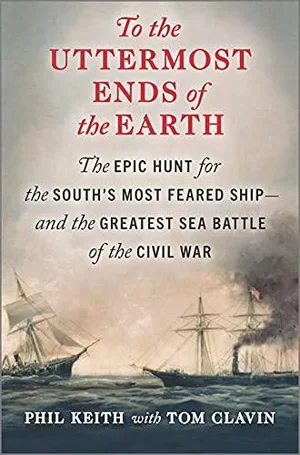
If you haven't already read it, @atlantis , you'd probably enjoy To the Uttermost Ends of the Earth by Phil Keith and Tom Clavin. It's a very good book about the Alabama's career and its final battle with the Kearsarge. I thoroughly enjoyed it, as I apparently have a "thing" for commerce raiders. It was released on April 12, 2022, so fairly new.

 www.kirkusreviews.com
TO THE UTTERMOST ENDS OF THE EARTH | Kirkus Reviews
Sturdy account of the Civil War’s most significant naval battle.
www.kirkusreviews.com

- Joined
- Feb 18, 2013
- Location
- Hoover, Alabama
I believe that it's in the museum at the Washington Navy Yard.Especially that one that hit the rudder, isn't the rudder post in some museum with a shell still embedded into it?
- Joined
- Feb 18, 2013
- Location
- Hoover, Alabama
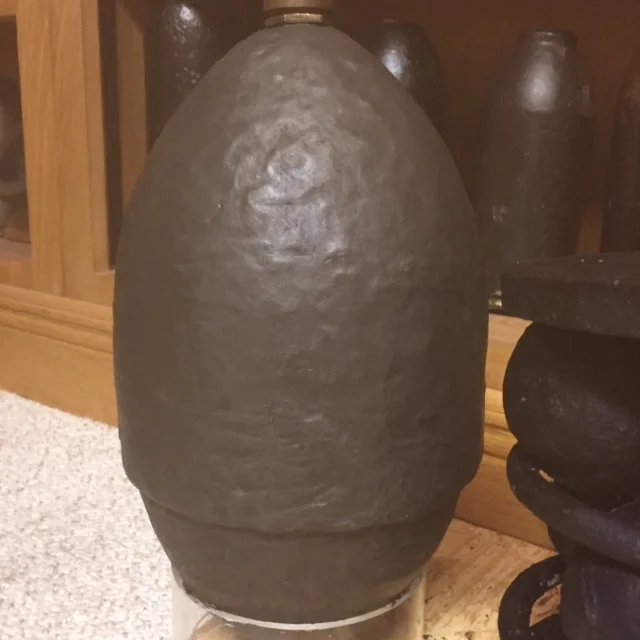
The shell in the sternpost is a 7" Britten shell.
- Joined
- Nov 25, 2021
- Location
- Chicagoland
Help me to understand what would have happened if the shot to the sternpost had detonated as expected. Does the Kearsarge:Regarding reported unexploded hits by the Alabama on the Kearsarge.
One 100-pounder shell fired by the Alabama's forward pivoted Blakely gun penetrated the Kearsarge's hull and lodged in her sternpost (a rear structure to support the rudder) but it failed to explode.
Another explosive shell fired from one of the Alabama's broadside 32-pounders struck the forward 11-inch gun of the Kearsarge but it too failed to work.
Yet another shell fired from the Alabama's forward 100-pounder Blakely gun plunged through the Kearsarge's engine room skylight but did not detonate upon impact.
Of these unexploded shells, thought the one that lodged in the sternpost would have likely been the most consequential for incapacitating the Kearsarge, if the hit had functioned properly.
(Source - 'Gray Raiders of the Sea' by Chester Hearn, @ pp. 228-29)
1. Sink?
2. Lose all steering control?
3. Continue to sail in whatever direction a jammed rudder would allow (including in circles as happened to the Bismarck)?
Had the shot through the engine room skylight detonated, would it have been sufficient to:
1. Sink the Kearsarge?
2. Leave the Kearsarge dead in the water (save for its sails)?
I'm not looking to start a fight. I'm just looking for more information. I find this very interesting and am trying to slot the information into what I know about other commerce raider experiences.
- Joined
- Sep 15, 2018
- Location
- South Texas
Sorry I knew it was a post of some kind and I was having a "Senior Moment" and called it a Rudderpost. Sternpost it is.Especially that one that hit the rudder, isn't the rudder post in some museum with a shell still embedded into it?

DaveBrt
1st Lieutenant
- Joined
- Mar 6, 2010
- Location
- Charlotte, NC
My best somewhat informed guesses:Help me to understand what would have happened if the shot to the sternpost had detonated as expected. Does the Kearsarge:
1. Sink?
2. Lose all steering control?
3. Continue to sail in whatever direction a jammed rudder would allow (including in circles as happened to the Bismarck)?
Had the shot through the engine room skylight detonated, would it have been sufficient to:
1. Sink the Kearsarge?
2. Leave the Kearsarge dead in the water (save for its sails)?
I'm not looking to start a fight. I'm just looking for more information. I find this very interesting and am trying to slot the information into what I know about other commerce raider experiences.
Sternpost -- Rudder would have been rendered useless. K. would have only been able to adjust her course by trimming the sails. This would have been totally effected by the wind speed and direction. K. would have been at a great disadvantage for the rest of the battle and would probably have been sunk by later hits (there would have been some flooding from the sternpost hit).
Skylight -- If the shell had exploded directly above the engine room, it would be like a shell exploding above an artillery battery, ie some men killed, some wounded, some damage to the engine and its supporting equipment, but not total destruction. How many of each category? Depends on pure chance. If a critical piece of machinery was damaged, K. would have had only sail power for propulsion until (if) repairs could be made. A ruptured boiler was rather likely, would kill many and put the engine out of commission for some time. A broken pump rod would have caused loss of propulsion until it was repaired -- say one half to two hours.
Both hits would have been consequential and each would have made more hits likely as K lost way and steering control.
Did France and UK have same policy on ammunition resupply?Yet another 'what if'. It didn't happen and the Kearsage sank Alabama. Alabama was basically a floating wreck - she had been out over two years and had been in harbor for repair/maintenance. I am sure that this period afloat may well have affected the ammunition aboard as France would not have allowed ammunition resupply.
It was a rather dicey venture actually. However there were no 'territorial waters' in those days. The French Navy ironclad Couronne escorted Alabama out of Cherbourg to ensure that the ensuing battle occurred outside the French harbor. It is on a par with the Bonhomme Richard and the Battle of Flamborough Head in 1779 - a battle fought within sight of the coast.
Nathan Stuart
1st Lieutenant
- Joined
- Apr 14, 2020
Thought it's a relevant question - am curious too.Help me to understand what would have happened if the shot to the sternpost had detonated as expected. Does the Kearsarge:
1. Sink?
2. Lose all steering control?
3. Continue to sail in whatever direction a jammed rudder would allow (including in circles as happened to the Bismarck)?
Had the shot through the engine room skylight detonated, would it have been sufficient to:
1. Sink the Kearsarge?
2. Leave the Kearsarge dead in the water (save for its sails)?
I'm not looking to start a fight. I'm just looking for more information. I find this very interesting and am trying to slot the information into what I know about other commerce raider experiences.
As I'm not an expert in ship design and construction, can only apply general logic and the comments of the author in response.
Also. Found the following entry in Wikipedia to possibly explain and illustrate a 'sternpost'.
...'Traditionally, the rudder was suspended from the sternpost, and the propellers descended from it. With changes in how these are positioned, in modern shipbuilding vessels are often not considered to have a sternpost'... (The illustration of a sternpost is separately shown in next post).
Logic dictates that if it's a support structure for the ship's rudder, then any serious damage to the sternpost would de-stabilize the rudder from properly functioning and possibly render the vessel unable to steer and maneuver - so it thereby might be a 'sitting duck' floating in the water.
Interestingly, the author of 'Gray Raiders of the Sea', Chester Hearn, at page 228, describes the hit as follows:-
..."About 15 minutes after the engagement started, Semmes got his lucky shot. Up to now, the Alabama had been firing twice as fast as the enemy, but the fire had been wild. After shouting at the gunners to aim lower and make their shots count, Semmes watched as a shell penetrated the Kearsarge's hull and lodged in her sternpost. A few anxious seconds passed, then he realized that it had failed to explode. Semmes wrote: 'If the cap had performed its duty and exploded the shell, I should have been called upon to save Captain Winslow's crew from drowning, instead of his being called upon to save mine. On so slight an incident - the defect of a percussion cap - did the battle hinge. The enemy was very proud of this shell. It was the only trophy they ever got of the Alabama.'..."
I thought what Semmes wrote in the above may have been an over-estimation of the effects of the shell that impacted the sternpost, if had exploded.
Perhaps one of the forum experts can more fully explain the likely consequences of a 100-pounder shell exploding on the ship's sternpost.
Nathan Stuart
1st Lieutenant
- Joined
- Apr 14, 2020
Below is an illustration of the traditional ship's sternpost taken from Wikipedia. (It's a side elevation of a sailing ship with the sternpost highlighted).


rebelatsea
Captain
- Joined
- Mar 30, 2013
- Location
- Kent ,England.
A sternpost detonation would be unlikely to sink the ship, destroy the rudder and cables almost certainly, and cause leakage. It may also damage or obstruct the screw, depending on where it hit.Help me to understand what would have happened if the shot to the sternpost had detonated as expected. Does the Kearsarge:
1. Sink?
2. Lose all steering control?
3. Continue to sail in whatever direction a jammed rudder would allow (including in circles as happened to the Bismarck)?
Had the shot through the engine room skylight detonated, would it have been sufficient to:
1. Sink the Kearsarge?
2. Leave the Kearsarge dead in the water (save for its sails)?
I'm not looking to start a fight. I'm just looking for more information. I find this very interesting and am trying to slot the information into what I know about other commerce raider experiences.
The shot that came through the engine room skylight would be more likely to cause personell casualties unless it came into contact with the engine itself.
Old Soldier
1st Lieutenant
- Joined
- Feb 15, 2022
- Location
- Yorkshire
Apparently so. They would not supply or allow the supply of munitions or weapons to warships (specifically) to prolong a war in which they were declared neutrals. They would allow the normal resupply of merchant ships and THAT resupply was all that was allowed to warships - food, water, rope, canvas. It also allowed repair for seaworthiness only. It also still disallowed the 'pressing' of British nationals for beligerent warships or privateers. It is certainly in the Royal Proclamation, but I have not seen any French equivalent (Napoleon III was then currently Emperor who could also issue proclamations.), however it was applied at Cherbourg.Did France and UK have same policy on ammunition resupply?
Apparently it followed the same principles as British neutrality and actively followed the British stance. France did not want to act alone so the British Royal Proclamation set the stance for BOTH countries. France followed a month later. France was actively engaged in Mexico at the time and was watching it's back, especially since the USA issued threats that anyone recognising the Confederacy was an act of war.
It is notable thet the Royal Proclamation concentrated on warships, up gunning or rearming ships and privateering. This was a continuation of the measures brought in during the War of 1812 and was still seen as the only direct way of preventing support for either side. The supply of arms was included in so much as the GOVERNMENT would not supply arms. Even though the Union complained bitterly about the supply of arms to the South, they were never GIVEN. They were bought - by both sides - the Union BOUGHT 400,000 P53s, the South, 500,000. The Union stopped buying around 1863 when supplies of M1861s were adequate. The number supplied to the South dropped after 1863 with the increasing effectiveness of the Blockade and lack of payment. The numbers are based on the contracts dispatched, not the number received.
BTW - During WW1 when the USA was neutral, Winchester, Eddystone and Remington made P1914 rifles for Britain. Just as well they did as Springfield could not produce enough M1903s in 1917 (rather like 1861!) and a quick modification for 30-06 ammunition enabled the three companies to provide 2 million M1917s equipping 75% of the AEF. Not a lot of Americans like to know that.
Old Soldier
1st Lieutenant
- Joined
- Feb 15, 2022
- Location
- Yorkshire
Yes, that is the TRADITIONAL stern post and was used on the older paddlewheel frigates. However USS Kearsage was a SCREW frigate This needed a new design - a two-stage stern post to support the screw shaft and bearings AND the rudder - a sort of box shape. Look at these two Kearsarge sections:Below is an illustration of the traditional ship's sternpost taken from Wikipedia. (It's a side elevation of a sailing ship with the sternpost highlighted).
View attachment 578851
Note the two posts at the screw AND the rudder. Both these could be described as 'sternpost'. There are no photos of Kearsarge in dry dock being repaired, just the extracted ball and post. One site puts the shell at the TOP of the rudder post. The only evidence I could find was this, which I shall use as the definitive:

The Building of a Wooden Ship
TheModelShipwright.com offers reprint of historic shipbuilding book Written by noted naval draftsman and model shipbuilder Charles G. DavisThe Building of a Wooden Ship Captures a moment in history…
www.themodelshipwright.com
The rudder was attached to the RUDDER POST.
And while I was searching for the dud shell photos, despite the heading to that photo, I noted that the description in the US Navy museum is called the RUDDER POST. The long rounded cavity in one side would have been used for a rudder pivot.
So, at the end of all this research , I am still confused.
Nathan Stuart
1st Lieutenant
- Joined
- Apr 14, 2020
Thanks for the extra information and particularly the photograph.
- Joined
- Nov 25, 2021
- Location
- Chicagoland
Was there any time limit imposed on a commerce raider (or a commissioned warship like the Kearsarge for that matter) for making repairs in a neutral harbor during the Civil War? It doesn't seem like it as the Alabama was in Cherbourg for more than 72 hours which was all the Graf Spee was originally allowed at Montevideo in a later war.
If a Union merchantman had been in port at Cherbourg when the Alabama arrived, would it have been given a 24-hour head start when it wanted to leave or could the Alabama have gone after it immediately? The reason I'm asking is that this delaying tactic was used at Montevideo as well.
If the 72-hour limit and the 24-hour delay came about later, did the impetus for those changes come from the Civil War or later (possibly from World War I)?
Thank you for bringing the book Gray Raiders of the Sea to my attention. Another fine title to add to my list for the interlibrary loan librarian at my village library.
If a Union merchantman had been in port at Cherbourg when the Alabama arrived, would it have been given a 24-hour head start when it wanted to leave or could the Alabama have gone after it immediately? The reason I'm asking is that this delaying tactic was used at Montevideo as well.
If the 72-hour limit and the 24-hour delay came about later, did the impetus for those changes come from the Civil War or later (possibly from World War I)?
Thank you for bringing the book Gray Raiders of the Sea to my attention. Another fine title to add to my list for the interlibrary loan librarian at my village library.
Old Soldier
1st Lieutenant
- Joined
- Feb 15, 2022
- Location
- Yorkshire
There are no details like that in the Royal Proclamation. It was left to the individual harbormasters and , of course, the local RN officer. This was pretty common in those days - there was no written set of instructions - or we would have some now! Note that the French Navy ensured the Alabama left the harbor, or rather, the Kearsarge would attack AFTER she had left the harbour.Was there any time limit imposed on a commerce raider (or a commissioned warship like the Kearsarge for that matter) for making repairs in a neutral harbor during the Civil War? It doesn't seem like it as the Alabama was in Cherbourg for more than 72 hours which was all the Graf Spee was originally allowed at Montevideo in a later war.
If a Union merchantman had been in port at Cherbourg when the Alabama arrived, would it have been given a 24-hour head start when it wanted to leave or could the Alabama have gone after it immediately? The reason I'm asking is that this delaying tactic was used at Montevideo as well.
If the 72-hour limit and the 24-hour delay came about later, did the impetus for those changes come from the Civil War or later (possibly from World War I)?
Thank you for bringing the book Gray Raiders of the Sea to my attention. Another fine title to add to my list for the interlibrary loan librarian at my village library.
I suspect that the Alabama was in need of much more repair and maintenance. However, the history was as follows (my emphasis):
- Arrival: The ship dropped anchor in Cherbourg Harbor on June 11, 1864, for repairs, coaling, and to land prisoners, having its boilers and machinery serviced.
- Blockade: On June 14, 1864, the Union warship USS Kearsarge arrived and began blockading the Alabama in the harbor.
- Departure: Captain Raphael Semmes decided to challenge the Kearsarge and sailed out of the harbor on June 19, 1864, to face the battle that would result in the Alabama being sunk
- The Treaty of Washington (1871): Following the American Civil War, this treaty between the U.S. and Great Britain established standards for neutral obligations, partly as a response to the Alabama claims (British-built ships for the Confederacy).
- https://history.state.gov/historicaldocuments/frus1872p2v1/d3
"That a neutral government is bound –
First, to use due diligence to prevent the fitting out, arming, or equipping, within its jurisdiction, of any vessel which it has reasonable ground to believe is intended to cruise or carry on war against a power with which it is at peace; and also to use like diligence to prevent the departure from its jurisdiction of any vessel intended to cruise or carry on war as above, such vessel having been specially adapted, in whole or in part, within such jurisdiction, to warlike use.
Secondly. Not to permit or suffer either belligerent to make use of its ports or waters as the base of naval operations against the other, or for the purpose of the renewal or augmentation of military supplies or arms, or the recruitment of men.
Thirdly. To exercise due diligence in its own ports or waters, and, as to all persons within its jurisdiction, to prevent any violation of the foregoing obligations and duties."
(Most of those were contained in the Royal Proclamation.)
Note that Switzerland had made itself a neutral country within Europe, starting in 1516 and officially recognized in the Treaty of Westphalia of 1648 and further rarified in the 1815 Congress of Vienna, so was more knowledgeable on the subject of Neutrality than most, hence the Geneva setting for the Conference.
Similar threads
- Replies
- 4
- Views
- 132

- Replies
- 8
- Views
- 131
- Replies
- 27
- Views
- 353

- Replies
- 12
- Views
- 390
Similar threads

- Replies
- 21
- Views
- 22

- Replies
- 5
- Views
- 126

- Replies
- 13
- Views
- 170
- Learn About Us
- ►About CivilWarTalk
- ►Contact the Webmaster
- ►Meet the Staff
- ►Link to CivilWarTalk
- Join Our Community
- ►Register
- ►Browse Forums
- ►View Today's Discussions
- ►Search the Forum
- Get Help
- ►FAQ
- ►Student Guide
- ►Forum Rules & Etiquette
- ►Copyright / DMCA
 Bringing the