Well, I haven't read it quite yet—I'm saving it for when I finish my own novel. But I have heard some things about the plot, and I'm not quite sure I like the sound of it.
1) Having James drop the accent doesn't quite have the effect that I think Percival Everett wanted it to. It creates the statement that some ways of speaking are just inherently better thank others, that someone's worth is tied to how well they can speak "properly." I know people IRL who actually do sound like Jim does in the original, and I'm sure that they would be very distressed to know they are perpetuating racist stereotypes every time they open their mouths!
I know this isn't what Everett intended, but it's what it comes across as.
2) Tying into the first point, Jim is much more learned here. But there's a difference between learned and intelligent. Jim was already plenty intelligent in the original novel. It's not unrealistic—there were plenty of educated slaves—but it's not the Jim we know and love.
3) Jim's daughter Elizabeth is no longer deaf. I don't know why.
4) I really like the twist close to the end
where Huck is actually Jim's biological son,
but I'm not sure that I like how it's done. There's almost no explanation for how this state of affairs came to be—what was going on there? Also this makes
the scene where Jim has to choose between Norman and Huck REALLY REALLY STUPID—who's he going to save, this guy who he's known for two weeks, or his actual son?
5) So the ending has been changed. Again, I understand why, but that doesn't mean I have to like it. There's a lot more thematic elements and layered narrative in the end of Adventures of Huckleberry Finn than a lot of people realize. Everett ditching the original ending for more of an action thriller ending sort of felt like he was sacrificing narrative depth for stuff blowing up.
6) The timeline is different. The original had a late 1840s setting. Everett moves it forward by almost a decade and a half, so it takes place during the Civil War. Which destroys one of the most fascinating implications of Adventures of Huckleberry Finn—if Huck was 13 in 1848, then he'd be 26 in 1861…
So all those changes combined make it too distant from Twain's work for me. Which is a shame because the concept of the story is solid!
Regardless, it's probably one of the better Adventures of Huckleberry Finn knockoffs out there.
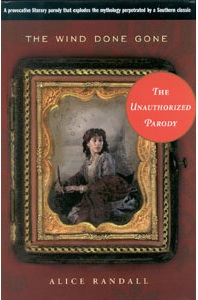
I guess its a play on The Wind Done Gone, an irreverent copyright-friendly satire of GWTW from a slave's perspective. I've never read it but it's probably funny.
The thing is, Gone With the Wind actually is racist, so I have no problem with picking it apart. But James takes an already anti-racist work and says, "No, this isn't good enough," which ironically almost seems to make it more racist. (Yes, I know Everett is Black, but I don't think the audience he was writing for is.)
I guess its a play on The Wind Done Gone, an irreverent copyright-friendly satire of GWTW from a slave's perspective. I've never read it but it's probably funny.
I have read it. There is absolutely nothing funny about it. It's very dark (and no, that's not a pun on skin color). Margaret Mitchell's estate certainly did not consider it copyright friendly.
Songwriter Randall’s audacious, highly controversial (the Margaret Mitchell estate is not amused) debut retells Gone With the Wind from the point of view of Scarlett O’Hara’s mulatto half-sister.
I have read it. There is absolutely nothing funny about it. It's very dark (and no, that's not a pun on skin color). Margaret Mitchell's estate certainly did not consider it copyright friendly.
Songwriter Randall’s audacious, highly controversial (the Margaret Mitchell estate is not amused) debut retells Gone With the Wind from the point of view of Scarlett O’Hara’s mulatto half-sister.
James has been short-listed for the 2024 Booker Prize.
Wikipedia describes the Booker Prize this way:
The Booker Prize, formerly the Booker Prize for Fiction (1969–2001) and the Man Booker Prize (2002–2019), is a prestigious literary award conferred each year for the best single work of sustained fiction written in the English language, which was published in the United Kingdom and/or Ireland. The winner of the Booker Prize receives £50,000, as well as international publicity that usually leads to a significant sales boost.[1] When the prize was created, only novels written by Commonwealth, Irish, and South African (and later Zimbabwean) citizens were eligible to receive the prize; in 2014, eligibility was widened to any English-language novel—a change that proved controversial.[2][3]
The Foundation's mission is to celebrate the best literature in America, expand its audience, and ensure that books have a prominent place in American culture.
I read it and greatly enjoyed it. I think it's best not to get too involved in comparing it to Huckleberry Finn. It certainly is based on it, but it has a life of it's own, and a very enjoyable one at that!
James was just named Barnes & Noble's book of the year. It also just won the National Book Award for fiction. It did not, however, win the Booker Prize.

 Forum Host




 Bringing the