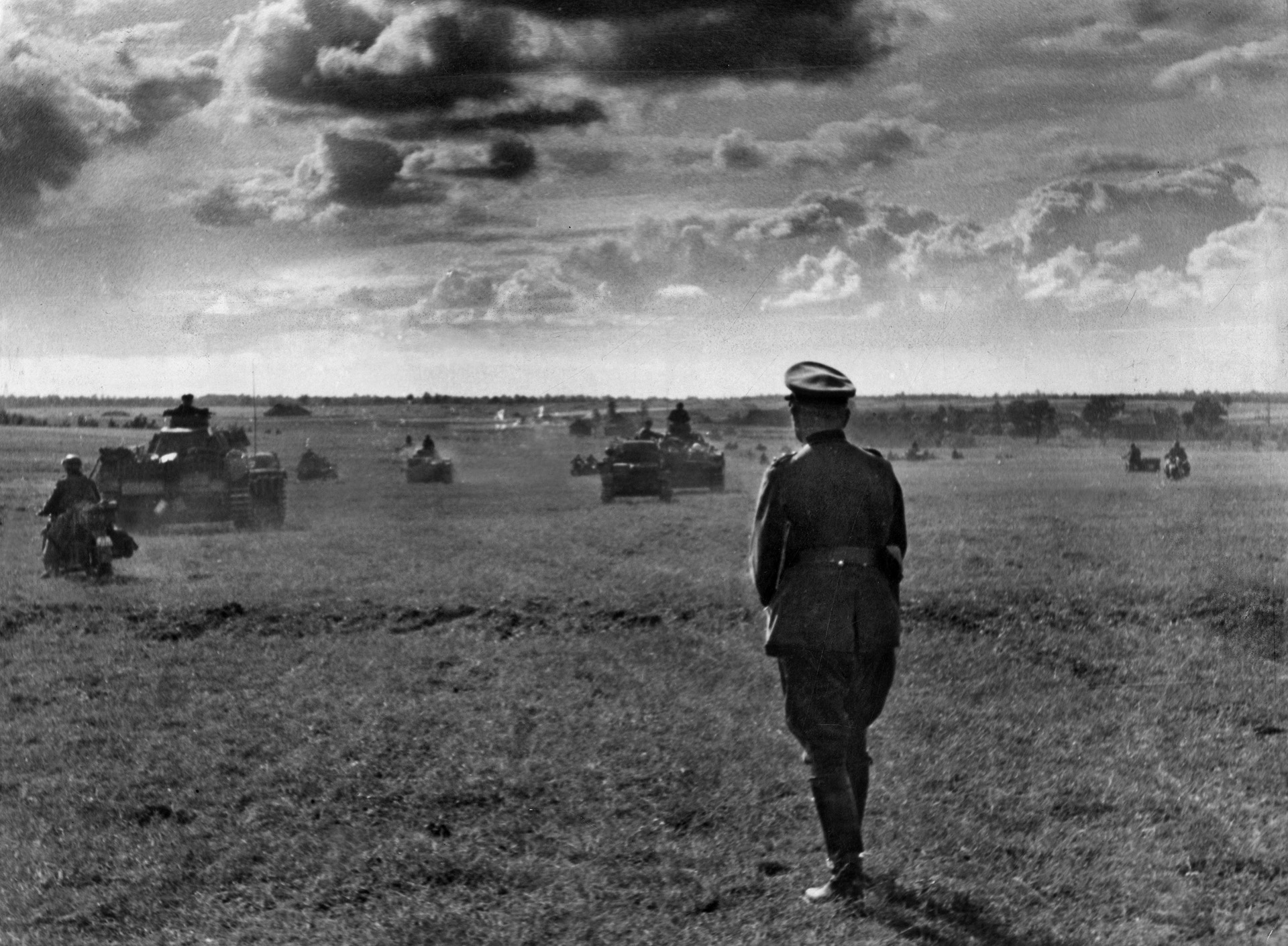
Is this true?

Joined
Jul 6, 2025
I read that a German officer was an observer in JEB Stuart's Invinceables. At that time cannon were permanently emplaced for a battle. Stuart pulled his with horses to where he thought most effective. He used them with great efect.
When the officer returned to Germany he wrote a book about Stuart's tactics. General Hasso von Manteuffel read the book and designed the blitxkrieg from Stuart's use of mobile cannon
 
GERMAN OBSERVATIONS AND EVALUATIONS OF THE U.S. CIVIL WAR: A STUDY IN LESSONS NOT LEARNED
KAY BRINKMANN, LTC, GERMAN ARMY
U.S. Army Command and General Staff College
MASTER OF MILITARY ART AND SCIENCE
Fort Leavenworth Kansas
2000
Approved for public release; distribution is unlimited. The opinions and conclusions expressed herein are those of the student author and do not necessarily represent the views of the U.S. Army Command and General Staff College or any other governmental agency. (References to this study should include the foregoing statement.)

ABSTRACT
Helmuth von Moltke's alleged statement the U.S. Civil War was an affair in which two armed mobs chased each other around the country and from which no lessons could be learned underlines a grave misjudgment of this war in contemporary Germany. Today, however, the American Civil War is recognized as the first modern war. It produced a number of lessons across the strategic operational and tactical levels that shaped the face of war. But the German observers failed to draw significant conclusions at the time. A wide variety of reasons inhibited a thorough and unbiased analysis. This study aims to analyze the German observations and to arrive at the causes that led to the underestimation and disregard of the lessons from the Civil War. The thesis provides a sketch of the Civil War and the situation of contemporary Germany. It then examines the German observers and their evaluations. Thereafter, the author reflects selected essential lessons of the war against the contemporary German military evolution. In a final step the conclusions of these sections will merge into an analysis of the causes, which prevented the German army from arriving at the lessons of the U.S. Civil War.


HTHs,
USS ALASKA
 

Attachments

There are two stories here that I think have conflated. Von Borcke rode with Stuart - his German saber is in the Gettysburg Visitor Center collection. Artillery tactics had changed after the Mexican War. During the 1840s, artillery was "foot artillery" for the most part, Served by crews who marched alongside, the guns were slow to move and not very responsive to changes in the tactical situation. But horse batteries, then called "Flying artillery" had been demonstrated to be a flexible and nimble way to put artillery right where you wanted it. The Ringgold Flying artillery became heroes of that war and their commander Samuel Ringgold one of the early heroes because of his dramatic battlefield death. Before that, Ringgold had instituted structural changes in the artillery branch that basically created the branch as it was known during the Civil War.
I don't think the Germans learned blitzkrieg from the American Civil War. They clearly weren't paying attention to the effect of weapons and fortifications from their performance in the 1870 French war. Had it been anyone else but the 2nd Empire they would have been in trouble with the kind of casualties they were willing to take on the offensive. Von Moltke's right hook of 1914 looks more like the blitzkrieg, and it nearly succeeded.
 
I read that a German officer was an observer in JEB Stuart's Invinceables. At that time cannon were permanently emplaced for a battle. Stuart pulled his with horses to where he thought most effective. He used them with great efect.
When the officer returned to Germany he wrote a book about Stuart's tactics. General Hasso von Manteuffel read the book and designed the blitxkrieg from Stuart's use of mobile cannon
Flying Artillery from the Mexican War predates Ol' JEB.
 
General Hasso von Manteuffel read the book and designed the blitxkrieg from Stuart's use of mobile cannon

This is a myth for two reasons:

1. Mobile artillery existed before the American Civil War. Germany had better examples such as Solferino in 1859. That involved the French and Austrians - armies the Prussians actually respected.

IIRC, the infamous Tom Carhart book used Solferino as an example of artillery rolling forward to support an infantry assault. (Carhart assumes Lee had somehow been able to study that battle's tactics.)

2. Blitzkrieg is a lot more than just mobile cannon. If Stuart's horse artillery inspired anything it would be basic tank tactics. And that's a big if, as noted in #1.

Blitzkrieg is about using mechanized forces to achieve breakthroughs then penetrate deep behind enemy lines, creating pockets of cut-off enemies to be eliminated at leisure by the non-mechanized troops following behind.

Von Moltke's right hook of 1914 looks more like the blitzkrieg, and it nearly succeeded.

Not at all. It was Napoleonic tactics on a grand scale. There was no speed involved, just foot sloggets.

Blitzkrieg requires mechanized warfare which 1914 most assuredly was not.
 
This is a myth for two reasons:

1. Mobile artillery existed before the American Civil War. Germany had better examples such as Solferino in 1859. That involved the French and Austrians - armies the Prussians actually respected.

IIRC, the infamous Tom Carhart book used Solferino as an example of artillery rolling forward to support an infantry assault. (Carhart assumes Lee had somehow been able to study that battle's tactics.)

2. Blitzkrieg is a lot more than just mobile cannon. If Stuart's horse artillery inspired anything it would be basic tank tactics. And that's a big if, as noted in #1.

Blitzkrieg is about using mechanized forces to achieve breakthroughs then penetrate deep behind enemy lines, creating pockets of cut-off enemies to be eliminated at leisure by the non-mechanized troops following behind.


Not at all. It was Napoleonic tactics on a grand scale. There was no speed involved, just foot sloggets.

Blitzkrieg requires mechanized warfare which 1914 most assuredly was not.
That's a fair point. I was thinking in terms of applying overwhelming force at a weak point, rather than across a broad front. But you are right, the speed of advance was completely limited to how fast the infantry could walk.
 
So that we're all on the same page with meaning, here is an excellent explanation of Blitzkrieg and its background from Time Ghost: What Actually is Blitzkrieg?

That channel (which I highly recommend) is off-topic for CWT, but I hope that since the linked video in question deals specifically with the topic at hand it is acceptable in context. Notably, the video makes no mention of any 19th century antecedents.

I was thinking in terms of applying overwhelming force at a weak point, rather than across a broad front.
Yes, but in 1914 that "weak point" was an entire flank - not the entire front, but still a broad front.

To put in Civil War terms: the Schlieffen Plan is Bragg's plan for the first day at Stones River and Blitzkrieg is Longstreet's column attack on the final day of Chickamauga...except Longstreet's brigades are all clones of the Lightning Brigade.

Wilder's Lightning Brigade at Tullahoma is probably the closest Civil War equivalent to Blitzkrieg.
 
When the officer returned to Germany he wrote a book about Stuart's tactics. General Hasso von Manteuffel read the book and designed the blitxkrieg from Stuart's use of mobile cannon
Pure hogwash.
We can start from the fact that there never was a German doctrine called Blitzkrieg. And what they did in 1940-41 was really just old Prussian maneuver warfare with new toys... and a good deal of corp and division commanders deliberately losing contact to high command, bending orders and outride going against orders...

But the German observers failed to draw significant conclusions at the time. A wide variety of reasons inhibited a thorough and unbiased analysis. This study aims to analyze the German observations and to arrive at the causes that led to the underestimation and disregard of the lessons from the Civil War.
I have read this one in the past. And it is full of nationalistic mythmaking.

The Prussians defeated Austria in 3 weeks and the French in a few month.
This showed how you won wars in a quick and effective manner.. and in the case of France an enemy armed with much more modern firearms than what was used during the civil war.

The war in north American showed how not to do things.
Starting with the issued from not having a general staff, not having a plan for mobilizing an actual army, not having a trained reserve for it, not having the needed arms and uniforms in stock and so on...

One lesson that was noted by Von Moltke (the elder) was the advantage of having a military railroad organization.
He was writing about the military use of railroads as early as the 1840ties... before Prussia actually had a rail road network. So the ide of using the railroads to move troops was in no way new by 1861 (and was done by the frence to a much bigger extent in 1859, then during the civil war)

But having a military organization to both run RRs and control them was new.
 
Last edited:
Hasso von Manteuffel was a name unfamiliar to me. Looking him up, he was a general during the Battle of the Bulge, but he was only a Major at the start of the war. Whatever his thoughts on mobile warfare in the late 1930s he would have been overshadowed by much more prominent figures like Heinz Guderian and Erwin Rommel.

I suspect the myth in question originated as someone's attempt to explain away the Battle of Bulge as the Germans using American tactics.
 
Foot artillery was horse-drawn artillery which acompanied infantry columns and marched at their rate. They were to support the infantry in the field on contact with the enemy. They were relatively light gun. Anything heavier was in the train and designated as 'siege' artillery to be used on fortresses and heavily engineered defences.
Horse artillery was light artillery to accompany cavalry on strategic moves. They were fast to keep up with the cavalry. Their job was to support the cavalry until the main force arrived or to disperse enemy cavalry.

The only thing the Germans did was to design and manufacture fast-firing artillery with steel barrels. That was what helped them to defeat France in 1871.
 
Tanks in the second world war basically assumed the traditional role of Heavy calvary in Europe and North Africa
NO. US Army tanks were basically used for infantry support as the foot artillery used to be. 'Heavy' cavalry had all but vanished from European armies by this time. The US Army was starting that in 1860.

Blitzkrieg was a new idea to replace the traditional Schlieffen Plan (1914 - infantry, cavalry, artillery) with fast-moving tanks supported by accompanying infantry and air support in place of artillery. The 'old' infantry and artillery followed up to occupy land or to defeat any heavily defended areas which were avoided and bypassed by the more mobile Panzers. Blitzkrieg cannot be easily compared to older warfare tactics and strategies.

The Brits used slow, heavily armored 'Infantry Tanks' to support infantry (Matilda, Churchill) and 'cruiser tanks' - fast and more lightly armored to replace all cavalry (Crusader, Cromwell), developing new tactics and vehicles as they went on ending in the 'medium tank' concept. (Can support infantry directly as well as take on enemy armor and defended positions)
 
"Fast Heinz" Guderian is the name you all are looking for.

IMG_3018.jpeg

Giderian, author of the Blitz Krieg, in his half track command vehicle in 1940. Note the Enigma Machine & radio operators essential for the success of his revolutionary tactics.

Link:


Guderian's books are almost all published in German. Achtung-Panzer & Panzer Leader are in English & available online for a moderate sum.
 
Last edited:
Hasso von Manteuffel was a name unfamiliar to me. Looking him up, he was a general during the Battle of the Bulge, but he was only a Major at the start of the war. Whatever his thoughts on mobile warfare in the late 1930s he would have been overshadowed by much more prominent figures like Heinz Guderian and Erwin Rommel.

I suspect the myth in question originated as someone's attempt to explain away the Battle of Bulge as the Germans using American tactics.

The Blitz Krieg doctrine was created by General Hienz Guderian. His book, "Achtung-Panzer" is the seminal treatise on blitz tactics.
 
I have read this one in the past. And it is full of nationalistic mythmaking.

Interesting sir, which nation is doing the 'mythmaking'? The author of the paper is a Lt Col of the German Army.

But having a military organization to both run RRs and control them was new.

Baron 'Ruffian' von Roon seemed to have a handle on the railway issues...

He needed his vulgar Kriegsminister quite as much as he needed his armorer, for Roon, in his own way, was a genius; designing railroad systems, he was perfecting a plan for speedy mobilization which would discount the numerical superiority of Prussia's potential enemies.

And American railroads were commercial entities until called upon to serve during wartime with government oversight / control. Germany seemed to have defensive uses planned into her network from the beginning.

...thanks to the foresight of the Generalstab, four double railroad lines ran straight across the Reich, with feeder lines which had been laid with swift assembly in mind.

The above Italicized from The Arms of Krupp: 1587-1968 by William Manchester

Cheers,
USS ALASKA
 
Prussian absorption of U.S. lessons in the military uses of railroads.
Kelley, John P.
Master of Military Art and Science Theses
United States Army

HTHs,
USS ALASKA
 

Learn About Us
About CivilWarTalk
Contact the Webmaster
Meet the Staff
Link to CivilWarTalk
Join Our Community
Register
Browse Forums
View Today's Discussions
Search the Forum
Get Help
FAQ
Student Guide
Forum Rules & Etiquette
Copyright / DMCA

     Contact Us CivilwarTalk on Facebook CivilWarTalk on YouTube CivilWarTalk on Twitter RSS Feed

Bringing the American Civil War and More to Life.
© 1999 - , CIVILWARTALK, LLC - Site Version 10.0

SlaveryTalk.com - SecessionTalk.com - CivilWarTalk.com - ReconstructionTalk.com
Back
Top