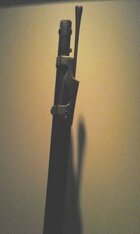
Identify John Burns' Musket?

Claude Bauer

First Sergeant
Forum Host
Joined
Jan 8, 2012
Anyone know what type of flintlock musket this is? I'm not that familiar with non-military arms or flintlocks in general. Apparently it's supposed to represent his personal firearm, which he ditched pretty quickly for an Enfield that he actually used in the battle. This must be a replacement added for the photo, which was taken after the battle, because he didn't return from battle with a firearm.

jb5.jpg
 
Last edited:
So the musket in the picture must be a prop. (And not a very good one at that, since as "yankee hoorah" points out, some of it is missing!) He left for the battle with a flintlock musket--I've haven't found a reference to what kind other than it was old. The poem about him describes it only as "his long brown rifle."

This somewhat romanticized painting has him firing a flintlock at the Confederates, but he switched to an Enfield he got from a wounded soldier before going into battle.

JohnBurnsBig.jpg
 
Last edited:

Yes! Newell Convers Wyeth, known as "N. C. Wyeth," an American artist and illustrator, did the John Burns painting above.

Not to be confused with his son, Andrew Newell Wyeth, a realist painter whose most recognizable piece "Christina's World" is below (Christina suffered from polio and her lower body was paralyzed, which is why she's in that awkward position).

Expired Image Removed
 
Last edited:
Where's the rest of it?
Anyone know what type of flintlock musket this is? I'm not that familiar with non-military arms or flintlocks in general. Apparently it's supposed to represent his personal firearm, which he ditched pretty quickly for an Enfield that he actually used in the battle. This must be a replacement added for the photo, which was taken after the battle, because he didn't return from battle with a firearm.

View attachment 51747
It looks to be missing the rest of the wood on the
weapon from the 2nd barrel band is located.
 
Looks like my next trip to Gettysburg will include a visit to the Gettysburg Seminary Ridge Museum where they supposedly have John Burns' musket! A visitor posted this fuzzy picture of the display case on the Internet--I think it says:

"Musket -- Manufacturer Royale St Etienne France 17--(?) ... Said to have been owned by John Burns resident of Gettysburg who volunteered to fight on July (?) from the collection of John White Johnson(?) who purchased John Burns relics as early as 1915(?) ... Adams County Historical Society." That's all I can make out.

https://www.flickr.com/photos/mandersonpics/9440933872/

There does appear to be a French manufacturer of arms, the Manufacture d'armes de Saint-Étienne, a French state-owned manufacturing company located in the town of Saint-Étienne that produced infantry muskets, some of which were used in the Revolutionary War and after, so it's possible that Burns had one, either handed down to him or picked up as surplus.

Can anyone identify the musket in the display case?
 
Last edited:
Burns was a War of 1812 vet, right? I recall an account in which some of the Union soldiers told him he needed to go back home or he might get hurt. All I remember was his answer; "I know how to fight. I've fit before."
 
If the assumption is that Burns showed up with his musket from the War of 1812 it ought not to be a model 1816. I have tried to see closely what the musket is from the lock. The hammer on the early muskets was usually flat, the later ones somewhat beveled. I can't tell from this photo which this is, but if it is the musket he was issued in the War of 1812, it is most likely some variant of the 1795 Springfield, probably the 1808 contract musket variant. Although there was a model 1812 musket it was not issued until just after the war ended. I do understand that he showed up in the old swallowtail regimental jacket, period hat and powder horn for the musket and if he appeared like this on a smoke shrouded battlefield it must have looked to his companions that he was a ghostly apparition come back to defend his country once again.
 
It was very common to sporterize old military muskets by cutting most of the forestock off, and soldering the front rammer thimble to the barrel, just like the one in the Burns photo. There are thousands of Civil War era muskets that suffered the same fate. "Poor man's shotguns" they were called. I'm guessing that that musket was another of Burns - unless he left the one he started out with on July 1st in someone's doorway or something, I suspect that it got lost on the field. He started out that morning with the Bucktail Brigade, and they sent him down the line to the left, where he hung out a while with the 7th Wisconsin. (His monument is behind their regimental location.) If they gave him a musket, it was an 1861 Springfield. The Iron Brigade boys kept shifting him farther left, so he was actually with every regiment, eventually ending up in that terrible firefight with the 24th Michigan. When he was wounded and the brigade retired, he threw away his musket, buried his cartridges and "infiltrated" back home. There's a photo taken of him after the battle with a modern military musket. Look at his eyes. He was a tough old bird. One of those "You kids get off my lawn" types.
 
I have a book with a photo of Burns taken a few days after the battle. He is shown on an upstairs porch with a musket leaning against the wall but it's not he one he is usually pictured with. The one taken on the upstairs porch seems to be a full stocked musket and flintlock and the location seems to be different, at the head of the stairs.
 
I can actually find a couple studio pictures of Burns, several different poses but obviously taken at the same time (same clothes, background and musket). in those, he's carrying a Springfield 1861. I doubt it's the battle musket, though, because it has a bayonet fixed. I doubt the old man went through that nonsense. HOWEVER, I think the boys in the Iron Brigade looked him up after the fighting stopped, and gave him a musket as a momento. His house isn't but a stones throw from their positions on Steven's Hill. That may be the "presentation" gun. There's also a photo of him cradling an 1842 smoothbore; you can identify it by the distinctive nosecap. I think that one's a studio prop because none of the units he fought beside carried that musket, and it was considered mildly obsolete by 1863. His monument at Gettysburg depicts the 1842, probably modeled from that photo. His is one of my favorite monuments because it's nearly ground level and life-sized. It's an action pose showing the old man advancing, looking west in the enemy's direction and his left hand is held low, but clenched in a fist. Great statue.
 
Yes, indeed, I just went out there this week to take another close look at the position near McPherson's Woods and his monument. I believe, though, that he was wearing a swallow tail, long coat that day and not the short jacket he is wearing in the monument image. As for those other photos if you have the one where he is posed above the steps look closely at the musket. My eyes may have it wrong but it looks like a flintlock that is fully stocked, not the cut down musket in the more famous photo.
 
No, you're right - the monument shows Burns wearing a sack coat. I don't know why the sculptor did that; the legend of the old man in the antique swallow-tail coat was already established. That musket in the porch photo is different too! It's long-barrelled, but the forestock has been shortened on that too.
 
I went to the Seminary Ridge Museum in Gettysburg today and saw the musket that is "said to have been owned" by John Burns. Tried to get some decent photos, but it's in the corner of a display case with low light in a dark room. I tried to lighten them up as best I could.

Here is the description of the musket:

John Burns Display.jpg


So if this was the flintlock musket he took into battle, it was quite old by the time of the Civil War, being a model 1763-1777. As noted previously, he supposedly went into battle with this musket and then ditched it for an Enfield, which leaves us to wonder how this firearm made it back to him, considering that he was unarmed when he left the field.

Here's a shot of the end of the barrel and the ramrod:
JB musket 1.jpg


Here's the lock and trigger--not great I know, but believe me, you can't see it much better than this in real life the way they have it displayed:

JBMusket 2.jpg


I also went to the John Burns monument on the battlefield. As noted by others, the sculptor has him toting an Enfield and wearing a different coat that the one described in the accounts of his participation. I guess he didn't want him to look as eccentric as he really did with his swallow tail coat and beat up top hat:

JB Monument 2.jpg


Here is what the inscription says:

Burns monument 1.jpg


Bottom line is that I think the John Burns story is full of holes and inconsistencies and nobody except him knows what really happened that day. Regardless of what firearm he used or how he was dressed, it's evident that he was there, he did fight, and he was wounded three times. For that he deserves the recognition he's received.

"I want a chance to shoot!"

--John Burns, as recounted by Colonel Wister, 1863
 

Attachments

  • JB musket 1.jpg
    JB musket 1.jpg
    125.6 KB · Views: 452
Last edited:
Without being able to read the lock I would say to be cautious about the musket being French from the 1760's, though quite a few of those stayed in America as this was the musket given by the French to Continental forces and those troops were permitted to take home their muskets in 1783 when demobilized. But the US model 1795 was a dead wringer for the French musket as that model served as the template for the Springfield of 1795. You would have to be able to read the lock to be certain. As for how Burns got it back, if you were a local picking up discarded muskets and ran into this one to who else could it have belonged? In 1863 not even Confederate militia would have been carrying something like this.
 
Without being able to read the lock I would say to be cautious about the musket being French from the 1760's, though quite a few of those stayed in America as this was the musket given by the French to Continental forces and those troops were permitted to take home their muskets in 1783 when demobilized. But the US model 1795 was a dead wringer for the French musket as that model served as the template for the Springfield of 1795. You would have to be able to read the lock to be certain.

You obviously have extensive knowledge of the subject, and I appreciate your interest in figuring this out--the next time I'm up there, I'll see if I can get a better look at that lock plate and let you know what it says.

As for how Burns got it back, if you were a local picking up discarded muskets and ran into this one to who else could it have belonged? In 1863 not even Confederate militia would have been carrying something like this.

That's certainly a plausible explanation, however, one could imagine any number of scenarios that might explain how this musket made it's way back to him, if indeed it ever did--for example, he could have told someone where he left it and sent them back to fetch it; a soldier from one of the units he fought with may have recognized it and returned it to him; etc. However, none of these have a historical basis, so until some evidence on this point emerges, it will have to remain a mystery. (One account has him getting the Enfield from a wounded solider before leaving for the battlefield not after he arrived with his flintlock. If that were the case, he could have taken the flintlock home and it never even made it to the battlefield--another plausible scenario, but again, it can't be proven. As I said before, I think only John Burns knows what really happened that day.)
 

Learn About Us
About CivilWarTalk
Contact the Webmaster
Meet the Staff
Link to CivilWarTalk
Join Our Community
Register
Browse Forums
View Today's Discussions
Search the Forum
Get Help
FAQ
Student Guide
Forum Rules & Etiquette
Copyright / DMCA

     Contact Us CivilwarTalk on Facebook CivilWarTalk on YouTube CivilWarTalk on Twitter RSS Feed

Bringing the American Civil War and More to Life.
© 1999 - , CIVILWARTALK, LLC - Site Version 10.0

SlaveryTalk.com - SecessionTalk.com - CivilWarTalk.com - ReconstructionTalk.com
Back
Top