How practical were 2 pound cannons?

major bill

Brev. Brig. Gen'l
Forum Host
Joined
Aug 25, 2012
Civil War lessons learned from the deployment of 2 pound cannons.

While mobile these would not pack much of a punch. While the Army did have a few 2 pound cannons during the Civil War, did the use of 2 pound cannons during the Civil Wsy justify pursuing the cocept of 2 pound cannons?

Was there a practical post Civil War use for these Hotchkiss 2 pound cannons? Did the Army develop tactics that employed these? Perhaps despite their mobility, cavalry commanders still thought they slowed down their movement too much.

Even an improved 2 pound cannon was still a 2 pound cannon.
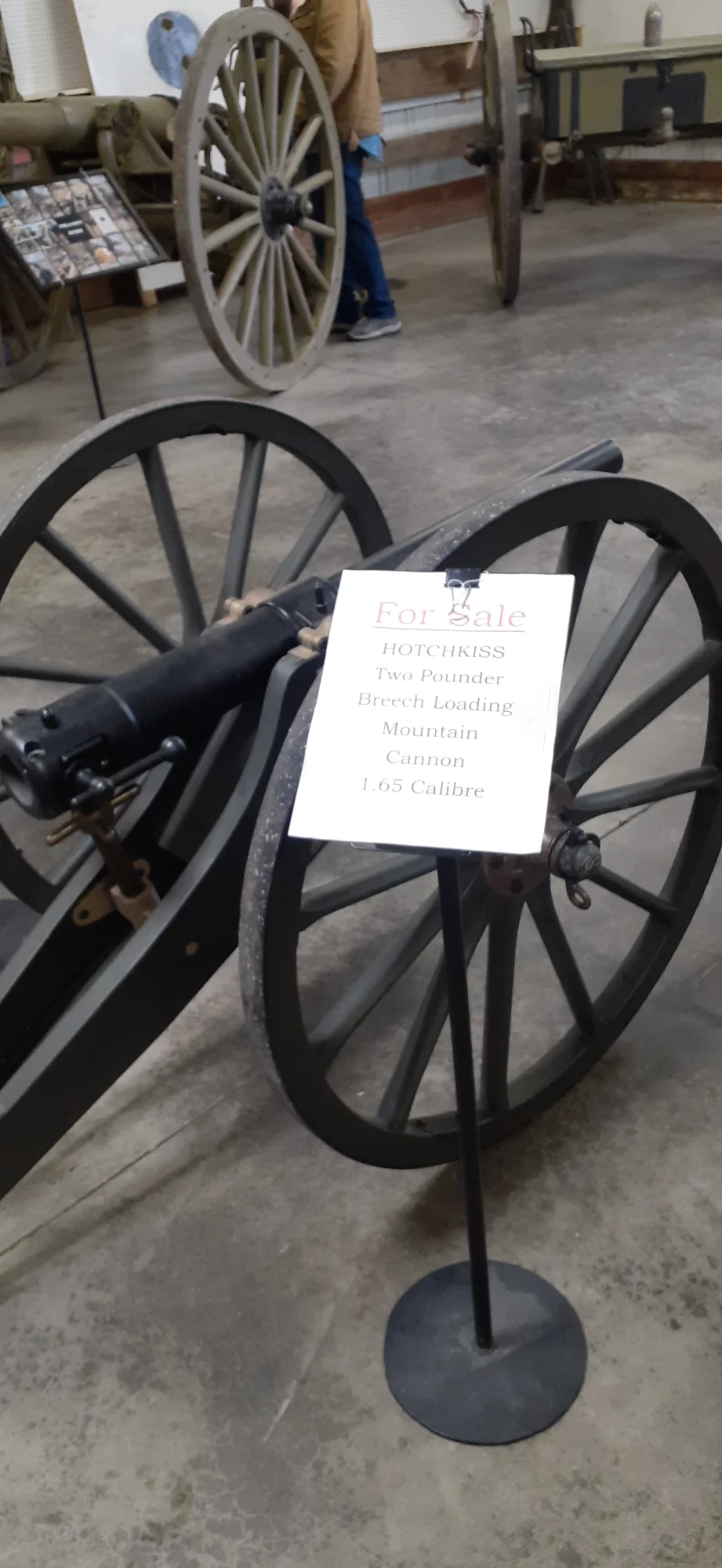

20250503_120422.webp
 
Last edited:
It seems like the lessons learned from the mountain artillery/mountain howitzers would apply to the 2 pdrs. They are light and easy to haul along with troops with minimal effort, and work well when the enemy ether does not have artillery or better artillery. But they don't do well against enemies with the field artillery that comes with larger organized military forces.
In short, they are good against irregulars, gorillas, and subjugating indigenous peoples. But don't do well against enemies like the Army of Northern Virginia and other similar armies.
 
It seems like the lessons learned from the mountain artillery/mountain howitzers would apply to the 2 pdrs. They are light and easy to haul along with troops with minimal effort, and work well when the enemy ether does not have artillery or better artillery. But they don't do well against enemies with the field artillery that comes with larger organized military forces.
In short, they are good against irregulars, gorillas, and subjugating indigenous peoples. But don't do well against enemies like the Army of Northern Virginia and other similar armies.
An interesting analogue is the 3 lb gun used in the AWI. It was routinely used as a "battalion" gun by the RA, attached to infantry units. It had a little more impact than these 2 lb guns but not a whole lot and was inferior against an army equipped with the 6 lb gun or the 12 lb gun. Its prevalence was primarily due to its mobility in an era when using horse teams required the use of civilian contractors and horses for that purpose were hard to come by in NA. The 3 lb gun often could be transported by one horse and, if not, by two.
 
An interesting analogue is the 3 lb gun used in the AWI. It was routinely used as a "battalion" gun by the RA, attached to infantry units. It had a little more impact than these 2 lb guns but not a whole lot and was inferior against an army equipped with the 6 lb gun or the 12 lb gun. Its prevalence was primarily due to its mobility in an era when using horse teams required the use of civilian contractors and horses for that purpose were hard to come by in NA. The 3 lb gun often could be transported by one horse and, if not, by two.

It is interesting that the 1841 bronze six pounder was revolutionary. At first the ordinance folks came up with an iron six pounder… I forget what it weighed. The rule of thumb was X 300% to allow for casting flaws. Even though it was much more expensive to cast, the durability & relative light weight of the bronze guns won out.

Mr. Newton's law being as it is, doubling the weight of the projectile from 3 to 6 pounds was an exponential increase in fire power.
 
It would be a terrible counterbattery gun, but a great anti-personnel weapon. The little 3 pounders and swivel guns of the generation before were fast loading street clearers with a load of grapeshot or a bag of musket balls down the barrel. I think the 2 pounder would be useful for the same purpose.
 
It would be a terrible counterbattery gun, but a great anti-personnel weapon. The little 3 pounders and swivel guns of the generation before were fast loading street clearers with a load of grapeshot or a bag of musket balls down the barrel. I think the 2 pounder would be useful for the same purpose.

I believe a famous French artillerist referred to that kind of thing as "… pif-poof…" The only ones I have ever seen referred to in the Civil War were just signal guns.
 
If talking actual effects and casualties inflicted probally rather minimal.

But psychological effects against those not experiencing cannon fire, or those thinking they sheltered behind wall/building ect would imagine at times would be effective. Think they often surprised natives facing them.

Whether worth hauling around for those instances would be up to commanders i reckon.

They were certainly a limited use gun in era/ACW. Besides Hotchkiss the Woodruff gun is associated to ACW courtesy of Abraham Lincoln.

 
Last edited:
2 pound cannons came in to wide use in the 1930s and were effective anti tank and anti aircraft guns through most of World War Two.
 
This discussion of three pounders does beg the evolution leading to the Hotchkiss designed in 1875.
U.S. Army Model 1875 Hotchkiss Mountain Gun


Ideally suited to the highly mobile rough terrain of the Indian Wars, the Hotchkiss replaced muzzle loading artillery. For a history read more here.

Link


1779838750097.webp

16 ounce shells were in accordance with prohibition on less than 14 ounce exploding ammunition fired at white people… the 19th Century, gotta love it.

Hotchkiss went on to invent a five barrel revolving 37 mm cannon. Unlike the Gatling gun, the single block Hotchkiss design was more robust. I was not satisfied with the links I found. This one provides the basics. Anyone who the a better one please post it. See more here.

Link


Today the 30mm automatic antiaircraft machine gun has been revived for a whole new type of warfare. Read more here.

Link

 
Last edited:
Small caliber guns, as well as just about all other calibers, are examples of the field artillery's search to find an artillery system that is a balance between firepower and mobility. The AWI 3-pounders had mobility, but not a whole lot of firepower. Ringgold's battery, with its lightweight bronze guns and stock trail carriages in the Mexican War was a pretty good system providing support to the infantry at the time and place where it was needed. There are examples in the CW, of course, but the point is that the 6-pounder quickly became obsolete.

Probably the best example of what I'm trying to say is from WW1. Although not a bonafide historical source, the movie, The Fighting 69th, gets the point across rather well. At the end of the film, Jimmy Cagney is shown using a 3-inch Stokes mortar. (If you've seen pictures of an 81mm mortar, that's what it essentially looked like.) Once the infantry went over the top, wire communications to the artillery Fire Direction Centers became virtually impossible because of cut wires. Timed, rolling barrages outstripped the infantry that was bogged down in the mud leaving them without artillery support. Couriers for several reasons were not an option. The Stokes mortar gave the infantry the immediately responsive fire support that the artillery could not.

Firepower and mobility remain a basic tenet of artillery tactics, but since WW1, communications have become equally important. It's no accident that a Redleg's motto is, Shoot. Move. Communicate.
 
2 pound cannons came in to wide use in the 1930s and were effective anti tank and anti aircraft guns through most of World War Two.
Different 2 pdr. Early WW II British tanks were equipped w/them (A9, A10,A13, Matilda II and early Crusaders). Good enough to knock out eearly German panzers.

What's the price on the hotchkiss?
 
Different 2 pdr. Early WW II British tanks were equipped w/them (A9, A10,A13, Matilda II and early Crusaders). Good enough to knock out eearly German panzers.

What's the price on the hotchkiss?
More than I could pay so I did not ask
 
While easy to pack and move, these small gun's small projectiles couldn't be expected to do much damage. The 2# Woodruff fired a
lead ball and the Ellsworth Gun fired a 1.43" projectile, neither of which would do much to intimidate an opponent unless they didn't have any artillery.

Bolts.webp
 
The 4th Iowa Cavalry used a captured Hughes 2-pounder breechloader to good effect at the skirmish that took place at Hill's Plantation near Vicksburg on June 22, 1863. They were attacked by a larger force of Confederate cavalry from Wirt Adams Mississippi Cavalry and the 28th Mississippi Cavalry, but because of the terrain they were forced to charge down a road, and the Hughes cannon blasted them with cannister at close range. After the fight the Confederates reported that they had over 40 horses killed in the action.
 
2 pound cannons came in to wide use in the 1930s and were effective anti tank and anti aircraft guns through most of World War Two.
Neither use has anything to do with ACW. 2 pdr At guns were also rather quickly obsolete in WW2.

Woodruff guns were definitely ACW, Hotchkiss was used in indian wars i think which would be loosely era.

It possible a odd 2 livre french gun may been somewhere from Mexican War.

1000000996.webp
 
It is interesting that the 1841 bronze six pounder was revolutionary. At first the ordinance folks came up with an iron six pounder… I forget what it weighed. The rule of thumb was X 300% to allow for casting flaws. Even though it was much more expensive to cast, the durability & relative light weight of the bronze guns won out.

Mr. Newton's law being as it is, doubling the weight of the projectile from 3 to 6 pounds was an exponential increase in fire power.
Just a minor addendum regarding "revolutionary" (pun intended): I assume you're accounting for the light 6 lb bronze gun that was standard issue to the RA in the AWI. The weight/mobility "issue" for that gun was the then-standard "bracket" carriage. They had some iron 6 lb guns but the predominant 6 pounder was the bronze tube.
 
Just a minor addendum regarding "revolutionary" (pun intended): I assume you're accounting for the light 6 lb bronze gun that was standard issue to the RA in the AWI. The weight/mobility "issue" for that gun was the then-standard "bracket" carriage. They had some iron 6 lb guns but the predominant 6 pounder was the bronze tube.

I was not climbing over fence into Belfoured's patch. I have a memorized history of the 1841 model history presentation for visitors.
 

Learn About Us
About CivilWarTalk
Contact the Webmaster
Meet the Staff
Link to CivilWarTalk
Join Our Community
Register
Browse Forums
View Today's Discussions
Search the Forum
Get Help
FAQ
Student Guide
Forum Rules & Etiquette
Copyright / DMCA

     Contact Us CivilwarTalk on Facebook CivilWarTalk on YouTube CivilWarTalk on Twitter RSS Feed

Bringing the American Civil War and More to Life.
© 1999 - , CIVILWARTALK, LLC - Site Version 10.0

SlaveryTalk.com - SecessionTalk.com - CivilWarTalk.com - ReconstructionTalk.com
Back
Top