Lieutenant Colonel J.W. Mallet, who was in charge of the Confederate States Central Laboratory at Macon Georgia, devised a shell having a polyhedral cavity instead of a conical or spherical one in order to provide for a definite number of pieces when it burst.
In explanation of his improvement, Colonel Mallet said that it obviously was not a matter of indifference into what number of pieces the shell might separate on bursting that if the pieces were very small the destructive effect of each would be insignificant while on the other hand if the pieces were large and few in number the chance of objects in the neighborhood being hit would be slight.
With the size of the fragments known in order to produce a certain effect, it was clearly desirable that the shell should burst into as many pieces of that size as possible and the fragments should be projected as equally as possible in all directions about the center of explosion.
As ordinary shells then made were either spherical or elongated it was almost impossible to tell along which lines the case would break since the interior surface was symmetrical and parallel to the exterior.
To effect the desired object, Colonel Mallet proposed to cast shells with the polyhedral cavity so that there would be certain lines of least resistance along which the shell would be certain to separate.
Prior to the invention of this device the efforts to cause the shell to burst into equal parts had been confined to the shrapnel shell and the segment shell.
In both of these types the walls of the case were thin and enclosed a definite number of pieces of metal which would scatter as the shellburst.
It was a matter of indifference as to how large or how small the pieces of the case became. In the use of this new form of shell for the 6, 12, 24 and 32 pounders the cavities were completely filled with powder.
Musket or rifle powder always gave the best results with the 6 pounder and fine grained cannon powder was suitable for the others.
The Federal artillery paid the Confederate service the compliment of appreciating the improvements in shells and in 1867. General Henry L Abbot of the Corps of Engineers in a report on siege ordnance used during the war stated that there were two improvements in mortar shells introduced by the Confederates which in his judgment should be adopted into the United States service.
He did not state who was responsible for the innovations in the Confederate service but the reference was to the shells perfected by Colonel Mallet and to the providing of certain mortar shells with ears to permit greater ease of handling.
[from The Photographic History of The Civil War Volume 5; page 190]


 Forum Host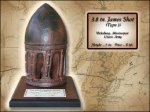


 Bringing the