The Jackson Greys/Grays a.k.a. Withington's Jackson Greys a.k.a. Jackson Light Infantry (Jackson, Jackson County) formed in 1858 under the name of the Jackson Light Infantry. In the fall of 1860, twenty Jackson Greys – under the command of Captain W.M. Bennett - attended the Michigan Uniformed Militia encampment in Jackson Michigan. There they were ranked ninth on the 1860 Michigan Uniformed Militia order of merit. Before the start of the Civil War Captain William H. Withington replaced Captain Bennett as company commander
. In 1861, they had 40 state owned rifled muskets.
In April 1861 President Lincoln requested troops from Michigan; the Jackson Greys were the first Michigan militia company to offer their service to the Federal Government. The state accepted their offer and the Jackson Greys joined the 1st Michigan Three Month Volunteer Infantry Regiment as Company B. They were entrusted with the honor of being the regimental color company.
The Michigan Adjutant General Report of 1860 only indicates that they wore gray uniforms, but the following period accounts tells us that The Jackson Greys wore grey coatees faced with red or crimson and trimmed with lace. Their trousers were gray with red stripes. For full dress occasions they wore Bearskin shakos. For fatigue duties, the Jackson Greys replaced their grand full dress uniforms with a more simple dress of grey jackets and gray trousers with red stripes. For fatigue duties their bearskins were replaced with blue caps.
The local newspapers describe the Jackson Greys uniforms differently and to get a clear understand of what they wore the various accounts must be studied. For example a article from the American Citizen stated that they adopted grey dress coats with red trimming and facings and "tastily ornamented with gold lace and buttons' and grey pants with stripes and bearskin shako or grenadier hats with a very stylish top.
[ii] The Detroit Daily Advertiser article published in September of 1860 gives the uniforms of the Jackson Greys as being gray dress coats
[iii] with crimson facings, trimmed with lace. The article goes on to say that the Jackson Greys wore gray pants with red stripes.
[iv]
According to a Detroit Free Press article of September 1 1860, the Jackson Greys wore gray dress coats and pants trimmed with red. Bearskin shakos were worn with their dress uniforms. For fatigue duties gray jackets and gray pants were worn. Blue caps replace the bearskins for fatigue duties.
[v]
Their uniforms were probably mixed to provide several optional dress options, for example, their blue caps likely replaced the bearskins during disagreeable weather.
A photograph of a re-enactor in a replica uniform shows a short gray double-breasted jacket with eight or nine gilt buttons. The sleeves have blue turnbacks with a possible vertical blue patch. The sleeves have four gilt buttons. There are large dark-blue or black epaulets, with white fringe. White belts are worn and the kepi is gray with a dark blue or black band with a gilt badge on front. The authenticity of this on line photograph is possibly based on a photograph of a member of the Jackson Grays.
The photograph shows a dark gray nine button double breasted jacket with dark colored collar with open gold lace button holes with the underlying dark color showing in the center. There are gilt buttons on each button hole lace. The sleeves have a rectangular black slash without points. The slash has 4 gilt buttons. The sleeves also have a dark turnback. The epaulettes are black with white semi-circle of white cord. The fringe on this is white. The cross strap and belt are white and the belt plate and cross strap have standard U.S. types. The trousers are gray with a watch chain tucked into a watch pocket. The headgear shown is a black bearskin with two light colored tassels. In a reconstructed uniform on display the dark color is shown as black. Why this does not match period accounts of red trim unknown.
A photograph said to be of the Civil War era Jackson Grays can be found in the book Centennial of the Incorporation of Jackson shows the company in gray coatees. The men wear gray triple breasted tail coats with nine buttons. With their tail coats they wear gray trousers, possibly with dark strips. For head gear they wear spiked helmets. Their belts are black with rectangular plates. Three of them wear a light colored sash across their bodies. Three men appear to wear kepis. The Officer wears a double breasted frock coat with 8? Buttons. The officer has gray trousers. He wears a spiked helmet. Although the photograph is titled The Jackson Grays entrain for volunteer service April 29 1861, with Captain Wm H. Withington in command it may not be from the Civil War era.
[vi]
They had their own small band, known as The Jackson Greys Band (Jackson, Jackson County). The uniforms worn by this band are unknown. During 1860, The Silver Band (Jackson, Jackson County) was also associated with the Jackson Greys. The Silver Band accompanied the Jackson Greys when they attended the 1860 Michigan Uniformed Militia encampment may in fact be the same band known as the Jackson Greys Band. The Silver Band likely wore distinctive uniforms; however, the style of uniforms worn by them remains undiscovered.
William H. Withington later ws the Colonel of the 17th Michigan Infantry. He became a brevet Brigadier General in 1865.
[ii] Jackson Light Infantry. The American Citizen (Jackson), December 15 1859, p. 3, col.1.
[iii] This newspaper article is probably is referring to coatees.
[iv] "The Encampment at Jackson", Detroit Daily Advertiser, August 30, 1860, p. 2, col. 1.
[v] "The State Encampment", Detroit Free Press
, September 1 1860, p. 1, col. 2-4.
[vi] Centennial of the Incorporation of Jackson, Jackson Centennial, Jackson Mi., 1929, p. 16. The photograph is credited to Mrs. J. S. Emmons. The photograph does not seem to match the period descriptions of the Jackson Grays. The photograph may show the Jackson Grays from a later period.
 Forum Host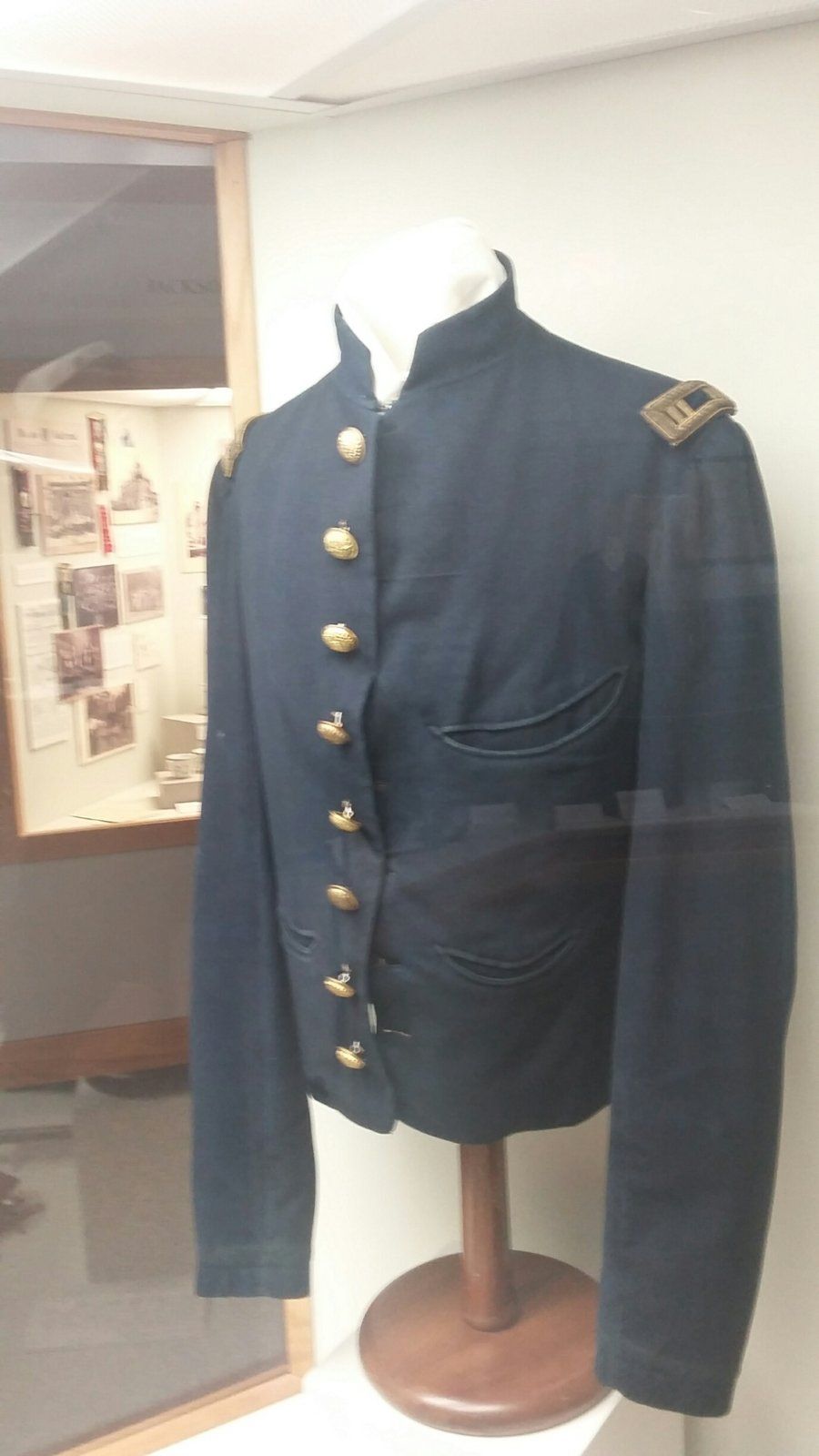


 Bringing the