For Just One Moment In Time

DBF

1st Lieutenant
Forum Host
Joined
Aug 6, 2016
An exile from home splendor dazzles in vain
Oh give me my lowly thatched cottage again
The birds singing gaily that came at my call
And gave me the peace of mind dearer than all
Home, home, sweet, sweet home
There's no place like home, there's no place like home!

(John Howard Payne - Lyrics)

A few weeks after the battle at Chancellorsville in the spring of 1863 - civil war soldiers were treated, for a brief moment in time, to a concert of regimental bands provided by both the Union and Confederate soldiers. Both sides were camped by the Rappahannock River approximately 1 mile from each other. "Yankee Doodle" was heard as "Dixie" was sent back from the boys in gray to those in blue. Soldiers of both sides sang along to the beloved song - "Home Sweet Home".

Unknown-2.jpeg

Richmond Virginia born John R. Thompson (1823-1873) wrote and dedicated a poem of this unity through music. He titled his poem "Music in Camp" and here it is (with some pictures [all in the Public Domain] to remind us of those that served in the bands).

Two armies covered hill and plain,
Where Rappahannock's waters
Ran deeply crimsoned with the stain
Of battle's recent slaughters.

The summer clouds lay pitched like tents
In meads of heavenly azure;
And each dread gun of the elements

Slept in its hid embrasure.

The breeze so softly blew it made

No forest leaf to quiver,
And the smoke of the random cannonade
Rolled slowly from the river.

And now where circling hills looked down
With cannon grimly planted,
O'er listless camp and silent town,
The golden sunset slanted.

When on the fervid air there came
A strain, now rich, now tender,
The music seemed itself aflame,

With day's departing splendor.

A Federal band, which eve and morn

Played measures brave and nimble,
Had just struck up with (lute and horn
And lively clash of cymbal.

Down flocked the soldiers to the banks
Till, margined by its pebbles,
One wooded shore was blue with "Yanks,"
And one was gray with "Rebels."

Then all was still, and then the band
With movements light and tricksy,
Made stream and forest, hill and strand,

Reverberate with "Dixie."
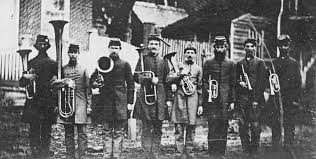
Unknown-3.jpeg


The conscious stream, with burnished glow,
Went proudly o'er its pebbles,
But thrilled throughout its deepest flow
With yelling of the Rebels.

Again a pause, and then again
The trumpet pealed sonorous,
And "Yankee Doodle" was the strain
To which the shore gave chorus.


The laughing ripple shoreward flew
To kiss the shining pebbles,
Loud shrieked the crowding Boys in Blue

Defiance to the Rebels.
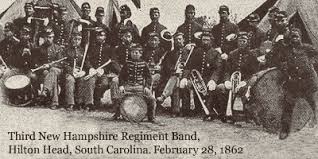
Unknown-1.jpeg


And yet once more the bugle sang
Above the stormy riot;
No shout upon the evening rang,
There reigned a holy quiet.

The sad slow stream its noiseless flood
Poured o'er the glistening pebbles:
All silent now the Yankee stood,

And silent stood the Rebels.

No unresponsive soul had heard

The plaintive note's appealing,
So deeply "Home, Sweet Home," had stirred

The hidden founts of feeling.
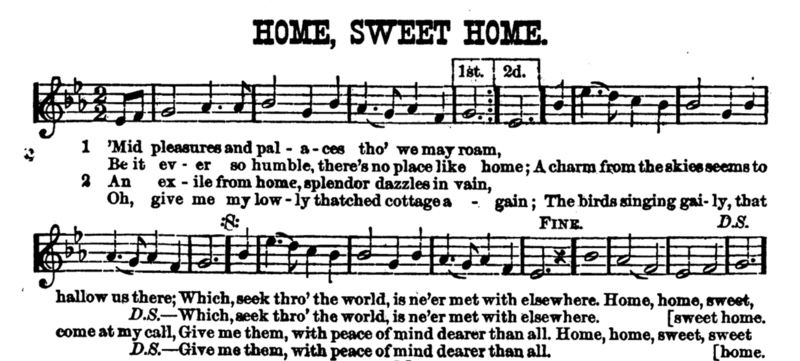
fullsizeoutput_1249.jpeg


Or Blue or Gray the soldier sees,
As by the wand of fairy,
The cottage 'neath the live-oak trees,

The cabin by the prairie.

Or cold or warm his native skies

Bend in their beauty o'er him;
Seen through the tear-mist in his eyes,
His loved ones stand before him.

As fades the iris after rain
In April's tearful weather,
The vision vanished as the strain
And daylight died together.

But Memory, waked by Music's art,
Express in simplest numbers,
Subdued the sternest Yankee's heart,

Made light the Rebel's slumbers.

And fair the form of Music; shines,

That bright, celestial creature,
Who still 'mid War's embattled lines

Gave this one touch of Nature.


* * *​


Sources
https://www.wearethemighty.com/arti...ped-fighting-and-played-music-for-one-another

https://archive.org/stream/poemsofjohnrthom00thomrich/poemsofjohnrthom00thomrich_djvu.txt
 
An exile from home splendor dazzles in vain
Oh give me my lowly thatched cottage again
The birds singing gaily that came at my call
And gave me the peace of mind dearer than all
Home, home, sweet, sweet home
There's no place like home, there's no place like home!

(John Howard Payne - Lyrics)

A few weeks after the battle at Chancellorsville in the spring of 1863 - civil war soldiers were treated, for a brief moment in time, to a concert of regimental bands provided by both the Union and Confederate soldiers. Both sides were camped by the Rappahannock River approximately 1 mile from each other. "Yankee Doodle" was heard as "Dixie" was sent back from the boys in gray to those in blue. Soldiers of both sides sang along to the beloved song - "Home Sweet Home".


Richmond Virginia born John R. Thompson (1823-1873) wrote and dedicated a poem of this unity through music. He titled his poem "Music in Camp" and here it is (with some pictures [all in the Public Domain] to remind us of those that served in the bands).

Two armies covered hill and plain,
Where Rappahannock's waters
Ran deeply crimsoned with the stain
Of battle's recent slaughters.

The summer clouds lay pitched like tents
In meads of heavenly azure;
And each dread gun of the elements

Slept in its hid embrasure.

The breeze so softly blew it made

No forest leaf to quiver,
And the smoke of the random cannonade
Rolled slowly from the river.

And now where circling hills looked down
With cannon grimly planted,
O'er listless camp and silent town,
The golden sunset slanted.

When on the fervid air there came
A strain, now rich, now tender,
The music seemed itself aflame,

With day's departing splendor.

A Federal band, which eve and morn

Played measures brave and nimble,
Had just struck up with (lute and horn
And lively clash of cymbal.

Down flocked the soldiers to the banks
Till, margined by its pebbles,
One wooded shore was blue with "Yanks,"
And one was gray with "Rebels."

Then all was still, and then the band
With movements light and tricksy,
Made stream and forest, hill and strand,

Reverberate with "Dixie."

View attachment 345889


The conscious stream, with burnished glow,
Went proudly o'er its pebbles,
But thrilled throughout its deepest flow
With yelling of the Rebels.

Again a pause, and then again
The trumpet pealed sonorous,
And "Yankee Doodle" was the strain
To which the shore gave chorus.


The laughing ripple shoreward flew
To kiss the shining pebbles,
Loud shrieked the crowding Boys in Blue

Defiance to the Rebels.

View attachment 345893

And yet once more the bugle sang
Above the stormy riot;
No shout upon the evening rang,
There reigned a holy quiet.

The sad slow stream its noiseless flood
Poured o'er the glistening pebbles:
All silent now the Yankee stood,

And silent stood the Rebels.

No unresponsive soul had heard

The plaintive note's appealing,
So deeply "Home, Sweet Home," had stirred

The hidden founts of feeling.

View attachment 345890

Or Blue or Gray the soldier sees,
As by the wand of fairy,
The cottage 'neath the live-oak trees,

The cabin by the prairie.

Or cold or warm his native skies

Bend in their beauty o'er him;
Seen through the tear-mist in his eyes,
His loved ones stand before him.

As fades the iris after rain
In April's tearful weather,
The vision vanished as the strain
And daylight died together.

But Memory, waked by Music's art,
Express in simplest numbers,
Subdued the sternest Yankee's heart,

Made light the Rebel's slumbers.

And fair the form of Music; shines,

That bright, celestial creature,
Who still 'mid War's embattled lines

Gave this one touch of Nature.


* * *​


Sources
https://www.wearethemighty.com/arti...ped-fighting-and-played-music-for-one-another

https://archive.org/stream/poemsofjohnrthom00thomrich/poemsofjohnrthom00thomrich_djvu.txt
Thanks for the post. Very nice! While we're on the subject of regimental bands, here's a photo I ran across today of "The President's Own" Marine Band along with regular Marines in 1864 at the Marine Barracks in Washington, DC. The musicians would have been wearing red coats and the Marines dark blue frock coats. All are wearing sky blue wool trousers. If this had been in the summer, they would be wearing white trousers.

Image from the Library of Congress.
The Presidents Own United States Marine Band and Marines at the Marine Barracks Washington 8th...jpg
 
While we're on the subject of regimental bands,
Another interesting fact about Regimental Bands.

On July 22, 1861, Congress passed "An Act to Authorize the Employment of Volunteers to aid in Enforcing Laws and Protecting Public Property." Section 2 authorized each Regular Army regiment of infantry two principal musicians per company and 24 musicians for a band". {*} This led to the creation of hundreds of bands and musicians (non-combatants). Initially they were regarded as good for boasting an armies morale - but -

It didn't take long for the grumbling to start. How to raise money for the bands: "The musicians were reasonably well paid, but not enough to buy and maintain instruments—especially considering that some retailers deliberately gouged bandsmen. So soldiers were asked to contribute some of their pay to the band. Some did so gladly and others resentfully". {*}

Not all musicians are of equal talent and ability and it seems this proved to be true. Music didn't necessary soothe the "savage beasts" for one union officer requested the band not play "because their music sours the meat every morning". {*} A naval crew requested their band should stop playing as it was causing dysentery as sick men were laying around.

But of course then came July of 1862:

"Congress permanently abolished all regimental bands on July 17, 1862. Accordingly, on August 9, General McClellan issued an order of dissolution. The order allowed musicians to be transferred to brigade bands subject to their own consent and the discretion of brigade commanders. Brigade bands were allowed only 16 musicians."

Fortunately - not all regarded the order. Great find on the picture - what an honor to have been in that band.

*https://music.allpurposeguru.com/2013/11/civil-war-regimental-bands-banned-and-disbanded/
http://www.jvmusic.net/brass-bands-of-the-civil-war/
 
Another interesting fact about Regimental Bands.

On July 22, 1861, Congress passed "An Act to Authorize the Employment of Volunteers to aid in Enforcing Laws and Protecting Public Property." Section 2 authorized each Regular Army regiment of infantry two principal musicians per company and 24 musicians for a band". {*} This led to the creation of hundreds of bands and musicians (non-combatants). Initially they were regarded as good for boasting an armies morale - but -

It didn't take long for the grumbling to start. How to raise money for the bands: "The musicians were reasonably well paid, but not enough to buy and maintain instruments—especially considering that some retailers deliberately gouged bandsmen. So soldiers were asked to contribute some of their pay to the band. Some did so gladly and others resentfully". {*}

Not all musicians are of equal talent and ability and it seems this proved to be true. Music didn't necessary soothe the "savage beasts" for one union officer requested the band not play "because their music sours the meat every morning". {*} A naval crew requested their band should stop playing as it was causing dysentery as sick men were laying around.

But of course then came July of 1862:

"Congress permanently abolished all regimental bands on July 17, 1862. Accordingly, on August 9, General McClellan issued an order of dissolution. The order allowed musicians to be transferred to brigade bands subject to their own consent and the discretion of brigade commanders. Brigade bands were allowed only 16 musicians."

Fortunately - not all regarded the order. Great find on the picture - what an honor to have been in that band.

*https://music.allpurposeguru.com/2013/11/civil-war-regimental-bands-banned-and-disbanded/
http://www.jvmusic.net/brass-bands-of-the-civil-war/

That's a great site. Anyone interested in more about bandsmen should visit there:

"Some regarded bandsmen as cowards who were afraid of combat, others as merely an unnecessary nuisance."

Also, "...some were quite happy to be rid of the lazy grumbling loafers."

Musicians were paid more, and apparently paid by a tax on soldiers in some volunteer units, so naturally, "...enlisted men grumbled about the regimental band tax."

But also, "The famously unmusical General Ulysses Grant specifically asked for the 4th Regiment Infantry and its Band to guard his headquarters in City Point, Virginia in July 1864. He remembered the band's Mexican War service with deep respect, if not musical appreciation."
 
But also, "The famously unmusical General Ulysses Grant specifically asked for the 4th Regiment Infantry and its Band to guard his headquarters in City Point, Virginia in July 1864. He remembered the band's Mexican War service with deep respect, if not musical appreciation."
How wonderful to learn this little know fact about Ulysses S. Grant.

Unfortunately, musical appreciation was probably a little beyond Grant due to his Congenital Amusia:

 
Another interesting fact about Regimental Bands.

On July 22, 1861, Congress passed "An Act to Authorize the Employment of Volunteers to aid in Enforcing Laws and Protecting Public Property." Section 2 authorized each Regular Army regiment of infantry two principal musicians per company and 24 musicians for a band". {*} This led to the creation of hundreds of bands and musicians (non-combatants). Initially they were regarded as good for boasting an armies morale - but -

It didn't take long for the grumbling to start. How to raise money for the bands: "The musicians were reasonably well paid, but not enough to buy and maintain instruments—especially considering that some retailers deliberately gouged bandsmen. So soldiers were asked to contribute some of their pay to the band. Some did so gladly and others resentfully". {*}

Not all musicians are of equal talent and ability and it seems this proved to be true. Music didn't necessary soothe the "savage beasts" for one union officer requested the band not play "because their music sours the meat every morning". {*} A naval crew requested their band should stop playing as it was causing dysentery as sick men were laying around.

But of course then came July of 1862:

"Congress permanently abolished all regimental bands on July 17, 1862. Accordingly, on August 9, General McClellan issued an order of dissolution. The order allowed musicians to be transferred to brigade bands subject to their own consent and the discretion of brigade commanders. Brigade bands were allowed only 16 musicians."

Fortunately - not all regarded the order. Great find on the picture - what an honor to have been in that band.

*https://music.allpurposeguru.com/2013/11/civil-war-regimental-bands-banned-and-disbanded/
http://www.jvmusic.net/brass-bands-of-the-civil-war/

A member of my reenacting unit, the 3rd US Regulars, sent me this reference to the 3rd US's regimental band that accompanied Meade's headquarters throughout the final campaign in 1865:

Headquarters Army of the Potomac,
June 30, 1865.
Commanding Officer Third U. S. Infantry:
The commanding general, in taking leave of the troops lately composing the Army of the Potomac, desires to express to the Third U. S. Infantry his high appreciation of the valuable and faithful services performed by officers and men of the regiment while serving as escort at these headquarters. He would especially express his acknowledgments for the daily performances of the band at his camp, and for the compliment paid him by the serenade during the past night.
GEO. D. RUGGLES, Assistant Adjutant-General
 
Last edited:

Learn About Us
About CivilWarTalk
Contact the Webmaster
Meet the Staff
Link to CivilWarTalk
Join Our Community
Register
Browse Forums
View Today's Discussions
Search the Forum
Get Help
FAQ
Student Guide
Forum Rules & Etiquette
Copyright / DMCA

     Contact Us CivilwarTalk on Facebook CivilWarTalk on YouTube CivilWarTalk on Twitter RSS Feed

Bringing the American Civil War and More to Life.
© 1999 - , CIVILWARTALK, LLC - Site Version 10.0

SlaveryTalk.com - SecessionTalk.com - CivilWarTalk.com - ReconstructionTalk.com
Back
Top