
 Forum Host
- Joined
- Oct 10, 2012
- Location
- Mt. Jackson, Va
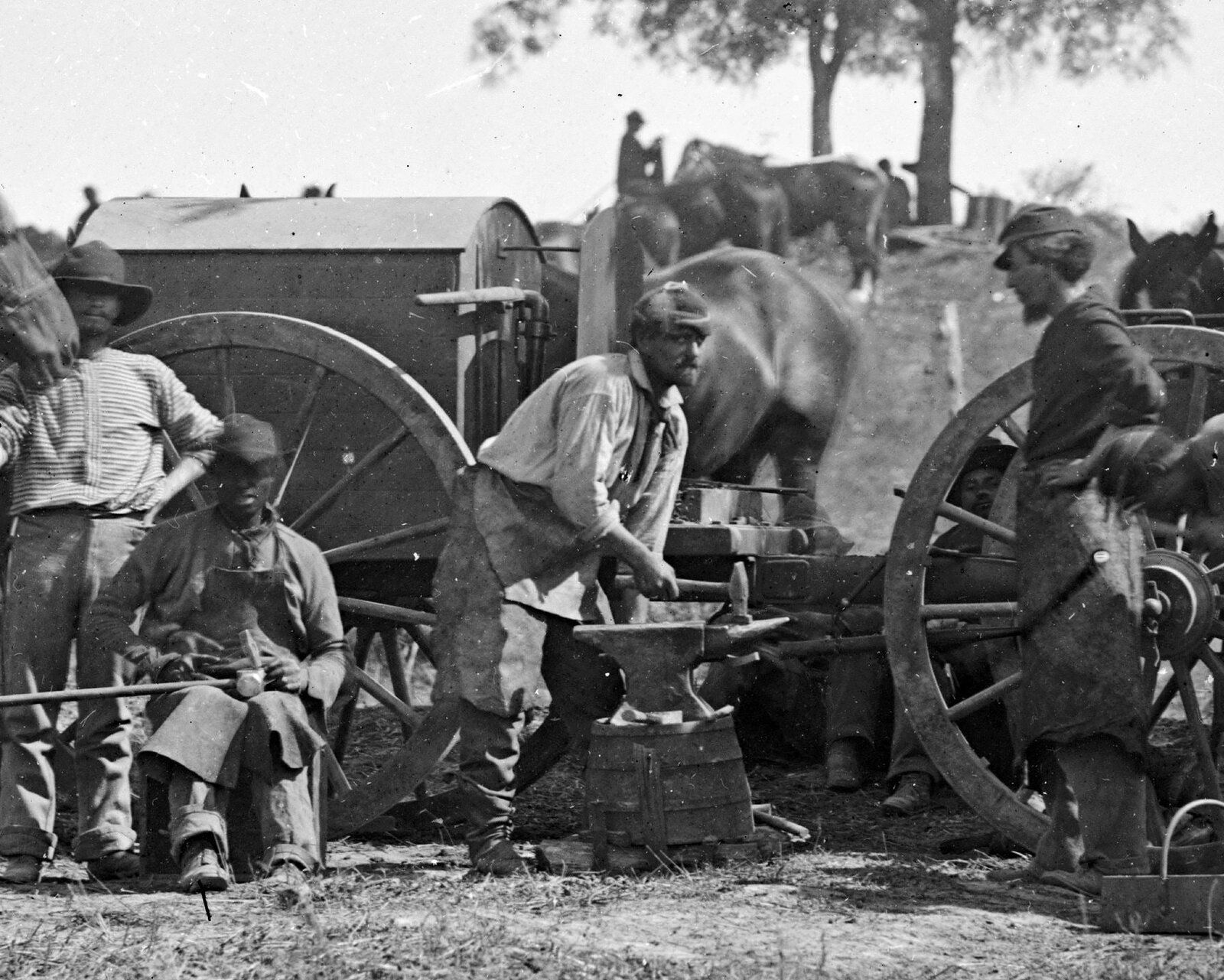
Union army farriers ( blacksmiths ) hard at work. They are probably attached to a cavalry unit or an artillery battery. The traveling forge was attached to the limber and a total of four to six horses were used to pull the complete vehicle and its contents. There were a total of five boxes for tools and supplies, another box called a shoeing box, and one can of oil. Each box contained certain items and was organized by a number. Two boxes or boxes #1 & 3 were designated to hold 100 horseshoes and weighed about 100 pounds each. Another box or box #2 was used to store washers, nuts, nails, tire bolts, keys for ammunition chests, linchpins, linchwashers, chains, and s-links. This box weighed just over 91 pounds. The next box or box #4 contained hand chisels, hardie, files, buttress, round and squared hand punches. It also contained a screw wrench, screwdriver, hand vice, calipers, taps & dies, wood screws, and a quart can of sperm oil, which together weighed about 28.5 pounds. The contents of box #5 contained a fire shovel, poker, split-broom, hand hammer, riveting hammer, nailing hammer, sledge hammer, chisels for hot and cold iron, tongs, fuller, nail-claw, round punch, fore punch, creaser, tap wrench, die-stock, nave, and tire bands. This box with all of the contents weighed about 80 pounds. The shoeing box contained the shoeing hammer, pincers, rasps, shoeing knife, toe knife, pritchel, nail punch, clinching iron, oil-stone, leather aprons, and weighed about 12.75 pounds. The boxes are divided out by number and are stored in a certain way in what is called the limber chest. The boxes in the limber chest are to be stacked with boxes # 1, 2 and 3 at the bottom of the chest itself with box #1 against the left hand side and box #2 in the middle. Box #4 is to be placed on top of boxes #1 & 2, against the left end and back of the chest. Box #5 is to be placed in the front end of the chest on top of boxes #1, 2 & 3. The shoeing box is to be placed on box #3 on the right hand side and toward the back. This distributes the weight evenly and all boxes are to be packed with tow. Additional tools and supplies were attached or stored in the forge itself such as the iron square, padlock, tar-bucket, and boxes and tow for packing. This added another 68 pounds, for a combined weight of about 480 pounds of material, supplies, and tools.
https://southmountaincw.wordpress.c...ttery-and-forge-wagons-lost-at-monterey-pass/
https://southmountaincw.wordpress.c...ttery-and-forge-wagons-lost-at-monterey-pass/


 Bringing the