Edwin Forbes

major bill

Brev. Brig. Gen'l
Forum Host
Joined
Aug 25, 2012
Edwin Forbes did many illustrious for Frank Leslie's Illustrated Newspaper during the Civil War. After the war he published two books of his etchings "Life Studies of the Great Army: A Historical Art Work in Copper Plate Etching Containing Forty Plates" (1876), and "Thirty Years After: An Artist's Story of the Great War Told and Illustrated with Nearly 300 Relief-etchings after Sketches in the Field and 20 Half-tone Equestiran Portraits from Original Oil Paintings" (1891).

Many of these show simple camp life and a fair amount show blacks serving with the Union Army. I was wondering what people think of his etchings as a source for research. Did Forbes accurately show in the etchings what he saw or did he added to things?

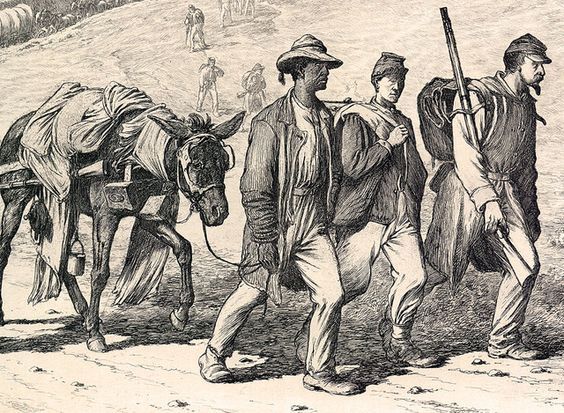
forbes 2.jpg


febes 7.jpg


Note the trousers tucked into the trousers in one and leggings in the other. Forbes also did some paintings
forbes 3.jpg


This is a great painting by an artist who was there. But does it show the real look of a camp?
 
Note the painting of the napping young Union "soldier" was done just after the end of the Civil War. Can I assume it is more or less accurate?
 
Last edited:
They look pretty realistic to me. That looks like a McClennan sadle laying next to the tent in the above picture.
And the middle picture looks like two soldiers and a contraband on the March through Georgia. I like the worn out nag carrying their acrutriments.
 
Forbes has been my favorite of the Civil War artists since I was a kid! Although he modeled his subjects a bit between sketch and final canvas - moving an arm or head, changing the angle of a lash in the air, etc, I've never seen anything that leads me to question his reliability. Fletcher Pratt, in "The Civil War in Pictures" argues that artists started the war with unrealistic and romantic artistic ideas and conventions, and learnedon the job to depict realistically what they saw. I would say the Forbes accurately recorded what he saw. I'd consider his artwork to be right below field photography in its reliability.
 
Artists are always suspect. The problem being they have to make a living off their art. So does the artist draw or paint what they saw or draw or paint what the public wants to purchase?

Case in point; Forbes shows many blacks in his works, but did how the buying public want to see blacks serving in a certain way?

Even modern artist of Civil War art works could be accused of doing their works in a way to please their potential buyers.
 
Artists are always suspect. Case in point; Forbes shows many blacks in his works, but did how the buying public want to see blacks serving in a certain way?
I doubt we'll ever know whether the images he created were exactly what he saw. It is well known, however, that the original sketches Frederick Remington made when memorializing the Black cavalry units serving in the west clearly show the soldiers as Blacks. When the paintings made from those sketches were done later, he made them all white soldiers. Authenticity took a backseat to racism.
 
My guess is that, as with other sketch artists, some of his sketches were drawn directly from his own eyes while others were probably based on what he had heard and/or imagined. As to uniforms, equipment and things like that, I'm sure they are fairly accurate since he traveled with the AotP and probably knew those details well.
 
Case in point; Forbes shows many blacks in his works, but did how the buying public want to see blacks serving in a certain way?
Here are a few other sketches he made of black teamsters. The first two especially look he met them in the road and decided to draw them on the spot.

3b26318r.jpg

Joe, sketched near Culpeper, Va., Sept. 29, 1863.

20539r.jpg

Dick, sketched on the 6th of May, 1863, on return to camp.

20610v.jpg

A breakdown in the wagoner's camp.

20638r.jpg

A mule driver.
 
Note in the post above note Dick wears a frock coat and in the breakdown at least one of the dancer wears a sack coat.
 
Note in the post above note Dick wears a frock coat and in the breakdown at least one of the dancer wears a sack coat.

ANS in the background leaning against the tree is a zouave, and what looks to me to be a canteen and a haversack hanging from the tree (why?) And off on the right is what I'm assuming is a teamster with a bull whip in his jacker pocket (or what ever that round thing is off his left side.

And I think his drawings of the individual 's show a lot of charator. He was a gifted artist.
 

Learn About Us
About CivilWarTalk
Contact the Webmaster
Meet the Staff
Link to CivilWarTalk
Join Our Community
Register
Browse Forums
View Today's Discussions
Search the Forum
Get Help
FAQ
Student Guide
Forum Rules & Etiquette
Copyright / DMCA

     Contact Us CivilwarTalk on Facebook CivilWarTalk on YouTube CivilWarTalk on Twitter RSS Feed

Bringing the American Civil War and More to Life.
© 1999 - , CIVILWARTALK, LLC - Site Version 10.0

SlaveryTalk.com - SecessionTalk.com - CivilWarTalk.com - ReconstructionTalk.com
Back
Top