On February 10th 1863, J J Reynolds writes to George Thomas that the federal armies are disadvantaged in the occupied territories because they are respecting the property rights of disloyal citizens, while the Confederates commit depredations on Union families wherever they travel.
George Thomas writes Rosecrans that he concurs and asks for a policy clarification: reconciliation or depredation.
Rosecrans forwards to Halleck.
Halleck replies nearly a month later and says "it's up to you" but offers suggestions for three classes of citizen: the loyal, the fence-sitters, and the disloyal.
If I'm not mistaken, Grant has already adopted the policy of confiscating anything he wants from disloyal families … food, livestock, forage, transportation, horses … and sending the family outside his lines, at least by October 1862, possibly earlier.
When did other armies adopt similar policies? Why wouldn't such a policy be set centrally?
The President and War Department classed the conflict as a large scale insurrection reaching the condition of civil war. The Confederate military forces were conceded a belligerent status, as in war, but the civil population, to the US forces, was classed as generally in insurrection against the laws of the Union, etc. after the President's proclamation of mid-August, 1861.
And in his proclamations, the President had determined upon the least necessary destruction of private property for its suppression...
Contrast with President Washington's proclamation in the Whiskey Rebellion of 1794 that his army was coming to make life certainly perilous to all who aided and abetted...
Much like Lincoln later, President Washington instructed his commanders in that case to act as necessary, viz. not necessarily visit entire devastation to the insurgent populace, but offer amnesty with a return to their allegiance, etc.
From April, 1861, the Northern papers observed...
From the period, Secretary of State Chase observed to Gen. McClellan in late 1861 that the United States would, where warranted, confiscate among other property, service or labor due to masters in the insurrectionary districts....
This was in conformity with the determinations of the Secretary of the Treasury, S.P. Chase, aiding the military authorities...
The military field commanders in the 1860s were free to make use of, or destroy private property where warranted first, by the laws of war, considering the state of civil war in effect, and second, by military authority/martial law over areas in insurrection where its suppression was paramount. Houses from which shots were fired at US forces were routinely torched, etc. Property confiscated, etc. as necessary. It was considered customary to expel non-combatants from the vicinity or areas of jurisdiction of the armies operating in the insurrectionary districts for various purposes.
Scott, Grant, Butler, etc. were generally on the same page from the beginning.
An outlier of sorts was Gen. McClellan perhaps, particularly by the summer of 1862.
General McClellan famously wrote a manifesto in mid-1862 that the private property of all kinds in the South, and somewhat irrespective of politics, should be inviolate to US forces, and when Lincoln visited the Army of the Potomac bottled up at Harrison's Landing after the Seven Days' Battles, he handed it to the President who read it and thanked him for it. But it evidently didn't impress Lincoln that while his army was beaten back from Richmond he took the time to prepare a manifesto on the correct mode of carrying on the war and protecting private property of all citizens, irrespective of the President's proclamation of an insurrection and the nature of the resistance to it. Lincoln's secretaries Hay and Nicolay say he just filed it away.
McClellan, subsequently, included his "Harrisons Landing letter" in his official report of operations, etc. Alexander K. McClure of Philadelphia later observed of McClellan's decision to insert his opinions into his official capacity... led to the appointment of Major General Halleck (a noted lawyer) as general-in-chief of the Army...
Congress passed "Confiscation acts" in 1861 and 61. That of July, 1862 relative to the forfeiture of the private property of insurgent or rebellious persons under the civil laws even in districts outside of those in insurrection... (where the courts etc. were yet in operation)...
Several months later War Department General Orders no. 100 of 1863, laid out the US Military modes clearly to all military personnel, to avoid any further debate among the generals, confusion, etc. For example, it noted that in the cases of occupied foreign country, the private property of citizens was to be protected so far as possible, and even indemnified...
However, the Southern States was not to the US forces identified as a foreign country, but a large district in insurrection by notice of a presidential proclamation, etc. So the General Orders declared it the duty of US forces to throw the burden of the conflict particularly upon the disloyal civil population until they cease their opposition to the authorities...
The military commanders having in their hands the decision on how far to proceed in this... just as they had before G.O. 100.
And commanders, etc. were allowed the ability to retaliate where they felt warranted... to deliver revengeful retribution...
....
There really isn't much new in the Lieber Code as these General Orders were called. Mostly paraphrases the old authors on the laws of war like Vattell and Grotius. But it was established to avoid any confusion.
The above is all exterior to wanton destruction of property, including robbery, etc., done by troops even contrary to specific orders. Even General Sherman lamented some of the volunteer troops' bad habits on that score. But he held no confusion about the military plan generally, and his and other commanders' authority to visit destruction and confiscation in their official capacity. From January, 1864 he explained to a subordinate about his occupation duties...
...
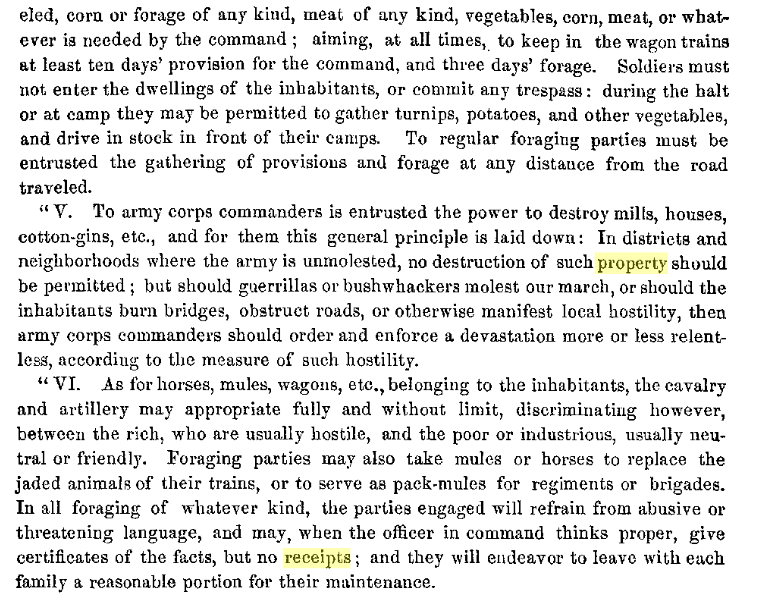
In April, 1864, the War Department ordered military commanders to, so far as possible, draw their "animals and provisions from the territory through which military operations are conducted." This would prevent their being taken up by the Confederate commissaries under their tithing system on farm goods, etc. to support the armies. Private property was to be confiscated too where necessary, but receipted for in the existing mode where warranted...
Only persons taking the oath of allegiance to the US, etc., would be due reimbursement for military receipts given for confiscated property for military uses. Otherwise, the persons were yet considered abiding the insurrectionary authorities, so no reimbursements for property damaged or destroyed would be due.
For Sherman's march to the sea, his general orders explain the impossibility of a general rule for commanders. Their actions depended upon the actions of the locals. Sherman says generally where unoffending, leave it alone. Where there is some "resistance" (armed or unarmed) act accordingly, etc.

As an aside, General Sherman had been major generals of the California Militia in the 1856 "vigilance committee" insurrection. The Governor, their commander-in-chief, after his proclamation of the insurrection, declined to follow it up with active military force under those circumstances, but he, and H.W. Halleck, also of that district, apparently doubted that had the Governor so ordered, they would have engaged the insurgents, and subjected their property to confiscation/destruction wherever and however necessary to its suppression. After the disbandment of the vigilance committee insurgents in that case, Halleck framed a new militia law subsequently adopted by the State, etc. and was a major general thereof when the conflict of 1861 broke out...


 Forum Host


 Bringing the