Dueling depredations

tony_gunter

2nd Lieutenant
Joined
Feb 19, 2011
Location
Mississippi
On February 10th 1863, J J Reynolds writes to George Thomas that the federal armies are disadvantaged in the occupied territories because they are respecting the property rights of disloyal citizens, while the Confederates commit depredations on Union families wherever they travel.

George Thomas writes Rosecrans that he concurs and asks for a policy clarification: reconciliation or depredation.

Rosecrans forwards to Halleck.

Halleck replies nearly a month later and says "it's up to you" but offers suggestions for three classes of citizen: the loyal, the fence-sitters, and the disloyal.

If I'm not mistaken, Grant has already adopted the policy of confiscating anything he wants from disloyal families … food, livestock, forage, transportation, horses … and sending the family outside his lines, at least by October 1862, possibly earlier.

When did other armies adopt similar policies? Why wouldn't such a policy be set centrally?
 
On February 10th 1863, J J Reynolds writes to George Thomas that the federal armies are disadvantaged in the occupied territories because they are respecting the property rights of disloyal citizens, while the Confederates commit depredations on Union families wherever they travel.

George Thomas writes Rosecrans that he concurs and asks for a policy clarification: reconciliation or depredation.

Rosecrans forwards to Halleck.

Halleck replies nearly a month later and says "it's up to you" but offers suggestions for three classes of citizen: the loyal, the fence-sitters, and the disloyal.

If I'm not mistaken, Grant has already adopted the policy of confiscating anything he wants from disloyal families … food, livestock, forage, transportation, horses … and sending the family outside his lines, at least by October 1862, possibly earlier.

When did other armies adopt similar policies? Why wouldn't such a policy be set centrally?


The President and War Department classed the conflict as a large scale insurrection reaching the condition of civil war. The Confederate military forces were conceded a belligerent status, as in war, but the civil population, to the US forces, was classed as generally in insurrection against the laws of the Union, etc. after the President's proclamation of mid-August, 1861.

And in his proclamations, the President had determined upon the least necessary destruction of private property for its suppression...

1744352315135.png


Contrast with President Washington's proclamation in the Whiskey Rebellion of 1794 that his army was coming to make life certainly perilous to all who aided and abetted...

1744352587554.png


Much like Lincoln later, President Washington instructed his commanders in that case to act as necessary, viz. not necessarily visit entire devastation to the insurgent populace, but offer amnesty with a return to their allegiance, etc.

From April, 1861, the Northern papers observed...

1744380360479.png


From the period, Secretary of State Chase observed to Gen. McClellan in late 1861 that the United States would, where warranted, confiscate among other property, service or labor due to masters in the insurrectionary districts....

1744378365602.png


This was in conformity with the determinations of the Secretary of the Treasury, S.P. Chase, aiding the military authorities...

1744378452775.png


The military field commanders in the 1860s were free to make use of, or destroy private property where warranted first, by the laws of war, considering the state of civil war in effect, and second, by military authority/martial law over areas in insurrection where its suppression was paramount. Houses from which shots were fired at US forces were routinely torched, etc. Property confiscated, etc. as necessary. It was considered customary to expel non-combatants from the vicinity or areas of jurisdiction of the armies operating in the insurrectionary districts for various purposes.

Scott, Grant, Butler, etc. were generally on the same page from the beginning.

An outlier of sorts was Gen. McClellan perhaps, particularly by the summer of 1862.
General McClellan famously wrote a manifesto in mid-1862 that the private property of all kinds in the South, and somewhat irrespective of politics, should be inviolate to US forces, and when Lincoln visited the Army of the Potomac bottled up at Harrison's Landing after the Seven Days' Battles, he handed it to the President who read it and thanked him for it. But it evidently didn't impress Lincoln that while his army was beaten back from Richmond he took the time to prepare a manifesto on the correct mode of carrying on the war and protecting private property of all citizens, irrespective of the President's proclamation of an insurrection and the nature of the resistance to it. Lincoln's secretaries Hay and Nicolay say he just filed it away.


McClellan, subsequently, included his "Harrisons Landing letter" in his official report of operations, etc. Alexander K. McClure of Philadelphia later observed of McClellan's decision to insert his opinions into his official capacity... led to the appointment of Major General Halleck (a noted lawyer) as general-in-chief of the Army...


1744379537687.png


Congress passed "Confiscation acts" in 1861 and 61. That of July, 1862 relative to the forfeiture of the private property of insurgent or rebellious persons under the civil laws even in districts outside of those in insurrection... (where the courts etc. were yet in operation)...

1744354856425.png


Several months later War Department General Orders no. 100 of 1863, laid out the US Military modes clearly to all military personnel, to avoid any further debate among the generals, confusion, etc. For example, it noted that in the cases of occupied foreign country, the private property of citizens was to be protected so far as possible, and even indemnified...

1744351368329.png


However, the Southern States was not to the US forces identified as a foreign country, but a large district in insurrection by notice of a presidential proclamation, etc. So the General Orders declared it the duty of US forces to throw the burden of the conflict particularly upon the disloyal civil population until they cease their opposition to the authorities...

1744351687033.png

1744351738533.png


The military commanders having in their hands the decision on how far to proceed in this... just as they had before G.O. 100.
And commanders, etc. were allowed the ability to retaliate where they felt warranted... to deliver revengeful retribution...

1744351971336.png

....

1744353195025.png


There really isn't much new in the Lieber Code as these General Orders were called. Mostly paraphrases the old authors on the laws of war like Vattell and Grotius. But it was established to avoid any confusion.


The above is all exterior to wanton destruction of property, including robbery, etc., done by troops even contrary to specific orders. Even General Sherman lamented some of the volunteer troops' bad habits on that score. But he held no confusion about the military plan generally, and his and other commanders' authority to visit destruction and confiscation in their official capacity. From January, 1864 he explained to a subordinate about his occupation duties...

1744355553135.png

1744355597715.png

...
1744355703112.png


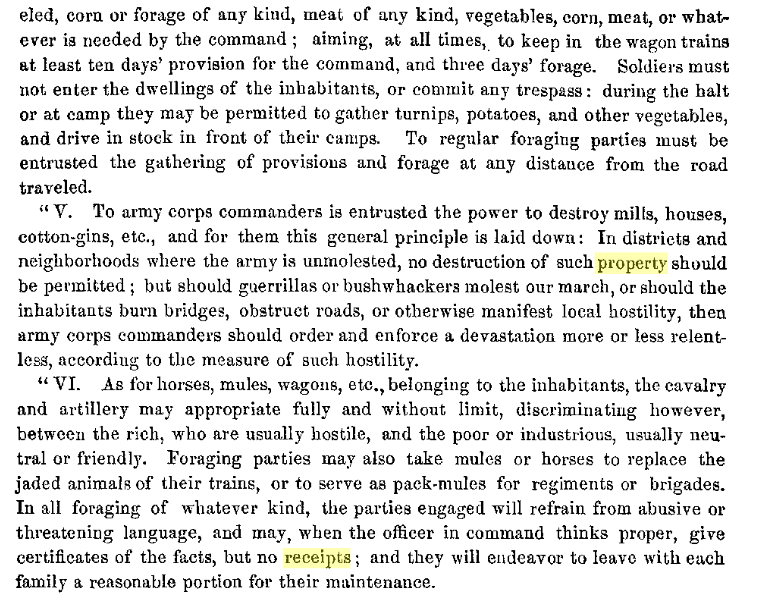
In April, 1864, the War Department ordered military commanders to, so far as possible, draw their "animals and provisions from the territory through which military operations are conducted." This would prevent their being taken up by the Confederate commissaries under their tithing system on farm goods, etc. to support the armies. Private property was to be confiscated too where necessary, but receipted for in the existing mode where warranted...

1744354320743.png


Only persons taking the oath of allegiance to the US, etc., would be due reimbursement for military receipts given for confiscated property for military uses. Otherwise, the persons were yet considered abiding the insurrectionary authorities, so no reimbursements for property damaged or destroyed would be due.

For Sherman's march to the sea, his general orders explain the impossibility of a general rule for commanders. Their actions depended upon the actions of the locals. Sherman says generally where unoffending, leave it alone. Where there is some "resistance" (armed or unarmed) act accordingly, etc.

1744356276944.png

1744356301623.png


As an aside, General Sherman had been major generals of the California Militia in the 1856 "vigilance committee" insurrection. The Governor, their commander-in-chief, after his proclamation of the insurrection, declined to follow it up with active military force under those circumstances, but he, and H.W. Halleck, also of that district, apparently doubted that had the Governor so ordered, they would have engaged the insurgents, and subjected their property to confiscation/destruction wherever and however necessary to its suppression. After the disbandment of the vigilance committee insurgents in that case, Halleck framed a new militia law subsequently adopted by the State, etc. and was a major general thereof when the conflict of 1861 broke out...
 
On February 10th 1863, J J Reynolds writes to George Thomas that the federal armies are disadvantaged in the occupied territories because they are respecting the property rights of disloyal citizens, while the Confederates commit depredations on Union families wherever they travel.

George Thomas writes Rosecrans that he concurs and asks for a policy clarification: reconciliation or depredation.

Rosecrans forwards to Halleck.

Halleck replies nearly a month later and says "it's up to you" but offers suggestions for three classes of citizen: the loyal, the fence-sitters, and the disloyal.

If I'm not mistaken, Grant has already adopted the policy of confiscating anything he wants from disloyal families … food, livestock, forage, transportation, horses … and sending the family outside his lines, at least by October 1862, possibly earlier.

When did other armies adopt similar policies? Why wouldn't such a policy be set centrally?
Excellent question. I do not know the answer.
 
Sometimes the only way to get a Devil is with another Devil. Ran across this in my Sherman research:
How the South Could Have Won the Civil War: The Fatal Errors That Led to Confederate Defeat Bevin Alexander P. 315, Footnote 16

"Sherman's remorseless pattern of deliberate personal injury to the Southern people sowed seeds of hate that bore bitter fruit. The purpose of war is a more perfect peace. Sherman's legacy was the opposite. The memory of the damage he and his men did was was passed from parent to child throughout the South for a century after the war. Sherman's march evoked an enduring folk memory of wanton havoc that embittered the Southern people against the North, the Republican Party, and the national government for generations. This is why the South remained "solid" in voting Democratic for many years."

The Civil War: The Final Year Told By Those Who Lived It Edited by Aaron Sheehan-Dean P. 522

Note: Writing about Sherman moving through Georgia:

"....Georgia residents were sometimes visited by different parties of Union "bummers" (foragers), as well as by groups of stragglers and Confederate deserters. At the end of the march Sherman estimated that his troops had consumed or destroyed resources worth $100 million, of which $20 million was used by the army, while the rest was "simple waste and destruction.'"

I don't imagine those "receipts" given for property "confiscated" were worth much later, when it was all over.

This Hallowed Ground: The Story of the Union Side of the Civil War Bruce Catton P. P. 441-443

"Plantations were looted outright; men who had set out to take no more than hams and chickens began carrying away heirlooms, silver, watches- anything that struck their fancy. Here and there southern patriots felled trees to obstruct roads, or burned bridges; there was never enough of this to delay the army seriously, but there was just enough to provoke reprisals, and barns and houses went up in smoke as a result. A general remarked that "as the habit of measuring right by might goes on, pillage becomes wanton and arson is committed to cover the pillage." An Illinois soldier confessed that "it could not be expected that among so many tens of thousands there would be no rogues," and another man from the same state burst out: "There is no God in war. It is merciless, cruel, vindictive, un-Christian, savage, relentless. It is all that devils could wish for."

Day after day crowds of fugitive slaves fell in on the roads to follow the army. A "Mammy" would show up, bundle on her head, baby in her arms, three small children at her heels; the soldiers would ask where she was going and she would say, "To Savannah, sah–" and officers, who were aware that the army's destination was not known even to the Union rank and file, would wonder how she knew that that was where they were heading. Sherman did his utmost to keep these fugitives from following. It was ordered that the army's progress was on no account to be obstructed or delayed by these hopeful contrabands, but there was no way to keep them from trailing after the soldiers if they chose, and many of them did choose. What became of most of them, no one ever knew. Thousands of Negroes, it was thought, followed the army for a few days and then vanished, going off no one knew where, uprooted persons wholly adrift in a strange and disordered world. In the end, thousands of them did reach the seacoast with the army, but they were only a fraction of the blind, desperate throng that followed for a time and then spun off into unremembered darkness.

They had no historian and they left no record, and the soldiers were by turns amused and bored by them; but as they moved- blindly, hopefully, doomed, going from one misery to another- they gave significance to the entire march, to the long dusty columns in blue with rowdy outriders and with the lines of bayonets that took no arguments from planters. For if this army was destroying much that did not need to be destroyed, it was also destroying slavery; dismantling one of the barricades that stood in the way of the advance of the human spirit, lighting dreadful fires that would finally stand as beacon lights no matter what they consumed.

It is believed that some of the fugitives met death by starvation, yet those who were able to stay with the troops usually got enough to eat. Some queer grapevine of slave-quarter information told the Negroes which regiments in all this army tended to be most kindly and hospitable; also, the soldiers simply had ever so much more food than they themselves could consume. Foragers brought in vast wagonloads of material that was abandoned to rot. Usually the surplus was given to the Negroes.

So much food was taken, indeed, that the soldiers themselves were almost appalled when they stopped to think about it. In one regiment the men made a rough rule-of-thumb estimate of the requisitions that had been made and concluded that the army must have accounted for one hundred thousand hogs, twenty thousand head of cattle, fifteen thousand horses and mules, five hundred thousand bushels of corn, and one hundred thousand bushels of sweet potatoes. Sherman himself later estimated that his army had caused one hundred million dollars' worth of damage in Georgia. Of this, he believed, perhaps twenty million dollars represented material that the army actually used; the rest was "simple waste and destruction." One officer wrote about burned houses, burned fences, roads cut to bits by marching men, fields despoiled and crossed by innumerable wagon tracks, and concluded that "Dante's Inferno could not furnish a more horrible and depressing picture than a countryside when war has swept over it." As the march went on, it was noted that the word "bummer" changed its character. Originally it had been a term of contempt, applied only to the notorious stragglers who never stayed in ranks, in battle or out of battle, and who were looked down on by all combat soldiers; before the army got to the coast the men were beginning to call themselves bummers, and even Sherman, looking back in post-war years, did not mind applying the word to all of his troops.

The effect of all of this was prodigious. As Sherman had foreseen, the fact that an army of sixty thousand men could march straight through the southern heartland, moving leisurely and taking all the time it needed to destroy the land's resources, without meeting enough resistance to cause even a day's delay was an unmistakable portent of the approaching end. No one could remain in much doubt about how the war was going to result when this could be done. Furthermore, the march was both revealing and contributing to the Confederacy's inability to use the resources that remained to it. Around Richmond, Lee's army was underfed, short of animals, perceptibly losing strength from simple lack of food and forage; yet here in Georgia there was a wealth of the things it needed, and it could not get them– primarily because the land's transportation and distribution system was all but in a state of total collapse, but also because this invading army was smashing straight through the source of supply. The morale of Confederate soldiers in Virginia and in Tennessee sank lower and lower as letters from home told how this army was wrecking everything and putting wives and children in danger of starvation.

P. 30

The army came up to Savannah on December 10. Sherman led it around to the right, striking for the Ogeechee River and Ossabaw Sound, where he could get in touch with the navy, receive supplies, and regain contact with Grant and with Washington. The XV Corps found itself making a night march along the bank of a canal; there was a moon, the evening was warm, and the swamp beside the canal looked strange, haunting, and mysterious, all silver and green and black, with dim vistas trailing off into shadowland. The men had been ordered to march quietly, but suddenly they began to sing- "Swanee River," "Old Kentucky Home," "John Brown's Body," and the like, moving on toward journey's end in an unreal night. An Iowa soldier remembered how "the great spreading live-oaks and the tall spectre-like pines, fringing the banks of the narrow and straight canal, formed an arch over it through which the shimmering rays of the full moon cast streaks of mellow light," and the picture stayed with him to old age.

Sherman missed a bet at Savannah, just as he had done at Atlanta. The Confederates had between ten and fifteen thousand soldiers there, and all of these might have been captured, but while he was investing the place Sherman incautiously left open a line of escape, and the defenders got out and moved up into the Carolinas.

Yet this did not really matter in the least. Prim General Hardee, the Confederate commander, might get his garrison away unscathed, but the war would not be prolonged ten minutes by this fact. For Sherman was not fighting an opposing army now; he was fighting an idea, knocking down the last shredded notion that the southern Confederacy could exist as an independent nation, moving steadily and relentlessly not toward a climactic engagement but simply toward the end of the war.

His soldiers found Savannah unlike any town they had ever been in before. They entered the place on December 21, marching formally for a change, with bands playing and flags flying, Sherman himself taking a salute as they marched past."

Note: After the stanza about his pet lambs meeting John Brown on the way, when soldiers went marching into the next stanza, they likely sang, "They will hang Jeff Davis to a sour apple tree, they will hang Jeff Davis to a sour apple tree, they will hang Jeff Davis to a sour apple tree, as they march along." To listen to a 1901 rendition of the song, see the YouTube video recorded May 21, 1901, 36 years after Appomattox. Does Jeff D. look like a raptor, or is that just me?

Note: The moon was full, too, on December 13th, 1864.

This Hallowed Ground: The Story of the Union Side of the Civil War Bruce Catton P. 357

"...and as it moved, the great march to the sea began to resemble nothing so much as one gigantic midwestern Halloween saturnalia, a whole month deep and two hundred and fifty miles long."

Hearts Touched by Fire: The Best of Battles and Leaders of the Civil War Edited by Harold Holzer P. 762 Joan Waugh

"Sherman and his force of 62,000 marched three hundred miles across the state– almost uncontested– living off the land and in some cases inflicting unauthorized damage to personal property. Captain Daniel Oakey of the 2nd Massachusetts remembered his unit's role, describing a rough and ready group of soldiers "who were expected to make fifteen miles a day; to corduroy the road when necessary; to destroy such property as was designed by our corps commander, and to consume everything eatable by man or beast.'" Crushing civilian and material support for the Confederacy, Sherman's troops arrived at Savannah's outskirts by December 17, and Confederate defenders led by General William J. Hardee abandoned the city on December 21. on the next day, Sherman sent a telegram to President Lincoln, offering him the city as a Christmas present."
 
Last edited:
Sometimes the only way to get a Devil is with another Devil. Ran across this in my Sherman research:
How the South Could Have Won the Civil War: The Fatal Errors That Led to Confederate Defeat Bevin Alexander P. 315, Footnote 16

"Sherman's remorseless pattern of deliberate personal injury to the Southern people sowed seeds of hate that bore bitter fruit. The purpose of war is a more perfect peace. Sherman's legacy was the opposite. The memory of the damage he and his men did was was passed from parent to child throughout the South for a century after the war. Sherman's march evoked an enduring folk memory of wanton havoc that embittered the Southern people against the North, the Republican Party, and the national government for generations. This is why the South remained "solid" in voting Democratic for many years."

The Civil War: The Final Year Told By Those Who Lived It Edited by Aaron Sheehan-Dean P. 522

Note: Writing about Sherman moving through Georgia:

"....Georgia residents were sometimes visited by different parties of Union "bummers" (foragers), as well as by groups of stragglers and Confederate deserters. At the end of the march Sherman estimated that his troops had consumed or destroyed resources worth $100 million, of which $20 million was used by the army, while the rest was "simple waste and destruction.'"

I don't imagine those "receipts" given for property "confiscated" were worth much later, when it was all over.

This Hallowed Ground: The Story of the Union Side of the Civil War Bruce Catton P. P. 441-443

"Plantations were looted outright; men who had set out to take no more than hams and chickens began carrying away heirlooms, silver, watches- anything that struck their fancy. Here and there southern patriots felled trees to obstruct roads, or burned bridges; there was never enough of this to delay the army seriously, but there was just enough to provoke reprisals, and barns and houses went up in smoke as a result. A general remarked that "as the habit of measuring right by might goes on, pillage becomes wanton and arson is committed to cover the pillage." An Illinois soldier confessed that "it could not be expected that among so many tens of thousands there would be no rogues," and another man from the same state burst out: "There is no God in war. It is merciless, cruel, vindictive, un-Christian, savage, relentless. It is all that devils could wish for."

Day after day crowds of fugitive slaves fell in on the roads to follow the army. A "Mammy" would show up, bundle on her head, baby in her arms, three small children at her heels; the soldiers would ask where she was going and she would say, "To Savannah, sah–" and officers, who were aware that the army's destination was not known even to the Union rank and file, would wonder how she knew that that was where they were heading. Sherman did his utmost to keep these fugitives from following. It was ordered that the army's progress was on no account to be obstructed or delayed by these hopeful contrabands, but there was no way to keep them from trailing after the soldiers if they chose, and many of them did choose. What became of most of them, no one ever knew. Thousands of Negroes, it was thought, followed the army for a few days and then vanished, going off no one knew where, uprooted persons wholly adrift in a strange and disordered world. In the end, thousands of them did reach the seacoast with the army, but they were only a fraction of the blind, desperate throng that followed for a time and then spun off into unremembered darkness.

They had no historian and they left no record, and the soldiers were by turns amused and bored by them; but as they moved- blindly, hopefully, doomed, going from one misery to another- they gave significance to the entire march, to the long dusty columns in blue with rowdy outriders and with the lines of bayonets that took no arguments from planters. For if this army was destroying much that did not need to be destroyed, it was also destroying slavery; dismantling one of the barricades that stood in the way of the advance of the human spirit, lighting dreadful fires that would finally stand as beacon lights no matter what they consumed.

It is believed that some of the fugitives met death by starvation, yet those who were able to stay with the troops usually got enough to eat. Some queer grapevine of slave-quarter information told the Negroes which regiments in all this army tended to be most kindly and hospitable; also, the soldiers simply had ever so much more food than they themselves could consume. Foragers brought in vast wagonloads of material that was abandoned to rot. Usually the surplus was given to the Negroes.

So much food was taken, indeed, that the soldiers themselves were almost appalled when they stopped to think about it. In one regiment the men made a rough rule-of-thumb estimate of the requisitions that had been made and concluded that the army must have accounted for one hundred thousand hogs, twenty thousand head of cattle, fifteen thousand horses and mules, five hundred thousand bushels of corn, and one hundred thousand bushels of sweet potatoes. Sherman himself later estimated that his army had caused one hundred million dollars' worth of damage in Georgia. Of this, he believed, perhaps twenty million dollars represented material that the army actually used; the rest was "simple waste and destruction." One officer wrote about burned houses, burned fences, roads cut to bits by marching men, fields despoiled and crossed by innumerable wagon tracks, and concluded that "Dante's Inferno could not furnish a more horrible and depressing picture than a countryside when war has swept over it." As the march went on, it was noted that the word "bummer" changed its character. Originally it had been a term of contempt, applied only to the notorious stragglers who never stayed in ranks, in battle or out of battle, and who were looked down on by all combat soldiers; before the army got to the coast the men were beginning to call themselves bummers, and even Sherman, looking back in post-war years, did not mind applying the word to all of his troops.

The effect of all of this was prodigious. As Sherman had foreseen, the fact that an army of sixty thousand men could march straight through the southern heartland, moving leisurely and taking all the time it needed to destroy the land's resources, without meeting enough resistance to cause even a day's delay was an unmistakable portent of the approaching end. No one could remain in much doubt about how the war was going to result when this could be done. Furthermore, the march was both revealing and contributing to the Confederacy's inability to use the resources that remained to it. Around Richmond, Lee's army was underfed, short of animals, perceptibly losing strength from simple lack of food and forage; yet here in Georgia there was a wealth of the things it needed, and it could not get them– primarily because the land's transportation and distribution system was all but in a state of total collapse, but also because this invading army was smashing straight through the source of supply. The morale of Confederate soldiers in Virginia and in Tennessee sank lower and lower as letters from home told how this army was wrecking everything and putting wives and children in danger of starvation.

P. 30

The army came up to Savannah on December 10. Sherman led it around to the right, striking for the Ogeechee River and Ossabaw Sound, where he could get in touch with the navy, receive supplies, and regain contact with Grant and with Washington. The XV Corps found itself making a night march along the bank of a canal; there was a moon, the evening was warm, and the swamp beside the canal looked strange, haunting, and mysterious, all silver and green and black, with dim vistas trailing off into shadowland. The men had been ordered to march quietly, but suddenly they began to sing- "Swanee River," "Old Kentucky Home," "John Brown's Body," and the like, moving on toward journey's end in an unreal night. An Iowa soldier remembered how "the great spreading live-oaks and the tall spectre-like pines, fringing the banks of the narrow and straight canal, formed an arch over it through which the shimmering rays of the full moon cast streaks of mellow light," and the picture stayed with him to old age.

Sherman missed a bet at Savannah, just as he had done at Atlanta. The Confederates had between ten and fifteen thousand soldiers there, and all of these might have been captured, but while he was investing the place Sherman incautiously left open a line of escape, and the defenders got out and moved up into the Carolinas.

Yet this did not really matter in the least. Prim General Hardee, the Confederate commander, might get his garrison away unscathed, but the war would not be prolonged ten minutes by this fact. For Sherman was not fighting an opposing army now; he was fighting an idea, knocking down the last shredded notion that the southern Confederacy could exist as an independent nation, moving steadily and relentlessly not toward a climactic engagement but simply toward the end of the war.

His soldiers found Savannah unlike any town they had ever been in before. They entered the place on December 21, marching formally for a change, with bands playing and flags flying, Sherman himself taking a salute as they marched past."

Note: After the stanza about his pet lambs meeting John Brown on the way, when soldiers went marching into the next stanza, they likely sang, "They will hang Jeff Davis to a sour apple tree, they will hang Jeff Davis to a sour apple tree, they will hang Jeff Davis to a sour apple tree, as they march along." To listen to a 1901 rendition of the song, see the YouTube video recorded May 21, 1901, 36 years after Appomattox. Does Jeff D. look like a raptor, or is that just me?

Note: The moon was full, too, on December 13th, 1864.

This Hallowed Ground: The Story of the Union Side of the Civil War Bruce Catton P. 357

"...and as it moved, the great march to the sea began to resemble nothing so much as one gigantic midwestern Halloween saturnalia, a whole month deep and two hundred and fifty miles long."

Hearts Touched by Fire: The Best of Battles and Leaders of the Civil War Edited by Harold Holzer P. 762 Joan Waugh

"Sherman and his force of 62,000 marched three hundred miles across the state– almost uncontested– living off the land and in some cases inflicting unauthorized damage to personal property. Captain Daniel Oakey of the 2nd Massachusetts remembered his unit's role, describing a rough and ready group of soldiers "who were expected to make fifteen miles a day; to corduroy the road when necessary; to destroy such property as was designed by our corps commander, and to consume everything eatable by man or beast.'" Crushing civilian and material support for the Confederacy, Sherman's troops arrived at Savannah's outskirts by December 17, and Confederate defenders led by General William J. Hardee abandoned the city on December 21. on the next day, Sherman sent a telegram to President Lincoln, offering him the city as a Christmas present."
Very good commentary, @CWdiaryPA.
 
How the South Could Have Won the Civil War: The Fatal Errors That Led to Confederate Defeat Bevin Alexander P. 315, Footnote 16

"Sherman's remorseless pattern of deliberate personal injury to the Southern people sowed seeds of hate that bore bitter fruit. The purpose of war is a more perfect peace

This is a misguided view of war.

The purpose of war is to beat your opponent into submission, such that they beg for mercy and never again dare to do whatever brought about the war in the first place. Break their will and make them see the error of their ways. Anything less is failure.

Sherman wasn't too hard; he wasn't hard enough.
 
This is a misguided view of war.

The purpose of war is to beat your opponent into submission, such that they beg for mercy and never again dare to do whatever brought about the war in the first place. Break their will and make them see the error of their ways. Anything less is failure.

Sherman wasn't too hard; he wasn't hard enough.
Sherman was plenty tough on Georgia until he got to Savannah, when he spared the city and made his men behave like angels while there. Then, Sherman was plenty tough on South Carolina. Upon arriving in North Carolina he made his men behave admirably, doing practically no harm on civilians other than confiscations of food and foraging liberally.
 
This is a misguided view of war.

The purpose of war is to beat your opponent into submission, such that they beg for mercy and never again dare to do whatever brought about the war in the first place. Break their will and make them see the error of their ways. Anything less is failure.

Sherman wasn't too hard; he wasn't hard enough.
That was the complaint being raised in the original post. Buell's Army, and the Rosecrans after him, were treating secessionist property with kid gloves. Meanwhile, the Confederates would sweep through and rob the Unionists blind, sometimes kill them or conscript them. Federal soldiers and unionists wanted a policy that would at least put their side on even ground.
 
This is a misguided view of war.

The purpose of war is to beat your opponent into submission, such that they beg for mercy and never again dare to do whatever brought about the war in the first place. Break their will and make them see the error of their ways. Anything less is failure.

Sherman wasn't too hard; he wasn't hard enough.
So it looks like the International Court of Justice has a slightly different view of war aims than you.

The first Geneva Convention came about August 22, 1864. Expansions since then include info. here, where pillaging is but one act frowned upon:
General Protection of the Civilian Population
Articles 13 to 18 of Additional Protocol II define the protection and means of protection that must be adopted for the benefit of civilians.

"The civilian population and individual civilians shall enjoy general protection against the dangers arising from military operations." To this effect, they must never be the object of attacks or of any acts or threats of violence the primary purpose of which is to spread terror (APII Art. 13).

Part IV
CIVILIAN POPULATION
Article 13 - Protection of the civilian population

"1. The civilian population and individual civilians shall enjoy general protection against the dangers arising from military operations. To give effect to this protection, the following rules shall be observed in all circumstances.

2. The civilian population as such, as well as individual civilians, shall not be the object of attack. Acts or threats of violence the primary purpose of which is to spread terror among the civilian population are prohibited.

3. Civilians shall enjoy the protection afforded by this Part, unless and for such time as they take a direct part in hostilities.

Article 14 - Protection of objects indispensable to the survival of the civilian population
Starvation of civilians as a method of combat is prohibited. It is therefore prohibited to attack, destroy, remove or render useless, for that purpose, objects indispensable to the survival of the civilian population, such as foodstuffs, agricultural areas for the production of foodstuffs, crops, livestock, drinking water installations and supplies and irrigation works."
 
On February 10th 1863, J J Reynolds writes to George Thomas that the federal armies are disadvantaged in the occupied territories because they are respecting the property rights of disloyal citizens, while the Confederates commit depredations on Union families wherever they travel.

George Thomas writes Rosecrans that he concurs and asks for a policy clarification: reconciliation or depredation.

Rosecrans forwards to Halleck.

Halleck replies nearly a month later and says "it's up to you" but offers suggestions for three classes of citizen: the loyal, the fence-sitters, and the disloyal.

If I'm not mistaken, Grant has already adopted the policy of confiscating anything he wants from disloyal families … food, livestock, forage, transportation, horses … and sending the family outside his lines, at least by October 1862, possibly earlier.

When did other armies adopt similar policies? Why wouldn't such a policy be set centrally?
"the Confederates commit depredations on Union families wherever they travel."

Shouldn't be a very long list
 

Learn About Us
About CivilWarTalk
Contact the Webmaster
Meet the Staff
Link to CivilWarTalk
Join Our Community
Register
Browse Forums
View Today's Discussions
Search the Forum
Get Help
FAQ
Student Guide
Forum Rules & Etiquette
Copyright / DMCA

     Contact Us CivilwarTalk on Facebook CivilWarTalk on YouTube CivilWarTalk on Twitter RSS Feed

Bringing the American Civil War and More to Life.
© 1999 - , CIVILWARTALK, LLC - Site Version 10.0

SlaveryTalk.com - SecessionTalk.com - CivilWarTalk.com - ReconstructionTalk.com
Back
Top