Dissing History

True, but apparently everyone else did too, or they really didn't care that much to make it an issue. It's a curious thing to me. We've got folks here that will blame it all on Jubal Early, an improbable scenario at best, IMO to shift blame away from their own historical and/or moral failures. But for the real historians, what was their excuse? They supposedly make a living poring through archives and just plain dropped the ball you'd have to agree. It's just real odd that they missed the holy grail for so long, maybe there's more to it than we know.

I suggest reading Thomas J. Pressly's Americans Interpret Their Civil War for an overview of the historiography.

https://scholarworks.iu.edu/journals/index.php/imh/article/view/8282/10277
 
Years ago... like when I was in 7th and 8 th grade, we learned pretty much what was in the textbooks... and the declarations of secession weren't there. Only teachers in recent years...Cash's comment about the internet is correct... only recently have teachers been actively encouraged to use primary documents. Mine got to read and analyze them in 7th and 8th grade. I was a terrible shock to a lot of those little pointy-headed children... but most of them seem to be quite happy about it now.
 
Eric is right. Slavery was the sole issue and all else is pure propaganda. The states right being fought over was the state right to have slaves. The so-called invasion was merely an effort by the rightful, elected government to put down rebellion. I say so-called because it is not possible for the U.S. to invade itself. There was and is no constitutional basis for secession and the U.S. government was fighting to prove that point. The point having been subjected to trial by combat was decided, once and for all, in the spring of 1865. The south has been trying in vain for 150 years to prove the constutionality of secession. I chalkenge anyone to point out a clause in the U.S. Constitution that either explicitly or implicitly gives authority for a state to depart from the union of the states.
Supposedly, Jeff Davis was chomping at the bit to prove the constitutionality of secession in court after the war.... He never was put on trial.
 
I agree that some folks seem to think that way, but history is (and should be) derived from the preponderance of evidence.

As a professional historian, I sometimes note the tendency on the part of some to cite the exception, not the rule. So, for example, yes, there were some African-Americans who served in the Confederate military, but they were relatively few and were, again, the exception, not the rule. And, when dealing with the sweep of history, especially in a lecture course or book with limited time or space, it's usually not particularly helpful to delve into the exception, at least not too much, while it is useful to study the rule.
 
As a professional historian, I sometimes note the tendency on the part of some to cite the exception, not the rule. So, for example, yes, there were some African-Americans who served in the Confederate military, but they were relatively few and were, again, the exception, not the rule. And, when dealing with the sweep of history, especially in a lecture course or book with limited time or space, it's usually not particularly helpful to delve into the exception, at least not too much, while it is useful to study the rule.
Occam's razor says that when choosing among multiple hypotheses, the simplest choice is best because it is harder to falsify and easier to prove.
 
The internet... 20 years ago, I was limited to the few books in my school library (which were written in the 50s for the most part), the "coffee table" type books my non-history buff family members bought me as a kid (you know, the kind of colorful and flashy books with pictures and art and little of no substance), and crappy movies like Gettysburg.
I also used the old (God love them) hill billies I reenacted with. As a kid, I was quick to take up their opinions about things.
Growing up in Louisiana, I was not exposed to many opposing views.

To be honest, you people on this site opened my eyes quite a bit. My modern political leanings made me begin to question my deep-set notions about the war and secession, but you people drove me to dig deeper. I thank you for it. @unionblue @brass napoleon @cash , among others. I was challenged, and I saw some errors.

I'm still a Southerner, but I see Early and the like in a different light now. Those men were products of their time and place. I will not judge them according to modern moral standards. It's not right to do so. Even the saintly Lincoln would be considered a racist or bigot today.
 
>I just can't understand why this wasn't beaten to death beginning in 1866 like it is today

It's hard to look at history when you're part of it or have been part of it recently. It becomes easier in retrospect, the farther one is from the occurrence of the actual events. Yes, I grant that it can be easier to gather source material closer to the events in question -- but not to analyze that material. We are all stuck in a certain paradigm (mindset) formed by the culture or society in which we grew up, and it's harder than it might seem to exceed the limits placed on us by those influences. We would not, for example, expect a white man of the 1860s to hold particularly modern views, even in the North, about the place of women and minorities in society, even if that white man was well-educated and an abolitionist. It takes time for people to become "objective," or objective enough to examine the past with a fresh or novel perspective. Even then, those interpretations of the past often reflect the period in which they were made. We're all "trapped" in history, so to speak, and can never be fully free of the influences of our time and place when analyzing the past.
 
Because the majority of people live their lives? Because there are other things to study besides the Civil War in college? Because most guys in high school liked shop, football, and girls and not always in that order? Dating an marriage might take ups one's time. Then there was Vietnam, Grenada, Iraq, Afghanistan, Watergate, 9/11, Oklahoma bombing, kids getting sick, daughter bringing home a Hell's Angel to dinner, car payments, mortgage payments, bills, balancing the check book, worrying about crime, well, life.

Just because we few, we band of civil war nuts, have such an extensive knowledge of the documentation concerning the secession of the Southern states over the issue of slavery, doesn't mean everyone else had (until they landed here).
We are not talking interests in high school or other responsibilities you had as an adult, though the Hell's Angel story is intriguiging. What we are talking about is the historical narrative of the United States about the Civil War for some 130 years after the end of it. Why was the ball dropped?
Ever since I've been participating here, and that's a long time now, many folks from your part of the world appear to act like they never heard or thought about slavery until discovering it as a result of interest in the war. That's always seemed very strange to me and I've often wondered what they must have been teaching up there.
 
Years ago... like when I was in 7th and 8 th grade, we learned pretty much what was in the textbooks... and the declarations of secession weren't there. Only teachers in recent years...Cash's comment about the internet is correct... only recently have teachers been actively encouraged to use primary documents. Mine got to read and analyze them in 7th and 8th grade. I was a terrible shock to a lot of those little pointy-headed children... but most of them seem to be quite happy about it now.
EEEK!! Space aliens!! :eek:
 
Speaking of exceptions to the rule, I once took a Civil War & Reconstruction class at my alma mater. The instructor, who was the model of competency, was discussing the role of the Freedmen's Bureau -- namely, to assist former slaves in this way and that. One student raised his hand and objected to the scope of her focus on the Freedmen's Bureau, pointing out that the Bureau also helped some poor southern whites. That is true, said the professor, but that was not it's primary role by any means -- thus the name, Freedmen's Bureau. This caused the student much consternation, but she was right: in the context of a one-hour class meeting twice a week to discuss the entire sweep of the Civil War and Reconstruction, the teacher and students needed to focus on the rule, not the exception -- although we were certainly free to explore the exceptions on our own. Often, however -- not always, but often enough -- I note that some bring up the exceptions not to present a fuller historical picture, but to derail the study of history or to undermine the authority of others. Thus, you end up with these books about "what they didn't teach you in school" or "what they didn't want you to find out in school" -- which is nonsense. The omission of lesser known facts is usually not evidence of an intellectual conspiracy, but of a shortage of time in which to do what needs to be done.
 
Speaking of exceptions to the rule, I once took a Civil War & Reconstruction class at my alma mater. The instructor, who was the model of competency, was discussing the role of the Freedmen's Bureau -- namely, to assist former slaves in this way and that. One student raised his hand and objected to the scope of her focus on the Freedmen's Bureau, pointing out that the Bureau also helped some poor southern whites. That is true, said the professor, but that was not it's primary role by any means -- thus the name, Freedmen's Bureau. This caused the student much consternation, but she was right: in the context of a one-hour class meeting twice a week to discuss the entire sweep of the Civil War and Reconstruction, the teacher and students needed to focus on the rule, not the exception -- although we were certainly free to explore the exceptions on our own. Often, however -- not always, but often enough -- I note that some bring up the exceptions not to present a fuller historical picture, but to derail the study of history or to undermine the authority of others. Thus, you end up with these books about "what they didn't teach you in school" or "what they didn't want you to find out in school" -- which is nonsense. The omission of lesser known facts is usually not evidence of an intellectual conspiracy, but of a shortage of time in which to do what needs to be done.

Exactly... From 8 am to 3:20 pm, 180 days, minus time for testing, school pictures, assemblies, pep rallies and, of course, lunch. Grades 6-12 have one 45 minute period in each subject, less time to get them in and working, and in Texas, the civil war is only taught in grades 7 and 8.
 
You make a large amount of assumptions

Why would they need to? Anyone relatively contemporary to that time knew slavery was the motivation behind actions. Anyone knowledgeable of antebellum US history would already know that slavery was an increasingly sectional issue causing continued division. I think you made a comment about someone not being from Texas, I guess you are implying then you are. If so then if you really know Texas history you already know this, the massive issues with the annexation of Texas as a slave state and the power issues that would cause. This event was immensely significant in the building sectional slave division.

Additionally I'm assuming you are read on people like Sam Houston, though he even was against the war constantly railed against abolitionists and anti-slave sectional movements, blaming them for division (you can't have anti-slave groups without slavery).

All of these contemporary records are readily available and anyone within decades of the slavery era wouldn't need it shoved in their face, everyone knew already. People remembered and just started to not want to talk about it. Talking about contemporary views 150 years later seems enlightening but 20 years later it isn't nearly so surprising, it was common knowledge.

Additionally outside of the former slave holding States after Reconstruction many Whites wanted to move on so many avoided the slavery topic as well. They were tired of spending time and money on Blacks and "fixing" slavery.

Further it's odd to ask why for a negative, you seem to have a deeper point or agenda, you should just state that point and what backs up that point.
So, in boiling down your assumptions you are saying is that they, historians and other knowledgeable people, knew about the Declarations and all the rest but just didn't care enough about it one way or the other to push it?
 
So, in boiling down your assumptions you are saying is that they, historians and other knowledgeable people, knew about the Declarations and all the rest but just didn't care enough about it one way or the other to push it?

Possibly, also I'm not sure your assumption is valid either. Many contemporary sources I've seen post Civil War within a certain time frame have no issue with knowing slavery's true ties to the events that lead to the Civil War. It was common knowledge. How do you come to the conclusion it wasn't pushed, what does that even mean. I'm not just going to take your word on such a general claim, no offense intended.

Additionally I could refer to some political act 10 years ago and the intentions behind it, it's very likely I don't have to cite the actual political verbiage for you to understand the motivations behind it, you probably just remember it.
 
So, in boiling down your assumptions you are saying is that they, historians and other knowledgeable people, knew about the Declarations and all the rest but just didn't care enough about it one way or the other to push it?

Further I'm still trying to understand your actual point and your backing for that point. You seem to flip everything back on others based off a point you seem to be dancing around. Make your point, back it up, and let's talk about that.

Are you claiming it wasn't talked about by people or historians until the last 50 years? Are you claiming slavery wasn't talked about until the last 50 years? Are you suggesting that if those previous assumptions/claims are in fact true it contradicts the declared causes?

What's your point. Please make it.
 
So going to a TN high school in the early 2000s then I learned that the Civil War was mainly over slavery, other issue may have been mentioned but slavery was always presented as the main cause. I don't think the text books went into the declarations of secessions, as I remember them being at a very high level. Then again I could be misremembering as I mainly learned Civil War history from my farther, who certainly always taught me that slavery was the underlining cause of the war.

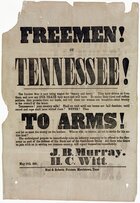
That being said, as someone who went to a lot of civil war battlefields as a kid and learned Civil War history from a Southern viewpoint, then the Union was always seen as an invading army. As a kid at a battlefield in TN (my home) seeing monuments/markers to TN units on one side and on the other side seeing units from far off cold northern states like Ohio or Illinois then it was easy to identify with a Southern who was being invaded. Plus my farther used to have the attached poster hanging on the wall… so in short I was taught that the cause of the war was slavery but the fight was about protecting one's home/country.
 

Attachments

  • TN.jpg
    TN.jpg
    182.3 KB · Views: 113
We are not talking interests in high school or other responsibilities you had as an adult, though the Hell's Angel story is intriguiging. What we are talking about is the historical narrative of the United States about the Civil War for some 130 years after the end of it. Why was the ball dropped?

Was it? Or was it merely "off sides" for that time?

Ever since I've been participating here, and that's a long time now, many folks from your part of the world appear to act like they never heard or thought about slavery until discovering it as a result of interest in the war.

Nope, thought about it a long time before I joined this forum in 1992-3. Had many a debate with my friend and reenacting pard oldrebel before joining this forum at his invitation.

That's always seemed very strange to me and I've often wondered what they must have been teaching up there.

RobertP, they taught history in paragraphs at my high school and the Civil War was a chapter in my American history books. All that I recall was the South seceded, Lincoln freed the slaves and then was assassinated. Next Chapter.

Now, if you want to know what they teach there after 1971, I was amazed at my grandson's knowledge of the Civil War, secession, slavery and the Constitution. He learned a heck of a lot more than me and reads on the topic quite a bit.

Me, I got started researching the war and it's causes because of my involvement in reenacting in order to answer questions from spectators at theses events. Until that time, I casually believed the war was over "States Rights." Once I started reading at my local library and researching on the internet, that quickly changed.

Hope that helps a tad,
Unionblue
 

Learn About Us
►About CivilWarTalk
►Contact the Webmaster
►Meet the Staff
►Link to CivilWarTalk
Join Our Community
►Register
►Browse Forums
►View Today's Discussions
►Search the Forum
Get Help
►FAQ
►Student Guide
►Forum Rules & Etiquette
►Copyright / DMCA

     Contact Us CivilwarTalk on Facebook CivilWarTalk on YouTube CivilWarTalk on Twitter RSS Feed

Bringing the American Civil War and More to Life.
© 1999 - , CIVILWARTALK, LLC - Site Version 10.0

SlaveryTalk.com - SecessionTalk.com - CivilWarTalk.com - ReconstructionTalk.com
Back
Top