Did soldiers receive reasonable pay?

major bill

Brev. Brig. Gen'l
Forum Host
Joined
Aug 25, 2012
I can look up how much a private and such made, but it is difficult to compare the soldier's pay to what a civilian with comparable skills made. By the time you consider the room and board (not always the best) and add in enlistment bonuses, reenlistment bonuses etc. did soldiers receive reasonable pay when compared to civilians? For example if a young man hired on to a Midwest farm and the farmer provided room and board, how much cash money did said farm hand make?

I have seen threads where it was stated that newly arrived immigrants join the Army for the money. I can not help but wonder if a soldier made enough money to justify this belief. Certainly Army pay beat not having any job but I could use an honest comparison of wages to judge if that many immigrants joined the Army for the money.
 
I just recently read a paper about inflation in the US since 1800. Mid 19th century dollar value based on inflation is difficult to estimate because of the common practice of bartering. But the estimate for 1863 was $1 then would equal $22 now. A private in the Union army made $13 a month so that would come out to be $286 in today's money. Not that much at all. But then again a soldier didn't need much either.
 
Keep in mind just prior to the ACW there had been a major financial crisis that rocked the whole country. Thus cash money was in short supply.

One thing I've only rarely read of in period letters was a disgust at short pay. Pay wouldn't significantly change for the best part of a century. What made the pay worth it was that it was all but guaranteed as were the rations as well as barracks & uniforms.
 
Last edited:
You have to ask yourself what is reasonable pay in a job where you can be called on to put your life on the line.

Fortunately for most individuals choosing that kind of service, pay isn't usually the top motivation.
 
I can look up how much a private and such made, but it is difficult to compare the soldier's pay to what a civilian with comparable skills made. By the time you consider the room and board (not always the best) and add in enlistment bonuses, reenlistment bonuses etc. did soldiers receive reasonable pay when compared to civilians? For example if a young man hired on to a Midwest farm and the farmer provided room and board, how much cash money did said farm hand make?

I have seen threads where it was stated that newly arrived immigrants join the Army for the money. I can not help but wonder if a soldier made enough money to justify this belief. Certainly Army pay beat not having any job but I could use an honest comparison of wages to judge if that many immigrants joined the Army for the money.

I can look up how much a private and such made, but it is difficult to compare the soldier's pay to what a civilian with comparable skills made. By the time you consider the room and board (not always the best) and add in enlistment bonuses, reenlistment bonuses etc. did soldiers receive reasonable pay when compared to civilians? For example if a young man hired on to a Midwest farm and the farmer provided room and board, how much cash money did said farm hand make?

I have seen threads where it was stated that newly arrived immigrants join the Army for the money. I can not help but wonder if a soldier made enough money to justify this belief. Certainly Army pay beat not having any job but I could use an honest comparison of wages to judge if that many immigrants joined the Army for the money.
I would argue that 13 dollars a month is very poor compensation considering the high risk of death, injury or serious disease from combat or merely drinking the water. A smart young man was far safer in hiring himself out to a farmer far from the battle lines plus their might be plenty of lonely young women to boot. Money go's fast because many young privates spent their wages and local food that was far tastier then the drab fare served by the Army or Navy. Alcohol of course is essential for many and not always inexpensive if far from a Union city. "Horizontal refreshment" well not every private is a choir boy not always cheap. Gambling again not everyone follows the good book.
On the other hand somehow some privates managed to save money of course we will never know the numbers. Marcus Woodcock an enlisted man of the 6th Ky USV spoke of the men in his company giving him thousands of dollars to take back to their kinfolk in Ky and Marcus was scared to death because that area of Ky had many bandits and CSA guerrillas. The men where quite lucky that Marcus didn't beat feet to a far distant location
13 dollars a month was not bad because 80 years later a private serving overseas only made $50 a month. A great article on WW2 pay is from usmn. reprints an article from Barron National Business &Financial weekly April 24 1944. They discus the same subject we are discussing but of course its 80 later. if we adjust the numbers for inflation it tells us what CW pay was worth.
Leftyhunter
 
Last edited:
I can look up how much a private and such made, but it is difficult to compare the soldier's pay to what a civilian with comparable skills made. By the time you consider the room and board (not always the best) and add in enlistment bonuses, reenlistment bonuses etc. did soldiers receive reasonable pay when compared to civilians? For example if a young man hired on to a Midwest farm and the farmer provided room and board, how much cash money did said farm hand make?

I have seen threads where it was stated that newly arrived immigrants join the Army for the money. I can not help but wonder if a soldier made enough money to justify this belief. Certainly Army pay beat not having any job but I could use an honest comparison of wages to judge if that many immigrants joined the Army for the money.
For the Confederate soldier it has to be argued they where not paid enough money since thevalue of their currency went down on monthly basis. That might be one reason that many deserted to join the Union Army. On the other hand many Union soldiers deserted as well . Which begs the question was the pay worth the risks?Many men on both sides where willing to risk the death penalty for their answer was no.
Leftyhunter
 
Here is a table from Clarence D. Long, Wages and Earnings in the United States, 1860-1890 (Princeton University Press, 1960), that compares census data on manufacturing wages during that period. The U.S. soldier's annual base pay of $156 is generally lower than manufacturing jobs, which in turn are higher-paid than unskilled labor or farm jobs. When you consider that much else was provided to soldiers (housing, rations, basic medical care) that generally was not provided to civilian manufacturing workers, Army pay was not inordinately low, and may have been a positive inducement to low- or unskilled laborers.

Earnings_Page_3 copy.jpg


The same paper also notes that there were significant variations in pay according to region; manufacturing workers in the western states generally earned more than their eastern counterparts, while those in the southern states earned less.

Note: This post has been edited because initially I forgot how to do basic arithmetic. Do'oh.
 
Last edited:
In no way was the money paid to the enlisted men

Leftyhunter

I'm not sure what you mean as the enlisted men certainly were paid. They were paid, as circumstances permitted, every other month. Many US Regiments went a bit longer between pay while on active campaign o when garrisoning posts well within enemy territory. Even the USCT men who went with less for too long received back pay. In many cases when those men were handed their first $20-30 it was more coin than they had ever held in their hands.

When town, county, state etc bonuses were added in a man could have enough coin at muster out to buy a farm, small business or pay off major debts. many a soldier bought a business or farm after the war and put that coin to good use.
 
Here is a table Clarence D. Long, Wages and Earnings in the United States, 1860-1890 (Princeton University Press, 1960), that compares census data on manufacturing wages during that period. The U.S. soldier's annual base pay of $260 is not very low, compared to the pay offered at the lower end of the manufacturing trades. When you consider that much else was provided to soldiers (housing, rations, basic medical care) that generally was not provided to civilian manufacturing workers, Army pay was not inordinately low, and may have been a positive inducement to low-skilled laborers.

View attachment 91515

The same paper also notes that there were significant variations in pay according to region; manufacturing workers in the western states generally earned more than their eastern counterparts, while those in the southern states earned less.
This is a splendid chart and is in keeping with what I have read. A typical unskilled laborer could consider $.50 a week a reasonable wage and could live off of that. A hired man on a farm might expect a bit more. A blacksmith or other skilled craftsman might expect $1-2 a day.
 
I am not sure a soldier ever gets paid enough to risk their life. When I deployed during the Gulf War my company made up the difference between my Army pay and civilian pay. My company only counted my base pay, so housing, danger pay etc. did not count. In the end I made out Ok but not sure the extra money was worth risking my life for.
 
I'm not sure what you mean as the enlisted men certainly were paid. They were paid, as circumstances permitted, every other month. Many US Regiments went a bit longer between pay while on active campaign o when garrisoning posts well within enemy territory. Even the USCT men who went with less for too long received back pay. In many cases when those men were handed their first $20-30 it was more coin than they had ever held in their hands.

When town, county, state etc bonuses were added in a man could have enough coin at muster out to buy a farm, small business or pay off major debts. many a soldier bought a business or farm after the war and put that coin to good use.
Actually I was trying to edit that sentence out and was unable to do so. I know the men where paid although not always on time due to various factors. Were the men paid well enough to compensate them for their hazardous duties? Based on the high amount of desertion on both sides it's an a question only an individual service man of the Civil War can answer.
Leftyhunter
 
Here is a table from Clarence D. Long, Wages and Earnings in the United States, 1860-1890 (Princeton University Press, 1960), that compares census data on manufacturing wages during that period. The U.S. soldier's annual base pay of $156 is generally lower than manufacturing jobs, which in turn are higher-paid than unskilled labor or farm jobs. When you consider that much else was provided to soldiers (housing, rations, basic medical care) that generally was not provided to civilian manufacturing workers, Army pay was not inordinately low, and may have been a positive inducement to low- or unskilled laborers.

View attachment 91517

The same paper also notes that there were significant variations in pay according to region; manufacturing workers in the western states generally earned more than their eastern counterparts, while those in the southern states earned less.

Note: This post has been edited because initially I forgot how to do basic arithmetic. Do'oh.
Great chart and it answers the question that being in active military service the men were not paid enough. On the other hand their is no way that the USA could actually pay the men enough money and the USA government was in deep debt after the Civil War. Fortunately for the Union money was not the main reason men enlisted in the military.
We should also keep in mind that many veterans where given pensions. . I don't know how much money was offered. I know that Cole Younger was denied a Missouri state pension because he was a guerrilla.
Leftyhunter
 
Last edited:
The state pensions given Confederate veterans were invariably "means-tested," and you had to be very nearly indigent to qualify for one. While the amount varied from state to state, it was generally very small, but the men receiving them badly needed anything they could get.

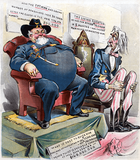
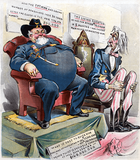
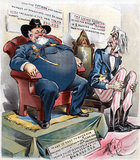
As for U.S. veterans, by the 1890s the vast amount of money (in aggregate) being paid to CW veterans was getting a lot of pushback, especially because there were far more of them, and (IIRC) the U.S. pension did not require the applicant to show need in the same way. In January 1898 -- just a few weeks before the battleship Maine when BOOM! in Havana -- this was the cover of the satirical magazine Puck, with pensioned Union veterans and Uncle Sam as carnival sideshow attractions in the "National Dime Museum," with the veterans as the Fat Man, getting ever fatter, and a destitute Uncle Sam as the "Living Skeleton."

nationaldimemuseum.png
 

Attachments

  • nationaldimemuseum.png
    nationaldimemuseum.png
    424.4 KB · Views: 50
Last edited:
The state pensions given Confederate veterans were invariably "means-tested," and you had to be very nearly indigent to qualify for one. While the amount varied from state to state, it was generally very small, but the men receiving them badly needed anything they could get.

As for U.S. veterans, by the 1890s the vast amount of money (in aggregate) being paid to CW veterans was getting a lot of pushback, especially because there were far more of them, and (IIRC) the U.S. pension did not require the applicant to show need in the same way. In January 1898 -- just a few weeks before the battleship Maine when BOOM! in Havana, this was the cover of the satirical magazine Puck, with pensioned Union veterans and Uncle Sam as carnival sideshow attractions in the "National Dime Museum" — with the veterans as the Fat Man, getting ever fatter, and a destitute Uncle Sam as the "Living Skeleton."

nationaldimemuseum.png
Great carton. I was wondering if Unionist vets could receive pensions from their state governments just like the Confederate vets? I did go on one website search.ancestory.com/search and at least in Tennessee they could but since the federal government paid more the Unionist vets and those CSA vets that changed sides preferred federal pensions. I don't know if the state of Tennessee allowed double dipping perhaps Mo did? Has you know every Southern state had at least one Unionist organization ( Ms only had one battalion) other then Sc which did have some men who joined out of state Union regiments. Tn had the most Unionist soldiers although half joined out of state regiments mostly from Ky.
Leftyhunter
 

Attachments

  • nationaldimemuseum.png
    nationaldimemuseum.png
    424.4 KB · Views: 89
Here is a table from Clarence D. Long, Wages and Earnings in the United States, 1860-1890 (Princeton University Press, 1960), that compares census data on manufacturing wages during that period. The U.S. soldier's annual base pay of $156 is generally lower than manufacturing jobs, which in turn are higher-paid than unskilled labor or farm jobs. When you consider that much else was provided to soldiers (housing, rations, basic medical care) that generally was not provided to civilian manufacturing workers, Army pay was not inordinately low, and may have been a positive inducement to low- or unskilled laborers.

View attachment 91517

The same paper also notes that there were significant variations in pay according to region; manufacturing workers in the western states generally earned more than their eastern counterparts, while those in the southern states earned less.

Note: This post has been edited because initially I forgot how to do basic arithmetic. Do'oh.
I found some interesting information regarding CW pensions from encyclopediaofarkansaw.net .
CSA vet as you know could not receive federal pensions. Per the pension laws of the Southern states if a CSA vet lived in a Southern state he applied to his state of residence for a pension.
For example Jacob Ridling was a long serving CSA soldier from Ark who moved to Tx after the CW. When Ridling died in 1916 the state of Tx paid him an annual pension of $31.60.
Edward Clanton was also a resident of Ark. Clanton served three years in the 1st Ark Cavalry US, Clanton applied for a federal pension in 1891. When Clanton died in 1912 his annual federal pension was 360 a year.
Leftyhunter
 
The state pensions given Confederate veterans were invariably "means-tested," and you had to be very nearly indigent to qualify for one. While the amount varied from state to state, it was generally very small, but the men receiving them badly needed anything they could get.

As for U.S. veterans, by the 1890s the vast amount of money (in aggregate) being paid to CW veterans was getting a lot of pushback, especially because there were far more of them, and (IIRC) the U.S. pension did not require the applicant to show need in the same way. In January 1898 -- just a few weeks before the battleship Maine when BOOM! in Havana -- this was the cover of the satirical magazine Puck, with pensioned Union veterans and Uncle Sam as carnival sideshow attractions in the "National Dime Museum," with the veterans as the Fat Man, getting ever fatter, and a destitute Uncle Sam as the "Living Skeleton."

nationaldimemuseum.png
Per mirgration.kentucky.gov Ky awarded pensions to CSA vets in 1912 but not to Union vets although about 50 k Ky men served in the Union Army vs 25k in the CSA. By 1912 of course their where not that many CSA vets left.
Leftyhunter
 

Attachments

  • nationaldimemuseum.png
    nationaldimemuseum.png
    424.4 KB · Views: 46
This site has a lot of information, including some of the information used above by @AndyHall
http://outrunchange.com/2012/06/14/typical-wages-in-1860-through-1890/

The fact that the army supplied a lot certainly helped. Remember, a great deal of soldiers sent money back home to offset them being gone. Interestingly enough, the army certainly made sure nothing was wasted. I've seen stoppages from everything from steamboat fairs to losing a spur.
 

Learn About Us
About CivilWarTalk
Contact the Webmaster
Meet the Staff
Link to CivilWarTalk
Join Our Community
Register
Browse Forums
View Today's Discussions
Search the Forum
Get Help
FAQ
Student Guide
Forum Rules & Etiquette
Copyright / DMCA

     Contact Us CivilwarTalk on Facebook CivilWarTalk on YouTube CivilWarTalk on Twitter RSS Feed

Bringing the American Civil War and More to Life.
© 1999 - , CIVILWARTALK, LLC - Site Version 10.0

SlaveryTalk.com - SecessionTalk.com - CivilWarTalk.com - ReconstructionTalk.com
Back
Top