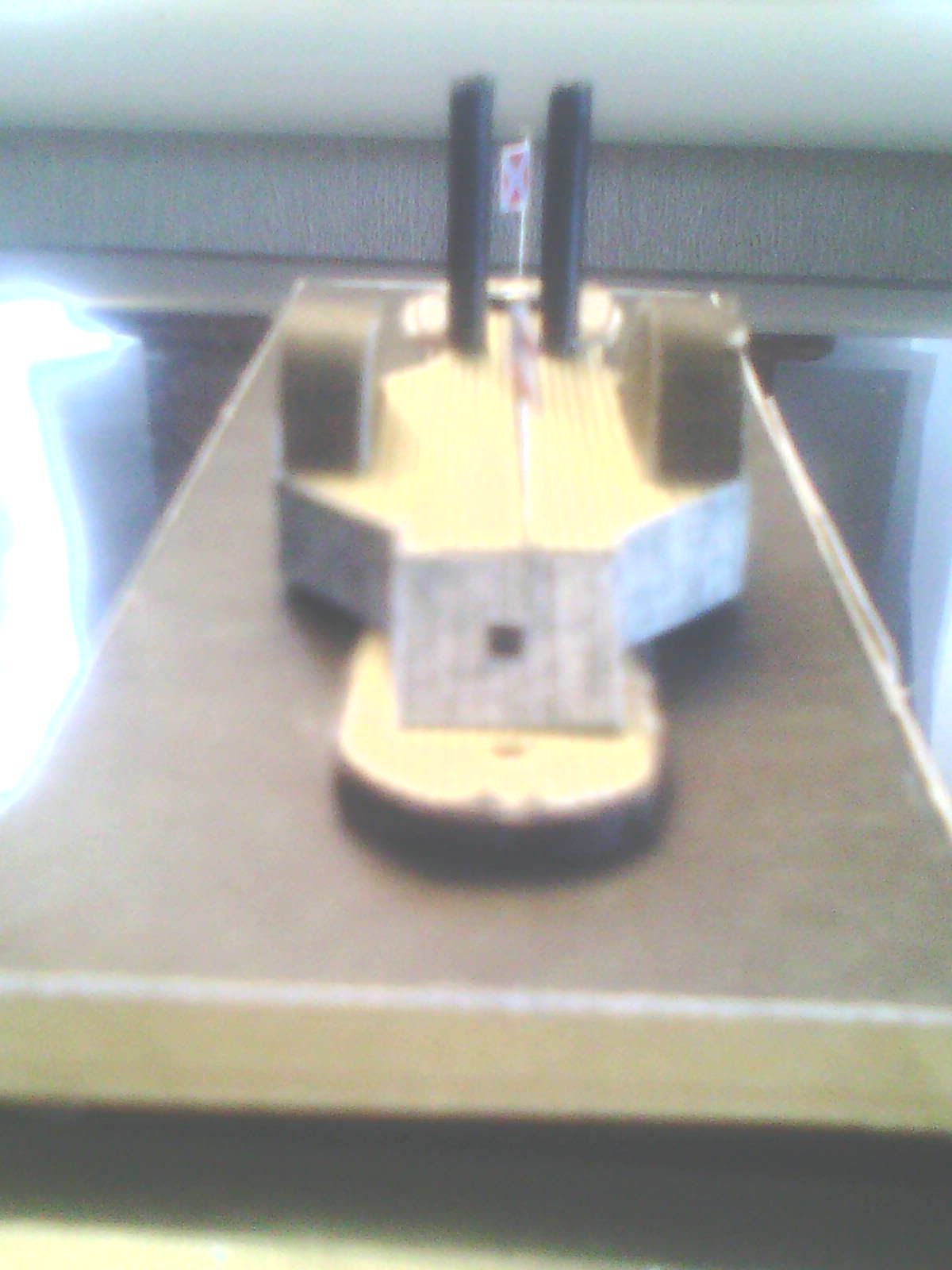
CSS EASTPORT MODEL

rebelatsea

Captain
Joined
Mar 30, 2013
Location
Kent ,England.
Following on from the discussion about this ship, I decided to model I.N.Brown's intended conversion in 1/600 sc
Port side.jpg
Starboard side.jpg
Stern.jpg
Bow.jpg
ale. I'm still getting used to the camera on my phone in close up work.
 
Following on from the discussion about this ship, I decided to model I.N.Brown's intended conversion in 1/600 scView attachment 60481 View attachment 60482 View attachment 60484 View attachment 60485 ale. I'm still getting used to the camera on my phone in close up work.
Howdy Again Rebel! So the Arkansas/Tennessee class was not the only western armorclad going with vertical broadside shields? Do we know how much iron they were planning on carrying? Looks like RR iron. Now we know why Brown was pirating every fastener he could get his hands on. Did they drop the Eastport's boilers into the hold?
 
Hi Georgew,

We think it would have been ironed in the same was as Arkansas /Tennessee, so 2 x t rail. Not sure the conversion actually started under Brown. The Union found all the materiel piled up and ready to go. .
 
Hmm... again, a very different direction taken by the USN when they acquired her. The only information I have about her progress under Confederate control is rather vague. "She was halfway through the process of being converted to an ironclad."And that may very well be more " received wisdom. "
 
While it's not much to go on, the work that had already been done on Eastport and the fact that iron had been collected to armor her is a pointer... and I believe rebelatsea extrapolated from what we know about Confederate conversions like the River Defense Fleet gunboats and the design of the Arkansas (please correct me if I have that wrong, John).


On the flip side, the conversion design as completed by the Union bears some strong similarities with the USS Lafayette, under conversion from the Aleck Scott at about the same time (though without the fancy curved frames of the Lafayette); I wouldn't be surprised if the Lafayette's conversion affected the course of Eastport's. (Or vice versa, I suppose, though I think that William D. Porter was more apt to go his way than to copy what Phelps was doing...)
 
Not at all disputing John's conclusions. I'm really just curious how much work had been done on her. At the time she was captured (early 1862, yes?) the River Defense Fleet was still a potent force (and a part of the Army, if I recall.) It makes me guess that, given the need for more firepower and iron in the short term, she may well have been far enough along that the US authorities decided she was worth finishing.
 
It's been a while since I've read it, but I'm wondering if there might not be some detail in Jay Slagle's Ironclad Captain. S. Ledyard Phelps captured the Eastport upstream of Fort Henry on the raid up the Tennessee after the fort's fall, and really took on the conversion into an ironclad as a personal mission.
 
While it's not much to go on, the work that had already been done on Eastport and the fact that iron had been collected to armor her is a pointer... and I believe rebelatsea extrapolated from what we know about Confederate conversions like the River Defense Fleet gunboats and the design of the Arkansas (please correct me if I have that wrong, John).


On the flip side, the conversion design as completed by the Union bears some strong similarities with the USS Lafayette, under conversion from the Aleck Scott at about the same time (though without the fancy curved frames of the Lafayette); I wouldn't be surprised if the Lafayette's conversion affected the course of Eastport's. (Or vice versa, I suppose, though I think that William D. Porter was more apt to go his way than to copy what Phelps was doing...)
Mark , George and I think Brown was guided by Arkansas. He wanted to construct a quick effective conversion, which that plan certainly would have been. The "received wisdom" bit is that all of he materiel the Union found was for Eastport, but of course it wasn't. Unfortunately it gave them a free gift for Phelps to use.
 
Not at all disputing John's conclusions. I'm really just curious how much work had been done on her. At the time she was captured (early 1862, yes?) the River Defense Fleet was still a potent force (and a part of the Army, if I recall.) It makes me guess that, given the need for more firepower and iron in the short term, she may well have been far enough along that the US authorities decided she was worth finishing.
Alex,
The Union were presented with a free gift in the form of a vessel already stripped for conversion and more than enough materiel collected for Phelps to do his own thing. Brown wanted to do a quick and effective conversion based on the Arkansas, had nothing to to do with the RDF. The "received wisdom" is that all of the materiel was for Eastport , it wasn't .
Brown was ready to do other conversion too.
 
Eastport and whatever other ironclads the Confederates might have built on the Tennessee illustrate the advantage geography gave to the Union. In terms of river travel, the Union fleet and shipyards were between them and the rebel squadron on the Mississippi, including the ironclads under construction at Memphis. Even if the Confederates had been able to complete all their planned ships, they would still have been separated, with the Union able to concentrate superior force wherever they met in battle.
 
Again highlighting what a catastrophically poor choice it was not to put more thought into the defense of New Orleans. I've often been asked when I believe the war was lost by the Confederacy: and I believe it was lost the moment New Orleans was in Union hands.
 
Again highlighting what a catastrophically poor choice it was not to put more thought into the defense of New Orleans. I've often been asked when I believe the war was lost by the Confederacy: and I believe it was lost the moment New Orleans was in Union hands.

Isolating one "turning point" is something of a never-ending endeavor, but New Orleans certainly is a viable candidate.
 
Completely agreed, Mark. One could argue for a resolution won with a decisive victory on the battlefield. Just a thought, really. I would argue (and I think I've seen you do the same, so forgive me if mis-quoting) that the Blockade also played a considerable role in forcing the South to commit to a kind of war it could not win.
 
Last edited:
Completely agreed, Mark. One could argue for a resolution won with a decisive victory on the battlefield. Just a thought, really. I would argue (and I think I've seen you do the same, so forgive me if mis-quoting) that the Blockade also played a considerable role in forcing the South to commit to a kind of war it could not win.

Ole characterized it as "death by a thousand cuts," or something along those lines, which I think is quite apt. Pressures exerted from all sides and in all manners, no one of which could have done the job alone; but cumulatively....
 

Learn About Us
About CivilWarTalk
Contact the Webmaster
Meet the Staff
Link to CivilWarTalk
Join Our Community
Register
Browse Forums
View Today's Discussions
Search the Forum
Get Help
FAQ
Student Guide
Forum Rules & Etiquette
Copyright / DMCA

     Contact Us CivilwarTalk on Facebook CivilWarTalk on YouTube CivilWarTalk on Twitter RSS Feed

Bringing the American Civil War and More to Life.
© 1999 - , CIVILWARTALK, LLC - Site Version 10.0

SlaveryTalk.com - SecessionTalk.com - CivilWarTalk.com - ReconstructionTalk.com
Back
Top