CSS Albemarle

I've been speaking to a very helpful person from the Neuse Museum, who directed me to some of these pictures.
http://www.nchistoricsites.org/neuse/drawings.htm
Thank you very much, that's great ,I'm always happy to learn new things, but to me they don't look like access hatches, although they are in the right places, rather they look like the thick bulbous glass skylights which several ironclads both Union and Confederate carried.
 
I was skeptical, not trying to cast doubt, but I thought about loading food and ammo through those hatches and I thought it would be a challenge to say the least. That is unless they loaded all that lot through the gunports and took them through the interior casemate hatches.

Also, I'm not sure how close the sisterly relationship was between the Albemarle and the Neuse. When I made my Tecumseh model, I found that different iron works did things in different ways, so there could be some large differences between two sisters made in different yards. Accounts seem to concur that they were virtually identical, but does that extend down to hatches?

Also, if anyone has any detailed drawings of what the engines and boiler would have looked like, it would be appreciated.
 
I was skeptical, not trying to cast doubt, but I thought about loading food and ammo through those hatches and I thought it would be a challenge to say the least. That is unless they loaded all that lot through the gunports and took them through the interior casemate hatches.

Also, I'm not sure how close the sisterly relationship was between the Albemarle and the Neuse. When I made my Tecumseh model, I found that different iron works did things in different ways, so there could be some large differences between two sisters made in different yards. Accounts seem to concur that they were virtually identical, but does that extend down to hatches?

Also, if anyone has any detailed drawings of what the engines and boiler would have looked like, it would be appreciated.
OwenEgan, something approaching true standardisation had to wait until until WWI, and even then different yards did their own thing with identical plans, so I would not be surprised if the two yards did different things to J.L.Porters plan.
Because Neuse had the quarter ports drawn in the plan and Albemarle didn't, I think it's always assumed that she was an exact copy of the drawings. That need not necessarily be true. Incidentally William Geoghehan is usually to be trusted with is drawings (except for his Mississippi, and I 'd still love to know how he came up with that). We owe the gentleman a great deal.
Any new information that adds to my understanding and knowledge of these vessel is always appreciated.
 
I haven't seen Goeghagen's drawing of Neuse, but in his drawings of CSS Tennessee and CSS Wilmington he shows cowl ventilators as a simple circles on the plan view. Maye whoever redrew those for the website misunderstood those to be hatches.
 
I haven't seen Goeghagen's drawing of Neuse, but in his drawings of CSS Tennessee and CSS Wilmington he shows cowl ventilators as a simple circles on the plan view. Maye whoever redrew those for the website misunderstood those to be hatches.
Andy, the reference OwenEgan gave is based on Geogehans plan. That suggestion of vent cowls is interesting and makes sense. Actually Albemarle did have one on the quarterdeck, but it is beside the aft hatch.
CSS ALBEMARLE.jpg
 
Ah the wonderful William Geogehan ! You will not get better than that, unless an original draft signed by John Luke Porter surfaces somewhere.

Well your request is found, did some deep research on JLP and found these:

Section and gun deck plan drawings of Confederate ironclad gunboats, including CSS Albemarle and CSS Neuse. Also includes a gun deck plan drawing of USS Merrimac/CSS Virginia, by John L. Porter C.S.N.C. [Confederate States Naval Constructor]. Digital reproduction from original drawing. 1 p. Signed and annotated by John L. Porter, with scale, dimensions, armament, etc. Date approximated.

Section drawings of armor plating designed and installed on the Confederate ironclad gunboat USS Merrimac/CSS Virginia by John Porter C.S.N.C. [Confederate States Naval Constructor]. Digital reproduction from original drawing. 1 item. 1 p. Note: "Iron on the Merrimac by J. L. Porter C. S. N. C." Date approximated.

Elevation, horizontal section & gun deck plan drawings of Confederate ironclad gunboat USS Merrimac/CSS Virginia, by John L. Porter (June 1861 - 1862). Digital reproduction of original drawing. 1 p. Date approximated.

Horizontal section drawing of ship's hull for Saunders' contract, by John L. Porter C.S.N.C. [Confederate States Naval Constructor]. Digital reproduction from original drawing. 1 p. Signed and annotated: "to be built of iron, arranged here for wood. Scale 5 feet = one inch". Date approximated.

Cants, elevation, and gun deck section plan drawings for unidentified spar torpedo boat, designed by John L. Porter. Digital reproduction from original drawing. 1 p. Signed by John L. Porter, "burned at Wilmington, N.C." Date approximated.

Last page of a letter from John Luke Porter to his son-in-law, John S. Moore, in Alabama. The letter discusses plans and designs for the Confederate ironclad gunboat USS Merrimac/CSS Virginia. Includes elevation and section drawings of the as well as a sketch map of the area between Paradise Creek and Scott's Creek in Portsmouth, Virginia. The letter also identifies Mr. John Ridgeley Porter, Jr., clerk of the Court of Hustings in Portsmouth, Virginia, as John Luke Porter's grandson.

Handwritten notebook in which John L. Porter recorded all the information he believed was required to pass the U. S. Naval Constructor's examination. The notebook features an examination guide for prospective naval contractor candidates, detailing information needed to know to pass the examination. As a note, the naval architectural notebook of John Porter was copied word-for-word directly from an 1816 treatise on steam propulsion by Robertson Buchanan. Robertson Buchanan, A practical treatise on propelling vessels by steam. (London: Ackerman 1816) appeared in numerous editions throughout the 19th century. It is not know which edition Porter copied. 234 numbered pages.

You'll have to access the page to see all the great images, tried to upload them but could not.

Notebook:
http://digital.lib.ecu.edu/3578

Images:
http://digital.lib.ecu.edu/search.aspx?q=local_id:850.*

These were a great find..hope y'all enjoy. :smile:
 
Last edited:
Great finds, After I wrote that I remembered I had JLP's Albemarle drawings. The new one's to me were the Sanders contract plans, and for that I thank you very much.
John Littlefield will be interested in the spar TB plans if he hasn't got them already.
 
Andy, the reference OwenEgan gave is based on Geogehans plan. That suggestion of vent cowls is interesting and makes sense. Actually Albemarle did have one on the quarterdeck, but it is beside the aft hatch.
View attachment 146999
One thing that doesn't make it into the drawings are the production techniques to execute the design. During Albemarle's construction, one of the builders relatives came up with an improved helical drill bit that greatly cut down on the amount of time required to drill iron. Her engines were supposed to be industrial mill types, adapted. It is unclear whether the boilers were the original industrial boilers or shipped in from elsewhere. Their on-site yard may or may not have had a saw mill.
 
One thing that doesn't make it into the drawings are the production techniques to execute the design. During Albemarle's construction, one of the builders relatives came up with an improved helical drill bit that greatly cut down on the amount of time required to drill iron. Her engines were supposed to be industrial mill types, adapted. It is unclear whether the boilers were the original industrial boilers or shipped in from elsewhere. Their on-site yard may or may not have had a saw mill.
That helical drill bit is still used today for drilling plate. Curiously the ones we had in our railway workshop, although bough t here were US imports.
 
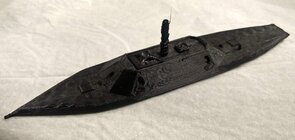
I thought you guys would like to see this. My friend has recently purchased a 3D printer.

This was an early test-print, so there are a lot of rough edges. Since then, things have improved greatly. When we've got a few more problems ironed out, I'll run her through again, and maybe the Passaic, Onondaga, Tecumseh, Teaser, Kickapoo, Manassas, etc...

hLCBOsp.jpg
 

Attachments

  • hLCBOsp.jpg
    hLCBOsp.jpg
    143.2 KB · Views: 126
Nice work. Is it possible to make them full hull also instead of just water line? I know 3d can be costly to make items, so not sure if it's practical for making them full hull. One dream of mine would be to have all the CSS ships and all the USN ACW ships as accurate as possible made into collections, small enough for people to paint and display and enjoy.
 
Most of the models are full hull. They were initially intended as naval wargame miniatures, so were cut down. We decided to do a larger test print. That Albemarle is the one in the previous renders, which has her hull, I just cut it off for that print. The Passaic doesn't have a lower hull, but that could be quickly remedied.

I might upload the STL files to a site where they can be downloaded for a small fee.

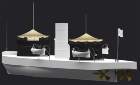
As an example, here's the Onondaga. She is still very 'Under Construction':
om3Oxge.jpg
 

Attachments

  • om3Oxge.jpg
    om3Oxge.jpg
    23.9 KB · Views: 105

Learn About Us
About CivilWarTalk
Contact the Webmaster
Meet the Staff
Link to CivilWarTalk
Join Our Community
Register
Browse Forums
View Today's Discussions
Search the Forum
Get Help
FAQ
Student Guide
Forum Rules & Etiquette
Copyright / DMCA

     Contact Us CivilwarTalk on Facebook CivilWarTalk on YouTube CivilWarTalk on Twitter RSS Feed

Bringing the American Civil War and More to Life.
© 1999 - , CIVILWARTALK, LLC - Site Version 10.0

SlaveryTalk.com - SecessionTalk.com - CivilWarTalk.com - ReconstructionTalk.com
Back
Top