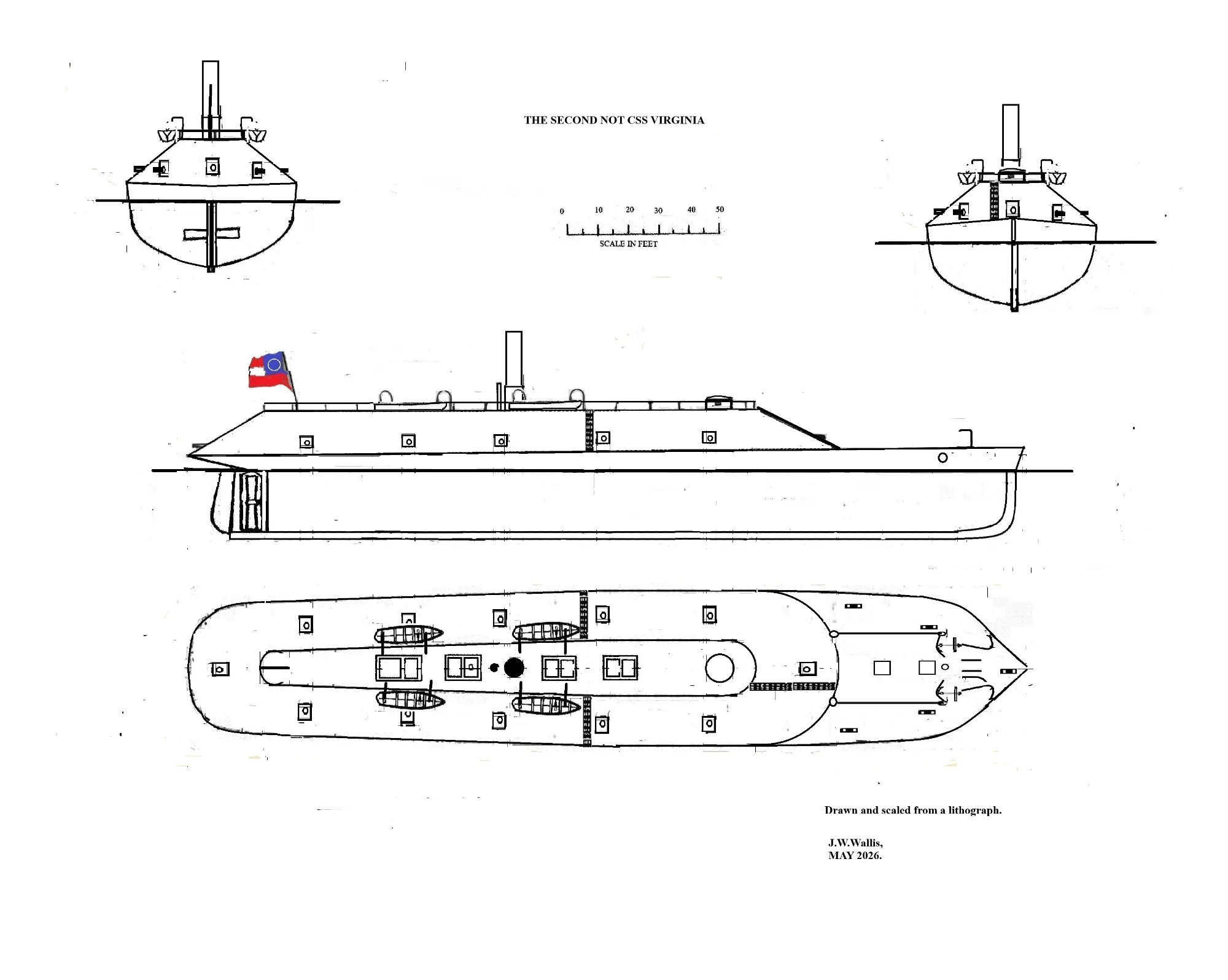
CSN IRONCLADS - NOT

rebelatsea

Captain
Joined
Mar 30, 2013
Location
Kent ,England.
I will start this series with the second litho I have purporting to be CSS Virginia and my interpretation thereof. I have "tarted" this one up by adding all the deck features. I will not put all the images up at once , but add them as we go.
ALTERNATICE VIRGINIA.webp
CSS THE SECOND NOT VIRGINIA.webp
 
Ironclads.
Much is made of these rather limited vessels. There is often the boast that these were 'revolutionary'. They were not. The first wooden ships sheathed in armor plate were armored floating batteries used to bombard Sevastopol in the Crimean war(1854-56) This was the spark that created the first sea-going fleet warship, the French 'Gloire' in 1859. THAT was the revolutionary step, to be followed by another revolutionary step with the British HMS Warrior - the first armored plated, iron hulled warship in 1860. Both were fleet ships capable of being used at sea. Neither were to see combat. (HMS Warrior survived and is now a museum ship - it is still afloat)

The real claim to fame was they were the first self-propelled ironclads to see action in 1862. The majority of US and CS ironclads were basically self-propelled floating batteries suitable only for river deployment, such was their freeboard. The ability to ram was built into a number as that was the only sure method of sinking or disabling enemy ironclads or ships. The Monitor was no exception, it's only claim to fame being the first vessel having an armored turret for its guns. It leaked like a sieve and sank in a storm being TOWED to deployment less than a year after commissioning! Even the two contemporaries of the Monitor - real sea-going ironclads - Galena and New Ironsides were converted into self-propelled floating batteries by removing their masts and rigging since there was no Conferderate fleet for them to attack.

The first fleet ironclad battle was the Battle of Lissa in the Mediterranian in 1866 between Austian and Italian fleets. The guns used did not create decisive damage, such was the armor protection, so ramming became the preferred method, hence the shape of warship hulls for decades, until the development of better guns and self-propelled torpedoes.
 
I'm sorry,
Ironclads.
Much is made of these rather limited vessels. There is often the boast that these were 'revolutionary'. They were not. The first wooden ships sheathed in armor plate were armored floating batteries used to bombard Sevastopol in the Crimean war(1854-56) This was the spark that created the first sea-going fleet warship, the French 'Gloire' in 1859. THAT was the revolutionary step, to be followed by another revolutionary step with the British HMS Warrior - the first armored plated, iron hulled warship in 1860. Both were fleet ships capable of being used at sea. Neither were to see combat. (HMS Warrior survived and is now a museum ship - it is still afloat)

The real claim to fame was they were the first self-propelled ironclads to see action in 1862. The majority of US and CS ironclads were basically self-propelled floating batteries suitable only for river deployment, such was their freeboard. The ability to ram was built into a number as that was the only sure method of sinking or disabling enemy ironclads or ships. The Monitor was no exception, it's only claim to fame being the first vessel having an armored turret for its guns. It leaked like a sieve and sank in a storm being TOWED to deployment less than a year after commissioning! Even the two contemporaries of the Monitor - real sea-going ironclads - Galena and New Ironsides were converted into self-propelled floating batteries by removing their masts and rigging since there was no Conferderate fleet for them to attack.

The first fleet ironclad battle was the Battle of Lissa in the Mediterranian in 1866 between Austian and Italian fleets. The guns used did not create decisive damage, such was the armor protection, so ramming became the preferred method, hence the shape of warship hulls for decades, until the development of better guns and self-propelled torpedoes.
I'm sorry, but your post has nothing to do with the subject of this thread, and is in error in many ways.
John Luke Porter's 1846 plan for a steam propelled coast defence vessel which is the direct ancestor of the CSN steam ironclads which were not "basically self propelled floating batteries", being intended to fight wooden vessels.

The plan preceded Dupuy de Lome's batterie flottante a vapeur by 9 years and the UK copies by 10, and these vessels were intended to fight and destroy shore forts and batteries, not fight other vessels.
Devastation led directly to Gloire only because the French iron industry at the time couldn't produce an iron hull.
Warrior was a totally different concept being more akin to the fast battleship of WWII.

I will return to the proper subject of the thread in my next post.
 
What IS the subject of this thread?

Plans and diagrams are available and so why are you using artistic drawings and etchings, many by artists who did not see what was happening or saw it from a distance - or at night - and drew it later. To produce plans you claim are NOT of those vessels? Is it to interpret those drawings and etchings?

For those wondering what I am on about, here is a photograph of people watching a bombardment. USS New Ironsides, bombarding Fort Moultrie Charleston, South Carolina. April 1863 and the published version:
1781094236783.webp
1781095040253.webp

This was one of the few photos found using 'civil war ironclads bombarding' image search. There is little detail to be seen and a sketch artist would need a telescope or opera glasses to get any detail. Most of the results of that search are wood engravings from etchings drawings which use a certain amount of 'artistic licence' - the only images that could be produced in illustrated productions like this one from Harpers Weekly.
 
Ironclads.
Much is made of these rather limited vessels. There is often the boast that these were 'revolutionary'. They were not. The first wooden ships sheathed in armor plate were armored floating batteries used to bombard Sevastopol in the Crimean war(1854-56)
The first iron cladded wood ships were the Korean Turtle Boats (they had cannons). I do concede that the Crimean War had a lot of "firsts" that predated the American centric claim for firsts for the Civil War. The Crimean War saw the first distribution of mass produced rifles (minie guns) issued to infantry (OK, Britain since the F&I had been playing with rifles, Germans, Austro-Hungarians and Russians had their rifle equipped jagers), railways used for troop movement (saving shoe leather and faster than foot), organized women nursing (but camp followers traditionally served as nurses), extensive journalism coverage (yes, it existed before the Crimean War).

The honor that belongs to the ACW is the first clash between ironclad ships (March 9, 1862). BTW, the Confederate floating ironclad battery off of Sullivan Island received the first shot from Sumter.
 
What IS the subject of this thread?

Plans and diagrams are available and so why are you using artistic drawings and etchings, many by artists who did not see what was happening or saw it from a distance - or at night - and drew it later. To produce plans you claim are NOT of those vessels? Is it to interpret those drawings and etchings?

For those wondering what I am on about, here is a photograph of people watching a bombardment. USS New Ironsides, bombarding Fort Moultrie Charleston, South Carolina. April 1863 and the published version:
View attachment 582345View attachment 582350
This was one of the few photos found using 'civil war ironclads bombarding' image search. There is little detail to be seen and a sketch artist would need a telescope or opera glasses to get any detail. Most of the results of that search are wood engravings from etchings drawings which use a certain amount of 'artistic licence' - the only images that could be produced in illustrated productions like this one from Harpers Weekly.
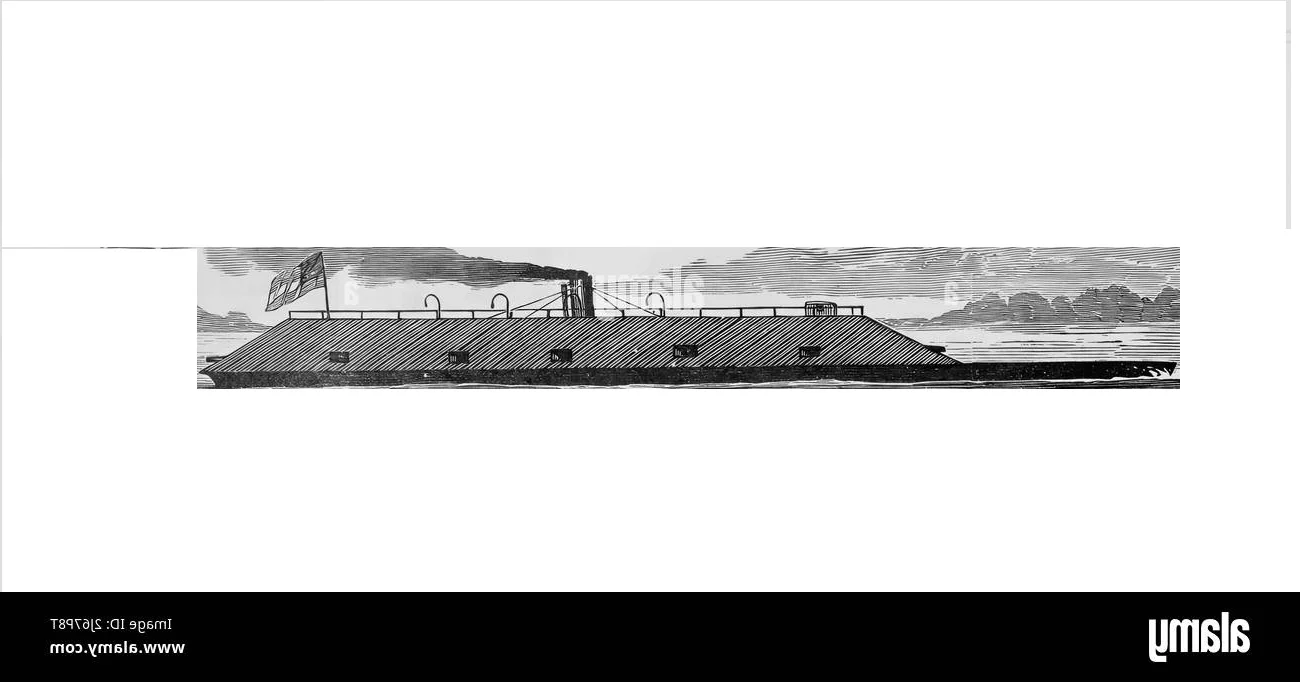
The purpose of this thread.
Please refer to "Interpretations of CSN ironclad lithographs posted on Sunday last.


In a facebook naval wargaming forum, I was asked to scale a lithograph purporting to be CSS Virginia against the plans of the USS Merrimac - surprisingly it was a match. The project was done at the request of and for the benefit of those who like to design and build their own ship models, I have continued the project, and indeed some may well become available for 3d printing. Subsequently I posted the same drawings here and asked if members would be interested in seeing more lithos converted into scale plans. The replies were positive and that is the purpose of this thread.
Indeed I know there are model making members in CivilWarTalk who may well be interested too.

So far as "real" plans etc being available, you apparently are unaware that I am the author of "The Southern Iron Navy" a volume of scale plans and "potted " histories of the ironclad and iron protected vessels of the Confederate States Navy published in 2019. with a revised version currently in preparation incorporating new information and corrections acquired since publication.
 
Last edited:
The first iron cladded wood ships were the Korean Turtle Boats (they had cannons). I do concede that the Crimean War had a lot of "firsts" that predated the American centric claim for firsts for the Civil War. The Crimean War saw the first distribution of mass produced rifles (minie guns) issued to infantry (OK, Britain since the F&I had been playing with rifles, Germans, Austro-Hungarians and Russians had their rifle equipped jagers), railways used for troop movement (saving shoe leather and faster than foot), organized women nursing (but camp followers traditionally served as nurses), extensive journalism coverage (yes, it existed before the Crimean War).

The honor that belongs to the ACW is the first clash between ironclad ships (March 9, 1862). BTW, the Confederate floating ironclad battery off of Sullivan Island received the first shot from Sumter.
Absolutely correct, not forgetting Sardinian Artillerist Colonel Cavalli with his system of breech loading which later became the Swedish Wahrendorf system, and his ironclad designs which have a direct connection to the CSN via Naval Architect W. T Smith.
 
Now to return to the thread. CSS Savannah is the next subject

The first lithograph Produces an eminently sensible vessel somewhat larger than the real one.
The second one, well I can only think waccy baccy was involved !
Bildschirmfoto 2026-06-11 um 13.12.49.webp

What could the marked section meant to be? (I believe it is not represented in your scaled plan)
Might it have been a kind of armoured paddle wheel housing?
 
It is in the plan, that's the pilot house atop the forward casemate.
Maybe there is a misunderstanding - I see the pilothouse on top of the casemate - I was thinking of the darker coloured part of the pilothouse. There is a line of about 45 degrees starting exactly where the right corner of the pilothouse meets the casemate. The casemate on the right of it seems darker coloured in my eyes - to me it looks
- as if the casemate is angled there
- or like a sideweheel casing.
Am I misled?
 
Maybe there is a misunderstanding - I see the pilothouse on top of the casemate - I was thinking of the darker coloured part of the pilothouse. There is a line of about 45 degrees starting exactly where the right corner of the pilothouse meets the casemate. The casemate on the right of it seems darker coloured in my eyes - to me it looks
- as if the casemate is angled there
- or like a sideweheel casing.
Am I misled?
I'm afraid you are. I work to as high a magnification as I can get without distorting the image, there is no angle or paddle housing, But it appears as if the front face of the casemate is extended upward, which I did leave off the plan by accident, so thank you for seeing an anomaly. incidentally the Loch Ness monster to her port bow is actually a boat with one mast under sail. Our sailing masters will probably be able to identify the type, looks broadly similar to a Norfolk wherry here in England,
 

Learn About Us
About CivilWarTalk
Contact the Webmaster
Meet the Staff
Link to CivilWarTalk
Join Our Community
Register
Browse Forums
View Today's Discussions
Search the Forum
Get Help
FAQ
Student Guide
Forum Rules & Etiquette
Copyright / DMCA

     Contact Us CivilwarTalk on Facebook CivilWarTalk on YouTube CivilWarTalk on Twitter RSS Feed

Bringing the American Civil War and More to Life.
© 1999 - , CIVILWARTALK, LLC - Site Version 10.0

SlaveryTalk.com - SecessionTalk.com - CivilWarTalk.com - ReconstructionTalk.com
Back
Top