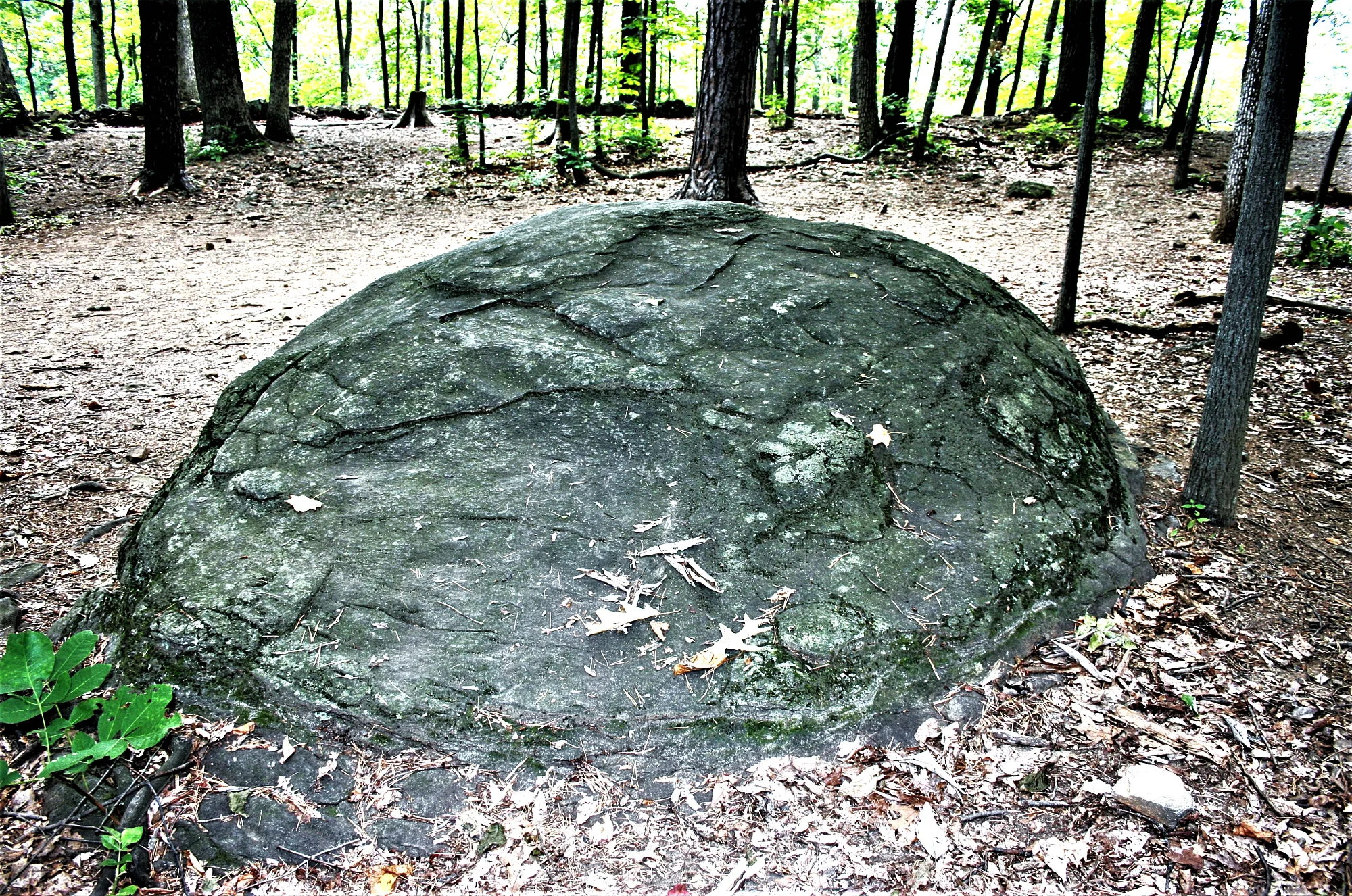
I can see two possibilities as to how this went. The first scenario is that the 20th Maine's line ebbed and flowed back and forth with the fluidity of the combat. There are accounts that stated that there were times that the two wings were almost back-to-back and I could see a small group of Confederates make it as far as the Oates rock before the Federal left whipped back to it's position, leaving a mortally wounded John Oates behind the line.
The other scenario is that there was a small break in the line due to casualties that allowed Lt. Oates to penetrate the position before the left wing reformed and cut him off.
IMO, I tend to think that the first scenario is more likely but I don't discount that it very well could be a combination of both as well.
Ryan
The first is pretty much what Colonel Chamberlain describes, that his men were in extended order. That at several points Confederates came reached and penetrated his line. That his men rallied behind their line, and advanced again to it, etc. etc.
Chamberlain says it all... the tactics employed were "wild rush and desperation." The troops were not formed in parade ground order, and they didn't go out of their way to expose themselves. As Chamberlain mentions, the "edge" of battle moving to and fro, over the casualties) as the men of the two sides did their best to kill each other, and hold or take the contested position.
"Squads of the enemy broke through our line in several places, and the fight was literally hand to hand. The edge of the fight rolled backward and forward like a wave. The dead and wounded were now in our front and then in our rear. Forced from our position, we desperately recovered it, and pushed the enemy down to the foot of the slope. The intervals of the struggle were seized to remove our wounded (and those of the enemy also), to gather ammunition from the cartridge-boxes of disabled friend or foe on the field, and even to secure better muskets than the Enfields, which we found did not stand service well. Rude shelters were thrown up of the loose rocks that covered the ground."
In this fighting, there were times the two forces mingled or intermixed to some degree: "the two lines met, and broke, and mingled amidst the shock." With Chamberlain himself "at times" seeing about him more enemy than friendly soldiers...
Chamberlain reported:
"Three times our line was forced back, but only to rally and repulse the enemy. As often as the enemy's line was broken and routed, a new line was unmasked..."
It is interesting to note both Chamberlain and Oates claimed that as they repulsed each other, they both assumed the new attacks directed on them
were reinforcements, rather than each regiment in turn rapidly reorganizing to advance again and again over the "contested ground" over which Chamberlain reported,
"the edge of the conflict swayed to and fro--now one and now the other party holding the contested ground..."
Captain Prince of the 20th Maine confirms...
Colonel Chamberlain reported that at the time his regiment made its final bayonet charge, to secure its position, etc., the ranks were "shattered" and he got the "groups" to charge downhill with the bayonet...
I see that in a letter to one of his senior officers (Letter to Gen. Barnes) Colonel Chamberlain noted that at the time of this charge, the men of his "shattered line" were directed to take five pace intervals, in reforming, viz. "ordered 'bayonets fixed,' and 'forward' at a run" and that
"I directed the whole Regiment to take intervals at 5 paces by the left flank, & change direction to the right, all this without checking our speed … while the left [wing] swept around …"
in one of his more straightforward accounts, Ellis Spear relates that at the time of the charge, the some of the 15th Alabama were principally "concealed" by the rocks, and the 20th Maines' dead were within the Confederates' lines...
"At one time our dead were within the advanced lines of the enemy; but just at this critical moment, in the hottest part of the fight, when it was perhaps uncertain whether we should hold the place assigned us or be driven back, the Colonel ordered a charge!
Nothing could have been more opportune. It saved the regiment perhaps from defeat and certainly gave it all the success which was gained. The men[,] encouraged by the order, rushed down over the slope with yells and so quickly that the rebels who were concealed amongst the rocks nearest us had no time to escape."



 Bringing the