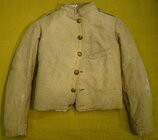
Confederate undyed uniforms

Forrest

Sergeant
Joined
Sep 25, 2015
I've read about the undyed uniforms, but never seen an example. They are mentioned by Union soldier(s) in their observations of Confederate soldiers they saw when they entered Vicksburg after the siege.

I'm curious what they looked like both new and well-worn. Perhaps it was just white and dirty white?
 
I've read about the undyed uniforms, but never seen an example. They are mentioned by Union soldier(s) in their observations of Confederate soldiers they saw when they entered Vicksburg after the siege.

I'm curious what they looked like both new and well-worn. Perhaps it was just white and dirty white?
Forrest, try this site by Frederick Adolphus (one of the gurus of Confederate clothing) IIRC, he talks quite a bit about undyed fabric as well as "drab". http://adolphusconfederateuniforms.com/free-article-downloads.html
 
L. Cormier, Boone's Louisiana Battery
L. Cormier, Boone's Battery, Louisiana.jpg
 
See these two previous threads:
http://civilwartalk.com/threads/texas-white-fatigue-uniforms.122361/
http://civilwartalk.com/threads/texans-in-white-uniforms.126872/

The 1st Missouri Brigade was issued undyed wool uniforms prior to Pea Ridge. They were manufactured at the Little Rock Penitentiary, originally intended for Albert Pike's Indians though later procured by Sterling Price for his men.

Our regiment was uniformed here; the cloth was of rough coarse texture, and the cutting and style would have produced a sensation in the fashionable circles: the stuff was white, never having been colored, with a goodly supply of grease--the wool had not been purified by any application of water since it had been taken from the back of the sheep. In pulling off and putting on the clothes, the olfactories were constantly exercised with a strong odor of that animal. Our brigade was the only body of troops that had these uniforms issued to them, and were often greeted with a chorus of ba-a-as.... Our clothes, however, were strong and serviceable, if we did look and feel sheepish in them.
- Anderson, Ephraim M. Memoirs: Historical and Personal; Including the Campaigns of the First Missouri Confederate Brigade, p. 161

The 2nd Texas Infantry was also issued undyed wool uniforms prior to Shiloh, as described by Col. John C. Moore:

When my regiment, the Second Texas Infantry, was organized, at Galveston in 1861, not being able to procure Confederate gray, the men were supplied with Federal blue uniforms captured at Texas military posts. When, in March, 1862, we were ordered to report to Gen. A. S. Johnston, then at Corinth, we marched across the country to Alexandria, and thence were conveyed by steamer and railroad to our destination.

Not believing Federal blue a life prolonging color for a Confederate's uniform in battle, I sent an agent with a requisition on the quartermaster at New Orleans for properly colored uniforms. He met us at Corinth a few days before marching for the Shiloh (or Pittsburg Landing) battlefield. When the packages were opened, we found the so-called uniforms as white as washed wool could make them. I shall never forget the men's consternation and many exclamations not quoted from the Bible, such as "Well, I'll be d-----!" "Don't them thing's beat h---" "Do the generals expect us to be killed, and want us to wear our shrouds?" etc. Being a case of Hobson's choice, the men cheerfully made the best of the situation, quickly stripped off the ragged blue and donned the virgin white. The clothing having no marks as to sizes, articles were issued just as they came hit or miss as to fit. Soon the company grounds were full of men strutting up and down, some with trousers dragging under their heels, while those of others scarcely reached the tops of their socks; some with jackets so tight they resembled stuffed toads, while others had ample room to carry three days' rations in their bosoms. The exhibition closed with a swapping scene that reminded one of a horse-trading day in a Georgia county town. A Federal prisoner at Shiloh inquired: "Who were them hell-cats that went into battle dressed in their grave clothes?"

- Confederate Veteran, Vol. 12, March 1904, p. 116.
 
Our regiment was uniformed here; the cloth was of rough coarse texture, and the cutting and style would have produced a sensation in the fashionable circles: the stuff was white, never having been colored, with a goodly supply of grease--the wool had not been purified by any application of water since it had been taken from the back of the sheep. In pulling off and putting on the clothes, the olfactories were constantly exercised with a strong odor of that animal. Our brigade was the only body of troops that had these uniforms issued to them, and were often greeted with a chorus of ba-a-as.... Our clothes, however, were strong and serviceable, if we did look and feel sheepish in them.
- Anderson, Ephraim M. Memoirs: Historical and Personal; Including the Campaigns of the First Missouri Confederate Brigade, p. 161

Fantastic stuff - thanks everyone! The above reminds me of the 'natural' wool sweaters I found on the west coast of Ireland many years ago. One of these, and a fisherman's knitted wool cap, and you did smell pretty much like a sheep.
 
Our regiment was uniformed here; the cloth was of rough coarse texture,

Page 3 Feb 62: "We reached Cave (Cove) Creek, the 22nd and encamped between two mountains. While here we received large supplies of clothes, belts cartridge boxes and cap boxes. Our clothes were very course material but they were warm." [Leach, John Miller, 1830-1907 Diary, 1861-1863, R1147], The State Historical Society of Missouri, Manuscript Collection

Looks like more Missouri troops got this uniform other than just the 1st Brigade in Arkansas just before Elk Horn(Pearidge). Leach was in Adams/Flemming's Company(organized Jan 1 62) - reorganized with Weildermire's company(Flemming remaining Captain and Weildermire to First LT), and attached to Roser's Reg. Slack's brigade.(March 16-28 62 Slacks' brigade was formed with Green's brigade to form the 3rd brigade) At the time of this quote.

They would later go on to form the; May 16th reorganized into 3rd(Erwin's) Missouri Infantry Battalion CSA-(not to be confused with the 3rd Regiment), then the Mid July 62 at Gun Town, Miss. 6th MO Inf., then finally 2nd-6th MO Inf. Consolidated in Demopolise Ala. Sept 63.
 
Forgot about this thread. Nice piece of info @MOBDEnut. Haven't had time yet to read through the Leach diary, but first I would like to add this here.

What may be undyed uniforms can be seen in this photograph of Confederate prisoners at Camp Morton. This was one of a collection of four photographs of Camp Morton owned by Eugene F. Drake, a private in Co. I, 60th Massachusetts Infantry. His regiment served as guards at Camp Morton in August 1864 until mustered out on November 30, 1864, so that may give some indication as to when this image was taken.

prigionieri32-jpg.133169.jpg


Most of Camp Morton's prisoners were from the Western theater - the Army of Tennessee, Morgan's raiders - as well as some from the Trans-Mississippi. Some of the Confederate troops captured in the battle of Helena, Ark., were sent Morton. The 43rd Indiana Infantry had participated in the capture of the 37th Arkansas Infantry at Helena in July 1863 and later met them again while guards at Camp Morton in summer of 1864. Quite possible they and other Confederate troops in the Western theater were issued undyed uniforms by 1863-64 if this photo was indeed taken around late 1864.

camp-morton-1-jpg.133173.jpg


camp-morton-2-jpg.133159.jpg
 
Were white uniforms and undyed uniforms the same thing?

I am going to say yes. In most descriptions of "white" uniforms it also refers to them as undyed, the wool and cotton being left in its natural color. So it would have a "white" appearance but not "bleach white" like we think of today. Was the technology there to bleach it? Yes, however I do not think this practice was wide spread.
 
Here is an example of one of Ben Tarts reproduction wool jeans
natural_cream_jean.jpg

"A reproduction wool and cotton fabric woven with a twill pattern often seen in confederate uniforms and civilian clothing of the 1800's.

Fiber Content: Wool and Cotton.

58 inches wide.

The wool in this cloth is a natural Cream sheep's fleece color and is woven on a natural cream cotton warp."
**************************************************************************************
Here is another example of a Natural gray jean wool also from Ben Tart
natgreyjean.jpg

A reproduction wool and cotton fabric woven with a twill pattern often seen in confederate uniforms and civilian clothing of the 1800's.

Fiber Content: Wool and Cotton.

58 inches wide.

The color of this fabric derives from the natural gray color in the sheep's fleece and is fade resistant.

This fabric has been finished/pre-shrunk.
*********************************************
You can find more examples of Conf. period vegetable dyed and natural (Undyed) Wool and Cotton Jeans on Ben's web site. http://www.bnbtart.com/jeancloth.html

Here is some stuff from his FAQ page that might help some better understand some things about Jean wool etc.

"
What is the difference between dyed and fleece colors?

Fleece colors are the natural color of the sheep's fleece. In other words brown colored Fleece/fiber comes from brown sheep, white colored Fleece/fiber comes from white sheep, and a tan Fleece/fiber is what happens when someone doesn't lock the gate... no seriously a tan fleece color can be achieved by mixing the brown sheep's fleece with the white sheep's fleece."


"What is the difference between plains, jean, cassimere & satinette ?
The terms plains, satinette , cassimere and jean all refer to the weave structure in the cloth. All four weaves in the cloth we carry are wool filling threads woven over cotton warp threads. Plains cloth is a plain weave where the wool thread goes over one cotton thread and under the next. In jean weave the wool thread goes under 1 cotton thread then over the next two. In cassimere cloth the wool thread goes under 2 cotton threads then over the next two this weave is offset so that there is a defined twill line on both the face and the back of the cloth. In satinette the wool thread floats over several cotton threads before going under one. Satinette has most of the wool on the face of the fabric and most of the cotton on the back to mimic an all wool fabric."
 
Last edited:
See these two previous threads:
http://civilwartalk.com/threads/texas-white-fatigue-uniforms.122361/
http://civilwartalk.com/threads/texans-in-white-uniforms.126872/

The 1st Missouri Brigade was issued undyed wool uniforms prior to Pea Ridge. They were manufactured at the Little Rock Penitentiary, originally intended for Albert Pike's Indians though later procured by Sterling Price for his men.

Our regiment was uniformed here; the cloth was of rough coarse texture, and the cutting and style would have produced a sensation in the fashionable circles: the stuff was white, never having been colored, with a goodly supply of grease--the wool had not been purified by any application of water since it had been taken from the back of the sheep. In pulling off and putting on the clothes, the olfactories were constantly exercised with a strong odor of that animal. Our brigade was the only body of troops that had these uniforms issued to them, and were often greeted with a chorus of ba-a-as.... Our clothes, however, were strong and serviceable, if we did look and feel sheepish in them.
- Anderson, Ephraim M. Memoirs: Historical and Personal; Including the Campaigns of the First Missouri Confederate Brigade, p. 161

The 2nd Texas Infantry was also issued undyed wool uniforms prior to Shiloh, as described by Col. John C. Moore:

When my regiment, the Second Texas Infantry, was organized, at Galveston in 1861, not being able to procure Confederate gray, the men were supplied with Federal blue uniforms captured at Texas military posts. When, in March, 1862, we were ordered to report to Gen. A. S. Johnston, then at Corinth, we marched across the country to Alexandria, and thence were conveyed by steamer and railroad to our destination.

Not believing Federal blue a life prolonging color for a Confederate's uniform in battle, I sent an agent with a requisition on the quartermaster at New Orleans for properly colored uniforms. He met us at Corinth a few days before marching for the Shiloh (or Pittsburg Landing) battlefield. When the packages were opened, we found the so-called uniforms as white as washed wool could make them. I shall never forget the men's consternation and many exclamations not quoted from the Bible, such as "Well, I'll be d-----!" "Don't them thing's beat h---" "Do the generals expect us to be killed, and want us to wear our shrouds?" etc. Being a case of Hobson's choice, the men cheerfully made the best of the situation, quickly stripped off the ragged blue and donned the virgin white. The clothing having no marks as to sizes, articles were issued just as they came hit or miss as to fit. Soon the company grounds were full of men strutting up and down, some with trousers dragging under their heels, while those of others scarcely reached the tops of their socks; some with jackets so tight they resembled stuffed toads, while others had ample room to carry three days' rations in their bosoms. The exhibition closed with a swapping scene that reminded one of a horse-trading day in a Georgia county town. A Federal prisoner at Shiloh inquired: "Who were them hell-cats that went into battle dressed in their grave clothes?"

- Confederate Veteran, Vol. 12, March 1904, p. 116.

Those are two fantastic memoirs regarding the white uniforms and the smell of sheep. "Sheepish" indeed. As a reenactor, I've had an undyed wool jacket to portray those made at the Huntsville, TX penitentiary. It's properly filthy now, but absolutely hot as hell to wear at Texas reenactments so it most stays in the closet.
 
Another undyed jacket, worn by John B.L. Grizzard of Hanleiter's Company, Georgia Light Artillery. According to Fred Adolphus it was likely made in Georgia, as Grizzard enlisted in February 1864 in Atlanta. The basic cloth is a two-over-one, woolen-cotton jeans; natural white woolen weft; natural white cotton warp; unbleached osnaburg lining in the body; and, polished cotton inside the sleeves. It has a five-button front (brass dome buttons); six-piece body; two-piece sleeves; two-piece collar (inside and out); and, one outside left breast pocket.

254335_orig.jpg

http://www.adolphusconfederateuniforms.com/basics-of-confederate-uniforms.html
 

I read the article, good overview of the subject. I would however advise the author on his wording when it comes to the Appler segment of the article.

He quotes, (Anderson) CO G 2nd MO Inf., (Not 1st MO) (1st MO was not in AK at this time) about the "White" uniforms issued in AK. And miss-states the 1st MO Reg. When in fact it was the 1st MO Brigade. Also with new insight of journals, it is now a possibility the 1st Brigade was not the only troops to receive the "coarse" "course" uniforms.

Also Appler is said to have wore it at Bakers Creek (Chapion Hill) that is in debate.
There are "new" documents that now have uniform issues for MO units also at their camps in Miss. during the summer of 62. Some of which "might" have been purchased in Mobile Ala.

Also you must take into account the MO troops uniform issue of Jan-Feb 63 of "gray" uniforms a year later. Which has Appler's uniform being unlikely to survive in its current condition that long. Appler's uniform is stated to be undyed yarn, however the pants when seen in person have a greenish hue that could be the result of vegetable dyeing (sumac, logwood). (Conjecture)

Just some food for thought. Nothing against the author. I am sure he would like some of the new info.
 
Last edited:
Ok, I am posting some photos of current reproduction jean wool dyed with Logwood. The small tan swatch is the same fabric exposed to the elements for two weeks and then 6 months. I am also including a close up of the Appler pants and jacket fabric. You can determine for yourself if the Appler uniform was dyed or not.

Modern reproduction Logwood dyed jean wool.
2 weeks
received_10204884951617895.jpeg

6 months
received_10206365639394164.jpeg


Appler pants
received_10206247756007153.jpeg

received_10206247807368437.jpeg

IMG_2596WEB.jpg


Appler jacket:
IMG_2544WEB.jpg

IMG_2571WEB.jpg

received_10203545736658358.jpeg
 
Last edited:
Another example of an "undyed" jacket from the eastern theater. The cloth almost matches the MS depot pants on Fred Adolphus' page. Notice the banded or "brindle" cloth achieved by various wool yarn used.
received_1520810027937761.jpeg


"Jacket of the 2nd Pattern produced by the Richmond Clothing Depo. This jacket has a verbal history of having been worn by Private James Stephens, 3rd Tennessee Cavalry. Butternut wool jean construction. The jacket has a nine button front; all buttons are large size US enlisted eagle of two variants. The same buttons are on each shoulder strap. There is also a pair of belt loops on each side."
 
This famous "Columbus Depot" type jacket, known as the Jones jacket. Notice the variations in the wool yarn used. This is also thought to be an "undyed" natural gray wool yarn on a brown cotton warp cloth. Note this jacket has the main seams and body top stitching machine sewn with brown(possibly oxidized black or gray) cotton thread. The sleeve and collar attachment to the body, outer pocket top stitching, and cuff top stitching is done by hand. This jacket also features a cassmeire collar lining which is typical of the "piecing" of various woven cloth found in southern manufactured garments of the time. Yup machine sewn garment in early 1863, "more than likely" issued in Jan-Feb 63 made late 62, with a sewing machine! This jacket is reported worn at Bakers Creek (Champion Hill) when he was wounded. Jones was a member of CO H 1-4 MO Infty. (Conjecture) I question the Columbus GA manufacture, I think it could possibly have been made in MS.
VICK572_jacket.jpg

Photo from VNMP https://www.nps.gov/museum/exhibits/vick/siege/VICK572_jacket.html

My apologies I had to edit due to spelling errors and incomplete information.
 
Last edited:

Learn About Us
About CivilWarTalk
Contact the Webmaster
Meet the Staff
Link to CivilWarTalk
Join Our Community
Register
Browse Forums
View Today's Discussions
Search the Forum
Get Help
FAQ
Student Guide
Forum Rules & Etiquette
Copyright / DMCA

     Contact Us CivilwarTalk on Facebook CivilWarTalk on YouTube CivilWarTalk on Twitter RSS Feed

Bringing the American Civil War and More to Life.
© 1999 - , CIVILWARTALK, LLC - Site Version 10.0

SlaveryTalk.com - SecessionTalk.com - CivilWarTalk.com - ReconstructionTalk.com
Back
Top