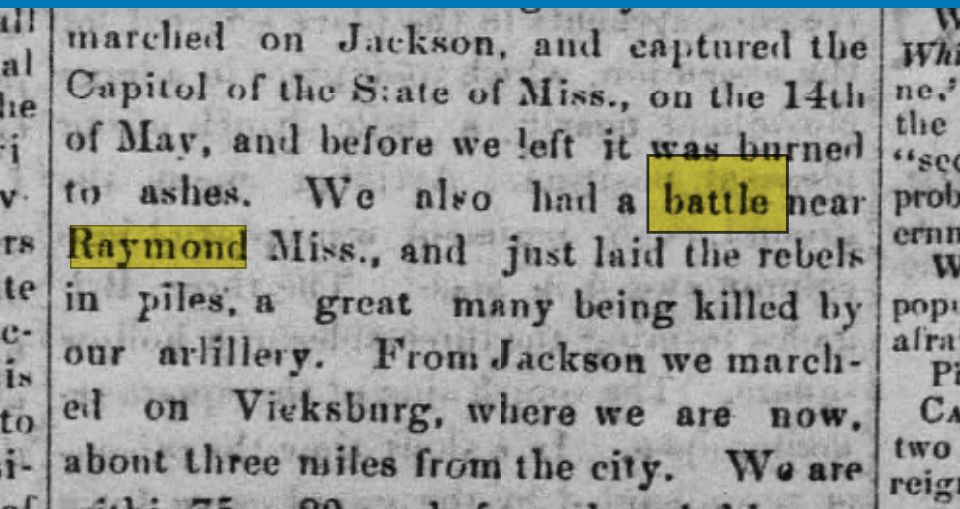
Confederate Dead In Piles

tony_gunter

2nd Lieutenant
Joined
Feb 19, 2011
Location
Mississippi
A member of the 25th Iowa, XV Corps marching through Raymond after the battle took note of the bodies laid to rest in piles, and assumed artillery was the culprit. In reality, Raymond was a toe-to-toe infantry fight with little artillery action.

IMG_5690.jpeg


Sydney Weekly Journal, July 10th
 
Thanks, guess this 25th IA soldier just got it wrong.

For what it is worth, there was no mistaking victims of artillery vs Minnie balls or hand to hand combat.

Casualties, Stones River drawing Adolph Metzner.jpeg


This Adolph Mentzer drawing made from personal observation at Stones River is an example of what spherical case (shrapnel) inflicted on its victims. Notice the rail fence blasted to splinters by impact of an artillery round.

service-pnp-ppmsca-51200-51289r.jpeg


Unlike the special correspondents who had to answer to editors at Harper's or Leslie's, Metzner answered only to himself.

Mentzer collection Library of Congress is a soldier's eye view of the war.

Chicken-Thieves-Being-Disciplined.jpeg

Scenes such as this punishment parade of chicken thieves don't appear anywhere else.
 
For what it is worth, there was no mistaking victims of artillery vs Minnie balls or hand to hand combat.

View attachment 556023

This Adolph Mentzer drawing made from personal observation at Stones River is an example of what spherical case (shrapnel) inflicted on its victims. Notice the rail fence blasted to splinters by impact of an artillery round.

View attachment 556024

Unlike the special correspondents who had to answer to editors at Harper's or Leslie's, Metzner answered only to himself.

Mentzer collection Library of Congress is a soldier's eye view of the war.

View attachment 556025
Scenes such as this punishment parade of chicken thieves don't appear anywhere else.
Wow... Thanks for posting these. Point duly taken.
 
Last edited:
For what it is worth, there was no mistaking victims of artillery vs Minnie balls or hand to hand combat.

View attachment 556023

This Adolph Mentzer drawing made from personal observation at Stones River is an example of what spherical case (shrapnel) inflicted on its victims. Notice the rail fence blasted to splinters by impact of an artillery round.

View attachment 556024

Unlike the special correspondents who had to answer to editors at Harper's or Leslie's, Metzner answered only to himself.

Mentzer collection Library of Congress is a soldier's eye view of the war.

View attachment 556025
Scenes such as this punishment parade of chicken thieves don't appear anywhere else.
I think one example to the artillery wounds being indiscernable from to gunshot wounds theory was in my family
My ggg grandfather was killed at Gettysburg within minutes of the Confederate artillery barrage being unleashed on the Union troops posted along the Emmittsburg rd at the Klingel house,,,,the assistant regimental surgeon reported his cause of death as "vul sclopet",, yet infantry attacks had yet to occur. We have since discovered the soldier next to him (the only other member of that unit to be killed that afternoon ) had much of his head taken off from a nearby shell explosion. My ggg grandfather was also killed in the same explosion,,But his records list vul sclopet, and now we aren't too convinced of that, given the fact that the Confederate infantry hadn't yet engaged when a gunshot wound to the skull supposedly killed him, yet his "neighbour" was killed by a shell explosion at the same time. Could very well had been a small piece of shrapnel that got each man, and without an autopsy, it looked to the surgeon like .58 caliber bullet wound
 
Last edited:
Was much of the artillery use canister shot? Perhaps that might explain the discrepancy.

I was part of an archaeological survey conducted on the battlefield by members of Friends of Raymond a decade or so ago. The only canister I recall finding came from a certain location marking the right flank of the 7th Texas, just north of 14-Mile Creek, and probably at the point of their farthest advance. These canister rounds were of large lead balls—which is unusual— and reminded me of what Wiard canister balls might've looked like. We also found a few case-shot rounds in the same locale. Of course, unlike the left flank companies, these right flank Texans never made it to the creek. It appears they came under reasonably intense artillery fire as well as heavy musketry fire— which probably explains why and how their advance stalled.
 
Last edited:
I was part of an archaeological survey conducted on the battlefield by members of Friends of Raymond a decade or so ago. The only canister I recall finding came from a certain location marking the right flank of the 7th Texas, just north of 14-Mile Creek, and probably at the point of their farthest advance. These canister rounds were of large lead balls—which is unusual— and reminded me of what Wiard canister balls might've looked like. We also found a few case-shot rounds in the same locale. Of course, unlike the left flank regiments, these right flank Texans never made it to the creek. It appears they came under reasonably intense artillery fire as well as heavy musketry fire— which probably explains why and how their advance stalled.
Thanks for the added context/info, lucky to be able to get the archaeo work in.
 
Whenever I hear the expression "the dead in piles" the Angle at Spotsylvania always comes to mind to me. One account stated that the bodies were piled on top of one another three and four deep in places. That, the Union works at Franklin and the Bloody Lane at Antietam rank among the goriest sights of carnage during the Civil War.
 
Did you mean to say companies?

Also, don't forget that the artillery was called up early to drive the Texan skirmishers (company A & B) away from the creek well before the battle broke out.
Oops. Good catch!! I meant companies (I went back to my post and made edits) Yeah, I've always suspected the guns that fired the rounds were likely from the two guns brought up early, as depicted here:

IMG_1466.jpeg

IMG_1467.jpeg


For more views of the battlefield then and now, see

 
I think one example to the artillery wounds being indiscernable from to gunshot wounds theory was in my family
My ggg grandfather was killed at Gettysburg within minutes of the Confederate artillery barrage being unleashed on the Union troops posted along the Emmittsburg rd at the Klingel house,,,,the assistant regimental surgeon reported his cause of death as "vul sclopet",, yet infantry attacks had yet to occur. We have since discovered the soldier next to him (the only other member of that unit to be killed that afternoon ) had much of his head taken off from a nearby shell explosion. My ggg grandfather was also killed in the same explosion,,But his records list vul sclopet, and now we aren't too convinced of that, given the fact that the Confederate infantry hadn't yet engaged when a gunshot wound to the skull supposedly killed him, yet his "neighbour" was killed by a shell explosion at the same time. Could very well had been a small piece of shrapnel that got each man, and without an autopsy, it looked to the surgeon like .58 caliber bullet wound
I had an uncle in the Gettysburg battle who had the top of his head taken off. He survived the war but had a sliver plate put in his skull. In the summer time he had convulsions.
 
In more than one instance, the corpses are depicted with arms and legs drawn up--almost as if riding an invisible horse. I have never seen this depiction nor read of rigor mortis doing this to a body. It is quite disturbing--as is the drawing of the man with arms blown off and intestines scattered beside him on the ground. I have often noted the hollow "thousand yard stare" in my ancestor's eyes when he sat for his post-war portrait. I am sure those eyes saw horrors that never left him.
 

Learn About Us
About CivilWarTalk
Contact the Webmaster
Meet the Staff
Link to CivilWarTalk
Join Our Community
Register
Browse Forums
View Today's Discussions
Search the Forum
Get Help
FAQ
Student Guide
Forum Rules & Etiquette
Copyright / DMCA

     Contact Us CivilwarTalk on Facebook CivilWarTalk on YouTube CivilWarTalk on Twitter RSS Feed

Bringing the American Civil War and More to Life.
© 1999 - , CIVILWARTALK, LLC - Site Version 10.0

SlaveryTalk.com - SecessionTalk.com - CivilWarTalk.com - ReconstructionTalk.com
Back
Top