Confederate Battle Shirts? Why?

JPK Huson 1863

Brev. Brig. Gen'l
Joined
Feb 14, 2012
Location
Central Pennsylvania
Given our Zouaves, really thought the uniforms the oddest things soldiers were expected to wear into battle. Since a few Zouave regiments have been honored with reputations for being fierce fighters I'm guessing no one went out of their way, picking fights with these fellows in clothing which would have gotten any of them beaten up on any playground as children.

Without having researched very carefully ( for a reason ) thought to look into some Confederate ' Battle Shirts. Why not research? Because I'd love to see more images, who they were and why, for Heaven's sake, the designs are so far removed from anything one could imagine seeing on any battlefield. The thing is, am also guessing even the oddest of these did the intended job- pride, patriotism, lending itself to a sense of belonging to the whole- how many major victories transpired early on? Men dressed this way rolled out the Union army like pastry. Must have been something a little special.

By the way, a guess would be women putting their heads together, coming up with regimental designs to sew. Men who knew not to argue.

confederate trans miss battle shirts.jpg

These are ' Mississippi ', I am certain there is a much more specific designation. Bowties? A wife sent her husband off in this shirt.
cbs.JPG

Better.
 
The chest pockets, while useful for carrying extra bullets and other small supplies, later proved to be a liability as the men were unexpectedly pitching forward on the battlefield from the top-heavy weight as they inevitably attempted to carry greater quantities in the pockets. On the positive side, more than a dozen documented cases exist where the soldier's sudden pitch forward saved them from enemy fire that now whizzed harmlessly above them.


OK I just made that all up.
 
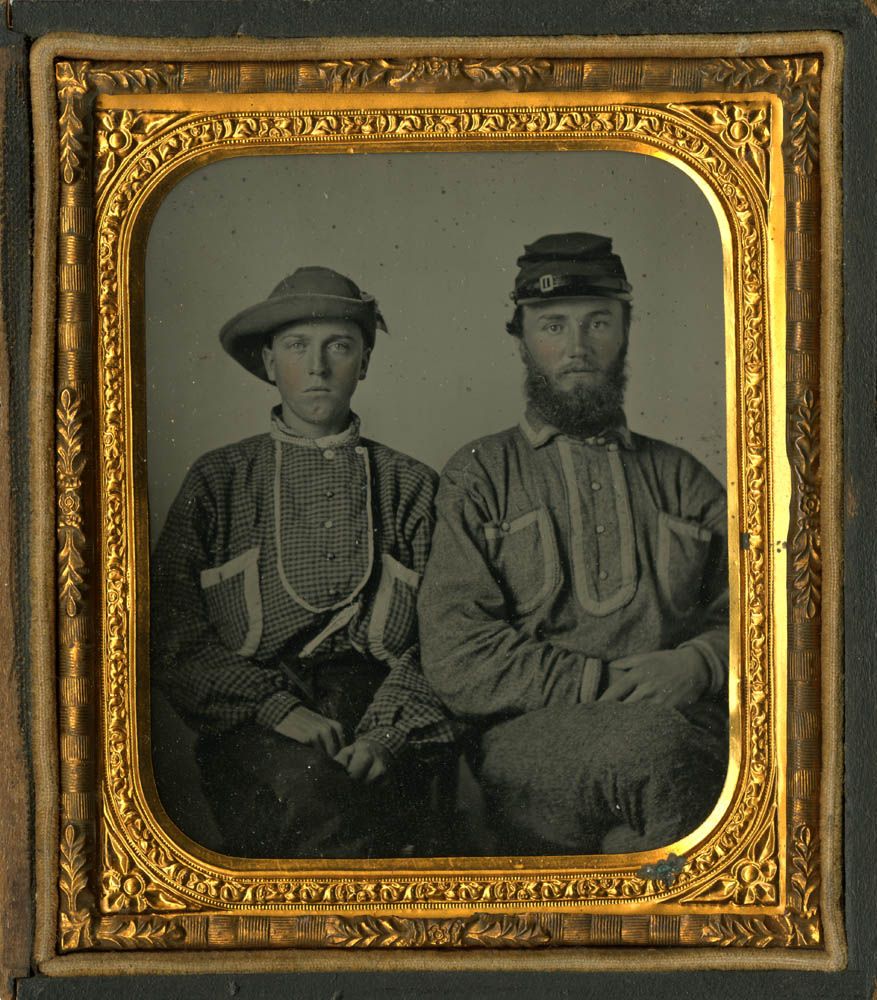
My, my the bowtie boys are quite a pair of shirts! Clearly some women wanted to send their men off to battle looking like gentlemen. Perhaps that was the motivation to look more refined than the Northern soldiers. As for the second picture that's far better but still comical looking to a modern eye.

Also, is it just me or in the second picture the man on the left who looks very young - is it a woman perhaps?! Or am I seeing things?
 
The two men in the second photo are Thomas and William Duvall, first serving in the Missouri State Guard and later in the 3rd Missouri Infantry (CSA). Some of the places they fought at include Wilson's Creek, Lexington, Pea Ridge, Iuka, and Corinth.

The photograph is part of the Wilson's Creek collection and I've actually seen it on display at the battlefield visitor center occasionally.

http://ozarkscivilwar.org/photographs/duvall-thomas-william-duvall/

Also, here's another thread with several more photos of Confederates in battle shirts.

http://civilwartalk.com/threads/confederate-battle-shirts.87411/
 
That one of the Duvall brothers is one of my favorites; they served in Cockrell's 1st Missouri Brigade.

Though not wearing a battle shirt, here's the link to a photo of the third brother (though some say cousin), Henderson Duvall: http://ozarkscivilwar.org/photographs/duvall-henderson/

Also, I could be wrong but I believe the large 'bow ties' are actually cravats.... Either way it may look strange today, but that was typical dress of the era (the cravat); there are many images out there of soldiers wearing them in the first year of the war.
 
http://www.encyclopediavirginia.org/media_player?mets_filename=evr9457mets.xmlxml

Member of the Lynchburg Rifles, Company E, 11th Virginia Infantry Volunteers

An unidentified member of the Lynchburg Rifles poses for a photograph in his unit's official uniform—a gray hunting shirt, with a dark blue collar, cuffs, and shirt front (known as a plastron). He is fully equipped with a model 1841 Mississippi rifle, a Sheffield-style Bowie knife, a canteen, a box-framed knapsack, and a blanket roll covered in oil cloth. The Richmond photographer Charles R. Rees took this hand-colored ambrotype in 1861, the year the militia unit was organized by faculty and students at Lynchburg College and became Company E, 11th Virginia Infantry in the Confederate army. The commanding officer of the company, Captain James E. Blankenship, was a mathematics professor at Lynchburg College. Though Blankenship had graduated at the top of his class at the Virginia Military Institute in 1852, his nerve failed when tested in battle. During the First Battle of Manassas he fled in the middle of the fighting.

This image is part of the Liljenquist Family Collection of Civil War Photographs at the Library of Congress.

Original Author: Charles R. Rees

Created: 1861

Medium: Hand-colored sixth-plate ambrotype

Courtesy of Library of Congress


download.jpg
 
http://www.encyclopediavirginia.org/media_player?mets_filename=evr9457mets.xmlxml

Member of the Lynchburg Rifles, Company E, 11th Virginia Infantry Volunteers

An unidentified member of the Lynchburg Rifles poses for a photograph in his unit's official uniform—a gray hunting shirt, with a dark blue collar, cuffs, and shirt front (known as a plastron). He is fully equipped with a model 1841 Mississippi rifle, a Sheffield-style Bowie knife, a canteen, a box-framed knapsack, and a blanket roll covered in oil cloth. The Richmond photographer Charles R. Rees took this hand-colored ambrotype in 1861, the year the militia unit was organized by faculty and students at Lynchburg College and became Company E, 11th Virginia Infantry in the Confederate army. The commanding officer of the company, Captain James E. Blankenship, was a mathematics professor at Lynchburg College. Though Blankenship had graduated at the top of his class at the Virginia Military Institute in 1852, his nerve failed when tested in battle. During the First Battle of Manassas he fled in the middle of the fighting.

This image is part of the Liljenquist Family Collection of Civil War Photographs at the Library of Congress.

Original Author: Charles R. Rees

Created: 1861

Medium: Hand-colored sixth-plate ambrotype

Courtesy of Library of Congress


View attachment 81798
What the Lychburg Rifles wore was referred to as a "Piedmont battle shirt."
Here's a good link on the Piedmont shirt and the Lynchburg Rifles: http://www.historicsandusky.org/uniforms.htm

A couple members of Co. B "Southern Guards" of the 11th Virginia Infantry, wearing Piedmont battle shirts and secession badges:
32608r.jpg

Private Peter S. Arthur of Company B, 11th Virginia Infantry Regiment, in uniform with secession badge and Virginia state seal breastplate.
http://www.loc.gov/pictures/item/2012646157/

38001r.jpg

Corporal John Wesley Edmunds of Co. B, 11th Virginia Infantry Regiment in uniform with secession badge and state seal breastplate holding musket.
http://www.loc.gov/item/2014646248/
 
Last edited:
Interesting shirt with starburst over right breast. Standing out could have been a way to get recognition or to be easily identifiable to friendly forces.


View attachment 81799


http://civilwartalk.com/threads/co-...ssippi-infantry-regiment.117044/#post-1186748


Artist Mark Maritato's impression of a soldier from the Sunflower Dispersers.


http://www.maritato.com/third-mississippi-infantry-company-b---1861---sunflower-dispersers.html


The third Mississippi Infantry, Company B, who named themselves the "Sunflower Dispersers" having been raised in Sunflower County shown here in their uniform of 1861. Confederate regiments consisted of companies that were raised in different counties within their namesake states. Each company was allowed to uniform and equip themselves as they wanted (or as available supplies allowed) and the result was a myriad of all conceivable forms of uniform dress, colors and style that would be represented even in one regiment during the early months of the Civil War. In the case of the "Sunflower Dispersers" Photographic evidence shows members of this company dressed in grey battle shirts trimmed in the state regulation color of Red with a sunflower symbol on the right breast of the shirt. The Third was also issued the m1841 Mississippi Rifle. The 3rd Mississippi Infantry was commanded by Colonel John B. Deason and served in the Western Theater initially assigned to the Army of Mississippi. The regiment participated in many of the major combat actions of the western theater where some of the most ferocious fighting took place including the defense of Vicksburg, the Atlanta Campaign and the disastrous battles of Franklin and Nashville. Survivors of the Third with their ranks shredded from losses, fought against William T. Sherman in the Carolinas under General Joseph E. Johnston in 1865. With it's ranks shattered: containing only a handful of it's original members, the Third was consolidated with two other Mississippi regiments (The 33rd and the 40th) and thus fought-on until the surrender of Johnston's army to Sherman on April 26th 1865. The Third Mississippi was truly one of the proud diehards that fought-on to the very end of hostilities.

641967.jpg
3rd-miss-02b.jpg
 
Wonder what those ribbons were all about

Expired Image Removed

battleshirtcravat.jpg


As far as the origins of the Battle Shirt practice, I'd like to throw a potential connection to Native War Shirts...


These are Succession Cockades.

http://creativecockades.blogspot.com/2015/03/the-complete-guide-to-confederate.html

Tn%2Bor%2BNC%2Bcockade%2B-%2BTN%2Barchives.jpg

Curious about Secession Cockades? Want to know what cockade to wear for your historical impression? Or maybe you'd like to know the kind of cockade your ancestors wore. Read on...

Colors
The most popular color for secession cockades was blue. But red, or red-and-white ranked a close second. And there were just a few cockades on both sides that were black - the color worn during America's first war for independence.

Like Union cockades, Confederate cockade designs included rosettes, rosettes with tails or ribbon designs such as bows or knots. Some Confederate cockades were generic, others were designed specifically for a certain state or region.

Unlike Union cockades, there was huge variety in the combination of colors, emblems and materials. For example, all of these cockades are from one state: South Carolina.

cockade13.jpg
cockade14.jpg
cockade16.jpg
SC%2Bcockade%2Bprint.jpg


Even among the blue cockades, there was a wide variety of designs.
cockade10.jpg
cockade18.jpg
cockade19.jpg

Center emblems included military buttons, spangled stars, pictures of famous people... and also natural products such as palmetto fronds, cotton bolls, pine cones, and corn.

SC%2BBlack%2BPalmetto.jpg
Secession%2BMOC%2B3.jpg
MA%2Bhistorical%2Bsociety.jpg
cockade20.jpg


Confederate cockades were worn by men, women and children, black and white. They were often pinned to the breast or lapel, but could also be worn on hats and bonnets. For a more in-depth look at how men wore cockades, see here. For a detailed look at how women wore cockades, see here.

Lady%2Bwith%2Bcockade%2B3.jpg
NEW%2B-%2Bchidl.jpg
Cockade%2B-%2BTX.jpg
 
For those wanting to read more about Battle Shirts:

http://militaryimagesmagazine.com/category/archives/page/5/


2014-v32-02-xxxii-232x300.jpg


Vol. XXXII, No. 2

Battle Shirt! A Field Guide to Unusual Patterns of Civil War Shirts by Ron Field (pp. 39-44)
An examination of the various types of battle dress known as battle, hunting, Garibaldi, or fire shirts is provided. The article includes 12 images that illustrate the garment's origins, variations in design, and different styles from both Northern and Southern regiments beyond the well-known red battle shirt of Confederate General A.P. Hill.
 
Does a large neck cloth qualify as ' battle shirt '? These phrases become thrown around so much, tough to know? Unique shirts caught my eye ages ago- some are just wonderful and reasons behind them never seem explained.

battle shirt.JPG
 

Learn About Us
About CivilWarTalk
Contact the Webmaster
Meet the Staff
Link to CivilWarTalk
Join Our Community
Register
Browse Forums
View Today's Discussions
Search the Forum
Get Help
FAQ
Student Guide
Forum Rules & Etiquette
Copyright / DMCA

     Contact Us CivilwarTalk on Facebook CivilWarTalk on YouTube CivilWarTalk on Twitter RSS Feed

Bringing the American Civil War and More to Life.
© 1999 - , CIVILWARTALK, LLC - Site Version 10.0

SlaveryTalk.com - SecessionTalk.com - CivilWarTalk.com - ReconstructionTalk.com
Back
Top