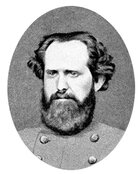
Col. Duncan K. McRae, CSA

Joined
Feb 19, 2011
Location
Germany
Duncan_K._McRae.jpg


Duncan Kirkland McRae

McRae was born in Fayetteville, North Carolina as son of Jon McRae (1792–1909); Fayetteville's postmaster in the 1840s and 1850s. In 1825 the five-years old Duncan held the welcome speech at the visit of the Marquis de Lafayette. He attended the University of Virginia, located in Charlottesville, and the College of William & Mary in Williamsburg. Back in North Carolina he studied law under Judge Robert Strange, was admitted to the bar in 1841 and briefly practiced in Oxford before becoming a courier to Mexico for the State Department.

In 1842 young McRae was elected into the North Carolina House of Commons as Democratic representative for his native Cumberland County; serving a single term until 1843. Then he became a U.S. District Attorney, gaining a reputation as sharp lawmen and outstanding speaker. Partnering with Perrin Busbee he founded a short-lived newspaper, the Democratic Signal, in 1843. It was based inRaleigh, where he had moved to. He resigned in 1850 and moved to Wilmington the next year.

McRae served as Consul to Paris with the U.S. Ambassador to France during the administration of U.S. President Franklin Pierce from 1853 to 1857; then relocated to New Bern. McRae became a candidate for the governorship of North Carolina in 1858. He left the Democratic Party and gained support from remnants of the Whig Party. McRae drew critiques for his changing political positions. He became an Independent Democrat campaigning as the Land Distribution Democratic nominee; calling for public lands given by North Carolina to the federal government in 1790 to be sold and the money granted to North Carolina. He lost his candidacy to John Willis Ellis by a wide margin.

McRae married Louise Virginia Henry, the daughter of Judge Louis D. Henry of Raleigh, on October 8, 1845. They had three daughters; Margaret Kirkland, Virginia Henry, and Marie.

When the American Civil War began Governor Ellis, shortly before he died in office, appointed McRae as commanding officer of the 5th North Carolina Infantry Regiment with the rank of Colonel in the Confederate States Army. During July the regiment was sent northwards to join the Army of the Potomac and was assigned to the brigade of Brig.Gen. James Longstreet. It participated in the First Battle of Manassas though McRae was absent ill. He commanded his regiment, now in the brigade of Jubal Early, during the Peninsula Campaign and fought in the Battle of Williamsburg. There he was wounded while leading a charge against troops under Gen.Winfield Scott Hancock. As the wound was only minor he stayed on the field and temporarily took command of the brigade when Gen. Early was wounded; later relinquishing command to Samuel Garland. McRae fought in theSeven Days Battles but afterwards sickness and complications from his wound forced him leave his unit again.

Colonel McRae was able to return in time to command his regiment during the Maryland Campaign. He wrote letters describing the actions of the campaign that survived as of today. He took over the brigade again after the death of Samuel Garland at South Mountain; leading it into the maelstrom of the Battle of Antietam where it nearly perished. McRae himself was badly wounded but again stayed with his command until after the battle when he was hospitalized.When the recuperating colonel was passed over for promotion he resigned his commission, effective on November 13, 1862.

In 1863 the new Governor of North Carolina, Zebulon B. Vance, appointed McRae a special envoy and purchase agent; sending him to southern Europe to find a market for cotton and to procure supplies. After his return, and a failed run for the Confederate Congress, McRae found another Raleigh-based newspaper, The Confederate.

When the war ended McRae moved toMemphis, Tennessee, practiced law as partner of McRae & Sneed and published a law journal. After 14 years in Tennessee he moved back to Wilmington. In 1880 McRae gave a speech in favor of Winfield S. Hancock, his former adversary during the Battle of Williamsburg, during the laters run for the U.S. presidency. McRae's frail health and reappearing complications from his war wounds made him relocate - first to Chicago, then to New York City. He died in Brooklyn on February 12, 1888; and was buried on Woodlawn Cemetery.

Transcribed from the overhauled wikipedia-article.
 

Attachments

  • Duncan_K._McRae.jpg
    Duncan_K._McRae.jpg
    37.6 KB · Views: 98
I am very interested in doing research into the 5th NC during the war. This thread mentions letters written by McRae that are still in existence. Does anyone know where one would find said letters?
 
I am very interested in doing research into the 5th NC during the war. This thread mentions letters written by McRae that are still in existence. Does anyone know where one would find said letters?
I suppose you have already read the chapter on the 5th NC from Histories of the Several Regiments and Battalions from North Carolina, in the Great War 1861-'65? That chapter was written by James C McRae and C M Busbee? If the personal papers of Col Duncan Kirkland McRae survive, I would guess they are located at UNC Chapel Hill or at the NC Dept of Archives and History at Raleigh.
 
I suppose you have already read the chapter on the 5th NC from Histories of the Several Regiments and Battalions from North Carolina, in the Great War 1861-'65? That chapter was written by James C McRae and C M Busbee? If the personal papers of Col Duncan Kirkland McRae survive, I would guess they are located at UNC Chapel Hill or at the NC Dept of Archives and History at Raleigh.
Yes, I've read that chapter. Thanks for the tips on where to look.
 
View attachment 248078

Duncan Kirkland McRae

McRae was born in Fayetteville, North Carolina as son of Jon McRae (1792–1909); Fayetteville's postmaster in the 1840s and 1850s. In 1825 the five-years old Duncan held the welcome speech at the visit of the Marquis de Lafayette. He attended the University of Virginia, located in Charlottesville, and the College of William & Mary in Williamsburg. Back in North Carolina he studied law under Judge Robert Strange, was admitted to the bar in 1841 and briefly practiced in Oxford before becoming a courier to Mexico for the State Department.

In 1842 young McRae was elected into the North Carolina House of Commons as Democratic representative for his native Cumberland County; serving a single term until 1843. Then he became a U.S. District Attorney, gaining a reputation as sharp lawmen and outstanding speaker. Partnering with Perrin Busbee he founded a short-lived newspaper, the Democratic Signal, in 1843. It was based inRaleigh, where he had moved to. He resigned in 1850 and moved to Wilmington the next year.

McRae served as Consul to Paris with the U.S. Ambassador to France during the administration of U.S. President Franklin Pierce from 1853 to 1857; then relocated to New Bern. McRae became a candidate for the governorship of North Carolina in 1858. He left the Democratic Party and gained support from remnants of the Whig Party. McRae drew critiques for his changing political positions. He became an Independent Democrat campaigning as the Land Distribution Democratic nominee; calling for public lands given by North Carolina to the federal government in 1790 to be sold and the money granted to North Carolina. He lost his candidacy to John Willis Ellis by a wide margin.

McRae married Louise Virginia Henry, the daughter of Judge Louis D. Henry of Raleigh, on October 8, 1845. They had three daughters; Margaret Kirkland, Virginia Henry, and Marie.

When the American Civil War began Governor Ellis, shortly before he died in office, appointed McRae as commanding officer of the 5th North Carolina Infantry Regiment with the rank of Colonel in the Confederate States Army. During July the regiment was sent northwards to join the Army of the Potomac and was assigned to the brigade of Brig.Gen. James Longstreet. It participated in the First Battle of Manassas though McRae was absent ill. He commanded his regiment, now in the brigade of Jubal Early, during the Peninsula Campaign and fought in the Battle of Williamsburg. There he was wounded while leading a charge against troops under Gen.Winfield Scott Hancock. As the wound was only minor he stayed on the field and temporarily took command of the brigade when Gen. Early was wounded; later relinquishing command to Samuel Garland. McRae fought in theSeven Days Battles but afterwards sickness and complications from his wound forced him leave his unit again.

Colonel McRae was able to return in time to command his regiment during the Maryland Campaign. He wrote letters describing the actions of the campaign that survived as of today. He took over the brigade again after the death of Samuel Garland at South Mountain; leading it into the maelstrom of the Battle of Antietam where it nearly perished. McRae himself was badly wounded but again stayed with his command until after the battle when he was hospitalized.When the recuperating colonel was passed over for promotion he resigned his commission, effective on November 13, 1862.

In 1863 the new Governor of North Carolina, Zebulon B. Vance, appointed McRae a special envoy and purchase agent; sending him to southern Europe to find a market for cotton and to procure supplies. After his return, and a failed run for the Confederate Congress, McRae found another Raleigh-based newspaper, The Confederate.

When the war ended McRae moved toMemphis, Tennessee, practiced law as partner of McRae & Sneed and published a law journal. After 14 years in Tennessee he moved back to Wilmington. In 1880 McRae gave a speech in favor of Winfield S. Hancock, his former adversary during the Battle of Williamsburg, during the laters run for the U.S. presidency. McRae's frail health and reappearing complications from his war wounds made him relocate - first to Chicago, then to New York City. He died in Brooklyn on February 12, 1888; and was buried on Woodlawn Cemetery.

Transcribed from the overhauled wikipedia-article.

This acount is remarkable for its omissions. McRae's unit was routed in a panic at Antietam and McRae resigned from army in disgrace. Look it up.
 
Well, of course there is some learning involved if you want to make things halfway decent and that depends on what and how much you want to do. There are tutorials available for about everything, lots of things are easier nowadays with templates (including citations) and menues and you can (and should) preview your edits before actually making them. Also if you create a user account (which you need if you want to create articles yourself, and is free, but are optional for editing [unprotected] articles) you have your own sandbox to try whatever you like.

Should you make edits somewhere and want a second look, or have any questions, just drop a note (be it here or there, where I´m named GELongstreet as well).
 
Before his resignation McRae penned a rather detailed report of the performance of Garland's Brigade during the battle of South Mountain. The brigade had performed creditably of that occasion, suffering severe casualties including the loss of its commander. Things were different after Sharpsburg. Two days after submitting the South Mountain report McRae submitted the following concerning the Brigade's action at Antietam.
HEADQUARTERS GARLAND'S BRIGADE,​
October 20, 1862.
MAJOR: I submit the following report of the action of this brigade in the battle of September 17, near Sharpsburg:​
The brigade was moved from its position, on the Hagerstown road, to the support of Colquitt's, which was then about engaging the enemy on our left front. This was about 10 o'clock. We moved by the left flank, until we reached a point near the woods, when line of battle was formed and the advance begun. Some confusion ensued, from conflicting orders. When the brigade crossed the fence, it was halted and formed and again advanced. Coming in sight of the enemy, the firing was commenced steadily and with good will, and from an excellent position, but, unaccountably to me, an order was given to cease firing - that General Ripley's brigade was in front. This produced great confusion, and in the midst of it a force of the enemy appearing on the right, it commenced to break, and a general panic ensued. It was in vain that the field and most of the company officers exerted themselves to rally it. The troops left the field in confusion, the field officers, company officers, and myself bringing up the rear. Subsequently several portions of the brigade, under Colonel Iverson, Captain Garrett, and others, were rallied and brought into action, rendering useful service. I refer to their general reports for their conduct.​
I am, very respectfully, your obedient servant,​
D. K. MCRAE,​
Colonel, Commanding Brigade.
Less than two weeks later McRae submitted his resignation citing health reasons. From what I've read about McRae it seems likely his health played a role, but I also suspect he knew he was in over his head as a brigade commander. That and the fact that a junior officer, Alfred Iverson was promoted to command the brigade.
 
Before his resignation McRae penned a rather detailed report of the performance of Garland's Brigade during the battle of South Mountain. The brigade had performed creditably of that occasion, suffering severe casualties including the loss of its commander. Things were different after Sharpsburg. Two days after submitting the South Mountain report McRae submitted the following concerning the Brigade's action at Antietam.
HEADQUARTERS GARLAND'S BRIGADE,​
October 20, 1862.
MAJOR: I submit the following report of the action of this brigade in the battle of September 17, near Sharpsburg:​
The brigade was moved from its position, on the Hagerstown road, to the support of Colquitt's, which was then about engaging the enemy on our left front. This was about 10 o'clock. We moved by the left flank, until we reached a point near the woods, when line of battle was formed and the advance begun. Some confusion ensued, from conflicting orders. When the brigade crossed the fence, it was halted and formed and again advanced. Coming in sight of the enemy, the firing was commenced steadily and with good will, and from an excellent position, but, unaccountably to me, an order was given to cease firing - that General Ripley's brigade was in front. This produced great confusion, and in the midst of it a force of the enemy appearing on the right, it commenced to break, and a general panic ensued. It was in vain that the field and most of the company officers exerted themselves to rally it. The troops left the field in confusion, the field officers, company officers, and myself bringing up the rear. Subsequently several portions of the brigade, under Colonel Iverson, Captain Garrett, and others, were rallied and brought into action, rendering useful service. I refer to their general reports for their conduct.​
I am, very respectfully, your obedient servant,​
D. K. MCRAE,​
Colonel, Commanding Brigade.
Less than two weeks later McRae submitted his resignation citing health reasons. From what I've read about McRae it seems likely his health played a role, but I also suspect he knew he was in over his head as a brigade commander. That and the fact that a junior officer, Alfred Iverson was promoted to command the brigade.

While true that Iverson was junior to McRae by official measures, Iverson actually had military experience whereas McRae had none. Iverson was a veteran of the Meixcan War, and had been an officer in the US cavalry at the time the war broke out. It made perfect sense to promote Iverson to replace the dead Garland, especially because of the black cloud over McRae.
 
While true that Iverson was junior to McRae by official measures, Iverson actually had military experience whereas McRae had none. Iverson was a veteran of the Meixcan War, and had been an officer in the US cavalry at the time the war broke out. It made perfect sense to promote Iverson to replace the dead Garland, especially because of the black cloud over McRae.
I agree that Iverson's promotion made good sense. Unfortunately assigning a Georgian to command a brigade of North Carolinians did not go over particularly well and was a source of contention for the eight months Iverson held command. If you get the opportunity, Robert Wynstra's book The Rashness of That Hour: Politics, Gettysburg, and the Downfall of Confederate Brigadier General Alfred Iverson provides some interesting reading on the topic.
 
I can't recall exactly where I read that McCrae had resigned "in disgrace." I am wracking my brain and will post again if I can locate that source in a reasonable amount of time.

Of cource, 'disgrace' may have been a mischaracterization. But the explanation of poor health doesn't ring true either, particularly given his long and active post-Antietam career. Disappointment and embarassment at being passed over for promotion may be the right answer.
 
Last edited:

Learn About Us
About CivilWarTalk
Contact the Webmaster
Meet the Staff
Link to CivilWarTalk
Join Our Community
Register
Browse Forums
View Today's Discussions
Search the Forum
Get Help
FAQ
Student Guide
Forum Rules & Etiquette
Copyright / DMCA

     Contact Us CivilwarTalk on Facebook CivilWarTalk on YouTube CivilWarTalk on Twitter RSS Feed

Bringing the American Civil War and More to Life.
© 1999 - , CIVILWARTALK, LLC - Site Version 10.0

SlaveryTalk.com - SecessionTalk.com - CivilWarTalk.com - ReconstructionTalk.com
Back
Top