
Robert Gray
Sergeant Major
- Joined
- Jul 24, 2012
Clement Claiborne Clay (December 13, 1816 – January 3, 1882), also known as C. C. Clay, Jr., was a United States Senator (Democrat) from the state of Alabama from 1853 to 1861, and a Confederate States Senator from Alabama from 1862 to 1864.
Clement Claiborne Clay was born to Clement Comer Clay and Susanna Claiborne Withers, a daughter of well-off planter John Withers, in Huntsville, Alabama. He was a third cousin of Henry Clay, the noted statesman from Kentucky. In 1853, he ...was elected by the Alabama legislature to serve in the United States Senate in a term beginning March 4, 1853; and was re-elected in 1857. He withdrew from the Senate when Alabama seceded from the Union on January 11, 1861. He was subsequently elected by the Alabama Confederate legislature as Senator in the First Confederate Congress. He served there from 1862 until 1864 acting as a supporter of Jefferson Davis.
Along with Jacob Thompson, Clay was a part of the Confederate War Department effort to create a network of secret agents to conduct espionage and sabotage. In May 1864, president Davis sent Clay to Canada with a secret mission to coordinate activities of the Southern sympathizes in the Great Lakes area, including members of the Order of the Sons of Liberty and the Knights of the Golden Circle. Clay took part in a secret meeting with John Hay, President Abraham Lincoln's secretary, at Niagara Falls, Canada.
It was suspected that Thompson and Clay had employed John Wilkes Booth for some services before he assassinated President Abraham Lincoln. President Andrew Johnson signed an order to arrest Clay. After learning from a newspaper that a reward was issued for his capture, Clay, who initially planned to escape to Mexico, turned himself in to General James H. Wilson in Macon, Georgia in May, 1865. He was arrested and held in Fort Monroe in Hampton, Virginia until April 1866. Former Confederate president Jefferson Davis was also held in Fort Monroe, but was never tried; he was released in 1867. [Wikipedia]
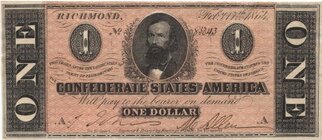
His portrait appeared on the Confederate $1 note on issues in 1862, 1863 and 1864.


Clement Claiborne Clay was born to Clement Comer Clay and Susanna Claiborne Withers, a daughter of well-off planter John Withers, in Huntsville, Alabama. He was a third cousin of Henry Clay, the noted statesman from Kentucky. In 1853, he ...was elected by the Alabama legislature to serve in the United States Senate in a term beginning March 4, 1853; and was re-elected in 1857. He withdrew from the Senate when Alabama seceded from the Union on January 11, 1861. He was subsequently elected by the Alabama Confederate legislature as Senator in the First Confederate Congress. He served there from 1862 until 1864 acting as a supporter of Jefferson Davis.
Along with Jacob Thompson, Clay was a part of the Confederate War Department effort to create a network of secret agents to conduct espionage and sabotage. In May 1864, president Davis sent Clay to Canada with a secret mission to coordinate activities of the Southern sympathizes in the Great Lakes area, including members of the Order of the Sons of Liberty and the Knights of the Golden Circle. Clay took part in a secret meeting with John Hay, President Abraham Lincoln's secretary, at Niagara Falls, Canada.
It was suspected that Thompson and Clay had employed John Wilkes Booth for some services before he assassinated President Abraham Lincoln. President Andrew Johnson signed an order to arrest Clay. After learning from a newspaper that a reward was issued for his capture, Clay, who initially planned to escape to Mexico, turned himself in to General James H. Wilson in Macon, Georgia in May, 1865. He was arrested and held in Fort Monroe in Hampton, Virginia until April 1866. Former Confederate president Jefferson Davis was also held in Fort Monroe, but was never tried; he was released in 1867. [Wikipedia]
His portrait appeared on the Confederate $1 note on issues in 1862, 1863 and 1864.
![T-62 [Evans & Cogswell].jpg](https://civilwartalkxf.nyc3.digitaloceanspaces.com/data/attachments/97/97025-b3ce7e4aca92b5e0f7b2e5ce4ec67457.jpg?hash=s85-SsqSte)


 Bringing the