Hello Fred from Texas. And thanks to Ms. Hellers for calling my attention to this thread.
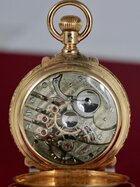
Fred, if you hang out at watch clubs, you may already know that what you have is called an "Elgin Convertible" model watch, because the movement was made in such a way that you can insert the winding stem in either of two different places, so that the movement can be used in either an open face case, or a "hunting case" in which the face is covered. (Forgive me if you already know these things, but most of the folks here likely don't.) When one looks at a watch face, called the "dial," one wants 12 o'clock to be in the upright position. In open face cases, the winding stem is inserted at 12 o'clock, and the 4th wheel of the watch movement that carries the seconds hand, is at 6 o'clock, making a 180 degree angle (i.e., a straight line) with the stem. But in hunting case watches, the winding stem is normally at 3 o'clock, so that it makes a 90 degree right angle with the seconds hand (and the 4th wheel underneath it) at 6 o'clock. Elgin convertible model movements were made so that the stem could make either a 180 degree or a 90 degree angle with the seconds hand, so the movement could be used with either style of watch case.
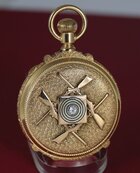
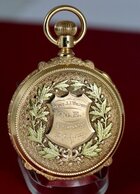
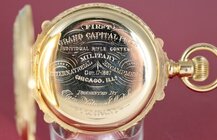
Elgin convertible movements were made in two different styles and several different grades. Your movement is an example of the "three finger bridge" style. It is in a hunting style case that appears - from the one photo - to be original. I cannot tell the jewel count for certain from your photograph, because, for among other reasons, the glass exhibition back (which is a second, decorative inner rear lid, or "dust cover," underneath the gold dust cover) over the movement is casting some glare. However, I believe yours to be a 21 jewel Grade 91 Convertible movement. I say this because the train jewels are in screwed down settings, and both the jewel settings and the wheel train appear to be gold. I would need to see clearer photographs, in which I could clearly see the cap jewels on the pallet bridge and the escape wheel to know for certain. However, if I am right, you either paid a hefty price for this watch or you lucked out - big time! The Elgin Grade 91 21 jewel convertible is among the very highest grade, most exquisitely finished watches ever made in the U.S. It had very limited production, and it is highly sought after by collectors. Your example appears to be in a solid gold hunting style case with a simulated "box hinge," which was a popular case style in the 1880's. Given the time period, the case is more likely 14K gold than 18K gold. I would like to see a dial picture. The 21 jewel convertibles had "double sunk" dials, in which the hour numerals appear on a separate ring that is raised slightly above the central disk of the dial, and the seconds bit is a third piece, another separate disk. The fact that this is a presentation watch makes the possibility that your watch is a 21 jewel example even more likely, and I have seen another 21 jewel example with a serial number only a few hundred numbers from yours. The decorative pattern on the nickel plates (called "damaskeening," which was different than a much older process used on Damascus steel, called "damascening") is a bit Plain Jane for a Grade 91, but I think that's OK.
If you truly didn't know what you were buying when you bought it, you are one lucky fellow! Congratulations.


 Bringing the