Chronometer Watch Identification

DaveBrt

1st Lieutenant
Joined
Mar 6, 2010
Location
Charlotte, NC
In September 1859, my avatar, future Confederate Quartermaster Captain Thomas R. Sharp, a railroad superintendent, bought (according to the entry in his diary) a chronometer watch of Mitchell & Tyler Company for $325, serial number 8889. The purchase was made in Richmond --- while he was unemployed.

I'm very familiar with chronometers (US Navy navigator for many years). Can anyone help me identify this particular watch?
 
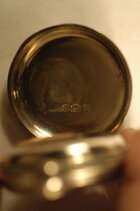
I am assuming that Mitchel and Tyler was the name of the Richmond retailer, not the British watch maker. Thus I fear we would need to have access to the watch to determine much more about it. Your chronometer watch itself likely did not carry the retailer's name, although it could have. Much more likely, though, is that it carried only the name of the English manufacturer. The case, unless the movement was cased in the US (some English watches were), should carry an assay hallmark (most likely, London), a date mark, and either a sterling silver mark (a rampant lion, indicating 92.5% purity), or a gold mark indicating the gold purity. These marks will be on the inside of the rear lid. There will also be a two-initial maker's mark on a lid interior or on the pendant, as the case and the movement would have been made in different shops. Most English case maker's marks can be identified to specific persons, if one knows the production date. English cases will be "swing-out," meaning that one must trip a catch on the edge of the dial (usually at 6 o'clock) with one's fingernail and rotate the movement up out of its case on a hinge. To see the movement, and the chronometer escapement, one would then need to release the latch on the integral dust cover and remove it. Unless the watch is a private label for the US retailer, you would then be able to see who actually made it. Production information is available for some English makers.

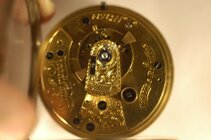
As you may know, in the 1859 period, the term " pocket chronometer" referred not just to a well made, relatively accurate watch, but to one with a "chronometer escapement." For those who may be less familiar with chronometers than yourself, allow me to explain that there were 2 basic types of chronometer escapement, and numerous subvarieties. "Spring detent escapement" pocket chronometers were favored by the high end English makers (such as Charles Frodsham, to name one, or Dent, to name another). The John Arnold marine chronometer (not a watch, but a clock) and the copy of it made by Larkum Kendall, which ultimately won for Arnold Parliament's coveted Longitude Prize, also had a spring detent escapement. (This is in fact why detent escapements were called "chronometer escapements." Marine chronometers, on gimbaled, shock absorbing mounts, and which were used on ships for determining longitude, had spring detent escapements as well.) The Swiss favored "pivoted detent escapement" pocket chronometers. No American makers were yet making pocket chronometers in 1859. (George P. Reed, who ultimately made perhaps a hundred or more pocket chronometers of his own patented designs, was to be America's most prolific maker, but he made his first chronometers around the time the ACW was ending.) The majority of pocket chronometers entering the US, which weren't many ($325 was an enormous sum for a watch in 1859!), were English, and especially so in the South, given that antebellum southerners idolized and obsessed over things English. Watch movements with chronometer escapements will have temperature compensated two-armed bimetallic balances (so called "chronometer balances") with gold timing screws. The mean time screws nearest the balance arms will have threaded nuts on them. The hairspring, which attaches the balance wheel to the balance cock, most likely will be helical (i.e., cylindrical), as helical hairsprings were the most "isochronous." (Most watches of the period had spiral (aka "volute"), disc-shaped hairsprings, which were cheaper to make, but gave more of a variation in rate over the running period.)

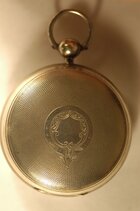
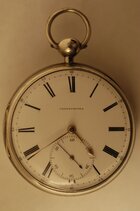
Here is an example of an English spring detent pocket chronometer by Thomas Rushton in a classic open face English Sterling silver swing-out case with the London hallmark and the date mark for 1839. This example is sufficiently early that it has trapezoidal weights on the balance wheel instead of timing screws.
 

Attachments

  • DSC_0956.JPG
    DSC_0956.JPG
    215.4 KB · Views: 209
  • DSC_0958.JPG
    DSC_0958.JPG
    128 KB · Views: 203
  • DSC_0959.JPG
    DSC_0959.JPG
    145.2 KB · Views: 210
  • English chronometer dial.JPG
    English chronometer dial.JPG
    151.6 KB · Views: 369
Last edited:
Mitchell & Tyler was a Richmond jewelry and military outfitter retail company. They made nothing, but stamped their name on a lot of things, including swords and other weapons made by Boyle & Gamble, and a whole bunch of VA State buttons made by many suppliers.

Now about the watch. Based on his business, it is likely a "Railroad Chronometer" and pretty darn early one for 1859. Waltham and Elgin made those in the US. I bet that the serial number is the number of the movement and not the case. 8889 Elgin serial number is later, so I would suspect that it is a Waltham movement watch. Also, I suggest that you look really close to the numbers. There has to be a period over there, as in $3.25. That was about the price of an acre of farm land, two months' worth or room and board or a month's rent for a family house. More in line with the price of a watch. Alternatively, the use of the word "chronometer" is casual, referring to a "time-piece".

Good luck!
 
Mitchell & Tyler was a Richmond jewelry and military outfitter retail company. They made nothing, but stamped their name on a lot of things, including swords and other weapons made by Boyle & Gamble, and a whole bunch of VA State buttons made by many suppliers.

Now about the watch. Based on his business, it is likely a "Railroad Chronometer" and pretty darn early one for 1859. Waltham and Elgin made those in the US. I bet that the serial number is the number of the movement and not the case. 8889 Elgin serial number is later, so I would suspect that it is a Waltham movement watch. Also, I suggest that you look really close to the numbers. There has to be a period over there, as in $3.25. That was about the price of an acre of farm land, two months' worth or room and board or a month's rent for a family house. More in line with the price of a watch. Alternatively, the use of the word "chronometer" is casual, referring to a "time-piece".

Good luck!
CW and E,

Thank you for your information -- just what I was looking for.

Capt. Sharp was not hurting for money. The watch entry in his diary is clearly $325. He only enters major purchases, the smallest being a horse for $150. He bought a house and a lot for his Mother for $2050. He and his wife and his sister traveled extensively in the North from late 1859 until August 1861.

Sharp gives times for departing and arriving every time he made a movement, giving accuracy to the 1/4 hour.

The watch has vanished, but I was certainly interested in what he would have bought for that price.
 
a
Mitchell & Tyler was a Richmond jewelry and military outfitter retail company. They made nothing, but stamped their name on a lot of things, including swords and other weapons made by Boyle & Gamble, and a whole bunch of VA State buttons made by many suppliers.

Now about the watch. Based on his business, it is likely a "Railroad Chronometer" and pretty darn early one for 1859. Waltham and Elgin made those in the US. I bet that the serial number is the number of the movement and not the case. 8889 Elgin serial number is later, so I would suspect that it is a Waltham movement watch. Also, I suggest that you look really close to the numbers. There has to be a period over there, as in $3.25. That was about the price of an acre of farm land, two months' worth or room and board or a month's rent for a family house. More in line with the price of a watch. Alternatively, the use of the word "chronometer" is casual, referring to a "time-piece".

Good luck!

A movement serial number of 8,889 would place a Waltham movement right around 1859, or even a little earlier. So that suggestion makes perfect sense. (Elgin put their first watches out in 1867.) However, Waltham did not refer to any of their movements in this period as "chronometers," either railroad or otherwise, so that detail is still strange. So if the retailer used the term "railroad chronometer," it was their idea, and the term was not common at the time. English watches made for the US market more often were marked "Railroad Timekeeper," but the age of the American "railroad watch" was still over a decade off. (The first watches made to order for a US railroad, which were Walthams and Elgins, were made in 1867, and the first watch model designed with railroad use in mind was the Waltham Model 1870.) I also agree that $3.25 is a lot more likely than $325. But again, in that period, the term "chronometer" was pretty specific, and no $3.25 watch would have deserved it. So the facts, either as presented, or as reinterpreted, still don't completely add up. It would be great to actually see the watch.

Update, if the price truly was $325, then it likely was a British pocket chronometer, since the written record of the purchase says it was, and because pocket chronometers often were favored by ships' captains as emergency back-ups to their main ship's chronometer.
 
ok. That changes things a bit :smile: Probably something that looked a lot like this (center second hand and lots of gradations), in a similar 18K gold case (English, of course) :

plymouth_auction_116.jpg

That looks like a "keyless" watch, i.e., a stem winder, which would date it to later than 1860. And I don't recall seeing a "pocket chronometer," which again, was a very specific kind of watch, from that period with a sweep second hand (though one might have been useful). Pocket chronometers of that period did often have winding reserve indicators at 12 o'clock, however. The circa 1839 example by Thos. Rushton I showed earlier, is a bit too early to have one.

I can't find one with a winding reserve indicator just now, but if you go here, and search on "Bennett chronometer," you'll find an English pocket chronometer dated 1859.

http://www.jones-horan.com/search/i...ennett+chronometer&sort_by=date&Submit=Submit

Just to show an example of a winding reserve indicator, here is a later, hunting cased keyless fusee pocket chronometer, made circa 1895, by Chas. Frodsham, a well known English firm, with a winding reserve indicator at 3 o'clock and the seconds bit at 9.

http://www.jones-horan.com/1501/images/18874_c.jpg
 
Last edited:

Learn About Us
About CivilWarTalk
Contact the Webmaster
Meet the Staff
Link to CivilWarTalk
Join Our Community
Register
Browse Forums
View Today's Discussions
Search the Forum
Get Help
FAQ
Student Guide
Forum Rules & Etiquette
Copyright / DMCA

     Contact Us CivilwarTalk on Facebook CivilWarTalk on YouTube CivilWarTalk on Twitter RSS Feed

Bringing the American Civil War and More to Life.
© 1999 - , CIVILWARTALK, LLC - Site Version 10.0

SlaveryTalk.com - SecessionTalk.com - CivilWarTalk.com - ReconstructionTalk.com
Back
Top