Captured at the Crater

Greg Taylor

Sergeant Major
Joined
Apr 29, 2011
Location
Los Angeles
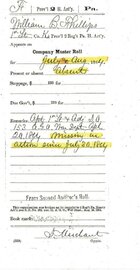
On this date 149 years ago my great-great grandfather Adjutant William Beynon Phillips of the 2nd. Pennsylvania Provisional Heavy Artillery was captured at the Battle of the Crater. His regiment was the very first into the pit after the mine explosion. By all accounts it was pure hell in that pit. Following his capture he spent the next 7 months as a Union prisoner at Camp Asylum in Columbia, S.C. May he rest in peace.
 
Interesting. Why was an artillery regiment sent into the battle?
Most of the Union heavy artillery regiments including the 2nd. PA Heavy Artillery were used as infantry regiments during the Overland Campaign into Virginia in 1864. Prior to this time most of these units were part of the Federal Defenses of Washington D.C. Grant needed infantrymen for the campaign into Virginia. He recognized that the heavy artillery could be better utilized as infantry. Most of these men had never served in battle before but they participated with as much honor and dedication as the regular infantry.
 
Most of the Union heavy artillery regiments including the 2nd. PA Heavy Artillery were used as infantry regiments during the Overland Campaign into Virginia in 1864. Prior to this time most of these units were part of the Federal Defenses of Washington D.C. Grant needed infantrymen for the campaign into Virginia. He recognized that the heavy artillery could be better utilized as infantry. Most of these men had never served in battle before but they participated with as much honor and dedication as the regular infantry.

Never before, they got one rude awakening at the Crater...I shudder..
 
Interesting. Why was an artillery regiment sent into the battle?

Jeff Shaara touches on this in his novel "Last Full Measure". Granted, this is from a novel, but, like his dad before him, he tries to base everything on historical fact. His account of the Overland campaign is gruesome. Grant was suffering such high casualty rates -- and the political cost of calling up more men was too high -- so Grant had to clear the cupboards of other areas, especially fortified areas, to replenish his ranks. Apparently, a lot of these heavy artillery men got little or no infantry training and were thrown into their first action at Cold Harbor. Their casualty rates from that fight were horrific. Brave men, unprepared and poorly led. I urge you to pick up that novel if only for his depiction of Cold Harbor. Grant was too confident, thought Lee was battered worse than he actually was. (He made Lee's mistake at Gettysburg.)

Shaara's depiction of The Crater is also first rate. As he tells it, the union plan was brilliant and it gave Lee a genuine cardiac moment, and only poor coordination and last minute changes of the Union plan doomed it.
 
Never before, they got one rude awakening at the Crater...I shudder..

Yes, the Crater was one horrendous battle but they also participated in the Battle of the Wilderness, the Battle of Spotsylvania Court House, North Anna River, Cold Harbor and the Second Battle of Petersburg. On the 17th. of June 1864 the 2nd. PA/HA suffered 250 casualties in their attack on the Confederate position. By comparison the regiment lost 116 at the Crater.
 
Jeff Shaara touches on this in his novel "Last Full Measure". Granted, this is from a novel, but, like his dad before him, he tries to base everything on historical fact. His account of the Overland campaign is gruesome. Grant was suffering such high casualty rates -- and the political cost of calling up more men was too high -- so Grant had to clear the cupboards of other areas, especially fortified areas, to replenish his ranks. Apparently, a lot of these heavy artillery men got little or no infantry training and were thrown into their first action at Cold Harbor. Their casualty rates from that fight were horrific. Brave men, unprepared and poorly led. I urge you to pick up that novel if only for his depiction of Cold Harbor. Grant was too confident, thought Lee was battered worse than he actually was. (He made Lee's mistake at Gettysburg.)

Shaara's depiction of The Crater is also first rate. As he tells it, the union plan was brilliant and it gave Lee a genuine cardiac moment, and only poor coordination and last minute changes of the Union plan doomed it.

I really must get this novel. My g-g grandfather's regiment, the 2nd. PA Provisional Heavy Artillery was formed out of the original 2nd. PA Heavy Artillery when it bloated to 1800 men, making it the largest regiment in the Union Army. They were detached and assigned to the IX Army Corps of Major General Ambrose Burnside. The 2nd. PA Provisionals were the first regiment to enter the Crater after the mine explosion. My g-g grandfather helped lead the charge and was one of 6 officers in the regiment to be captured as a prisoner of war. It is important to note that he was Adjutant of the regiment which is basically chief clerk yet he was assigned to help lead the charge in this historic battle. He and his men had no training for the assault and were only notified 2 hours prior to the explosion that they would attack. They were given no information except to secure their canteens, wait for something "unusual" to happen and charge. My ancestor, Adj. William B. Phillips, a recent Welsh immigrant did his best under impossible circumstances. I am proud of him and on this day I honor his memory.
WP Muster Roll July-Aug 1864-crop.jpg
 

Attachments

  • WP Muster Roll July-Aug 1864-crop.jpg
    WP Muster Roll July-Aug 1864-crop.jpg
    91.4 KB · Views: 143
It has been a few years since I read specifically about the Battle of the Crater. There are several good books out on the subject. A few things do stick out in the memory though: First,
Meade and Army HQ did not support the operation; Second, a unit of USCT was selected and trained to exploit the breach once it occurred, but at the very last minute they were pulled by Meade, supposedly due to PC of the day, which is why a new, untrained unit made the assault; the initial fuse did not work and some very brave men went back in to reset everything.

I visited the Crater this past spring and the NPS has put in a new road and path that I was not familiar with from an earlier visit. If anyone is ever in the area, I highly recommend the Pamplin Historical Military Park and National Museum of the Civil War Soldier. It is easy to get to between I-85 and I-95 south of Petersburg.
 
Among the lack of preperations at The Crater (due largly to the last minute changes in units assigned to lead the charge): (a) the men didn't have ladders to get out of the trenches, many had to lift each other up or stick bayonnets between chinks in the logs; (b) the troops had no idea what to do once they got there, and ended up milling around in the center of the crater or digging out half-burried men, all while the Confederates organized a counter-attack.

Once the coloured units were committed they attempted to go around the edge of the crater and expand the breach, but a line of Confederates attacked them with bayonnets. (I've never been quite sure if this was a planned second line of entrenchments - Lee liked to install them at that point - or a temporary line preparing to go on the attack).
 
Interesting. Why was an artillery regiment sent into the battle?
The 1st Maine Heavy Artillery was another Heavy Artillery regiment that got sent into an attack during the Siege of Petersburg. During Grant's attacks from June 15 to June 18, 1864, the 1st Maine Heavies were sent in on June 18. In the attack on the Confederate works the regiments on their flanks gave away but they kept on going. They attacked in three columns and were enfiladed on both sides, taking fire from Confederate infantry in 4 ranks in their works and several batteries firing double canister. The 1st Maine Heavy Artillery lost 7 officers and 108 men killed, and another 25 officers and 464 men wounded out of 900 men engaged, 67% of their strength.
 
Has anyone read Kevin Levine's book on the Battle of the Crater? I find him to be kind of a nozzle on his blog which is why I stopped following it. Just curious what some thoughts were (I didn't find it on a search)
 
I visited the Crater this past spring and the NPS has put in a new road and path that I was not familiar with from an earlier visit. If anyone is ever in the area, I highly recommend the Pamplin Historical Military Park and National Museum of the Civil War Soldier. It is easy to get to between I-85 and I-95 south of Petersburg.
I likewise high recommend the Pamplin Historic Military Park. The Petersburg National Battlefield is also worth a day to visit. I had the opportunity to make a make several stops over the past couple years and have found the Petersburg Campaigns to be among the most interesting of the war.
 
Has anyone read Kevin Levine's book on the Battle of the Crater? I find him to be kind of a nozzle on his blog which is why I stopped following it. Just curious what some thoughts were (I didn't find it on a search)
I haven't read Levin's book and cannot comment. I did read Richard Stotkin's No Quarter: The Battle of the Crater, 1864 and found it to be very well done.
 

Learn About Us
About CivilWarTalk
Contact the Webmaster
Meet the Staff
Link to CivilWarTalk
Join Our Community
Register
Browse Forums
View Today's Discussions
Search the Forum
Get Help
FAQ
Student Guide
Forum Rules & Etiquette
Copyright / DMCA

     Contact Us CivilwarTalk on Facebook CivilWarTalk on YouTube CivilWarTalk on Twitter RSS Feed

Bringing the American Civil War and More to Life.
© 1999 - , CIVILWARTALK, LLC - Site Version 10.0

SlaveryTalk.com - SecessionTalk.com - CivilWarTalk.com - ReconstructionTalk.com
Back
Top