Calling all experts!

Joined
May 18, 2005
Location
Spring Hill, Tennessee
I need to know if there was a standard field of degrees that a camera lens used - or were there interchangeable lenses that could create a wider field of view.

So, was there a standard width of degrees? That is, from the lens of the camera that created the left to right field of view, how many degrees would that have been?

This question is for cameras that would have been developed and used up to - and especially including - 1886.

Thanks for your responses in advance!
Jamie
 
There were three basic type used. A portrait lens for studio work that had removable elements to allow for a type of telephoto. A single achromat that came in various focal lengths a used for outdoor landscapes and "Globe/Globular lens. Those were usually wide angle and quite often used for making stereo views.

I don't believe there were standard focal lengths like 24-70 and 70-200 like we think of today.
 
There were three basic type used. A portrait lens for studio work that had removable elements to allow for a type of telephoto. A single achromat that came in various focal lengths a used for outdoor landscapes and "Globe/Globular lens. Those were usually wide angle and quite often used for making stereo views.

I don't believe there were standard focal lengths like 24-70 and 70-200 like we think of today.
If I posted the picture in question, could you make an educated guess as to the degrees that the photo may have been shot in? It may have been a wide angle lens, but how many degrees might that equate to?
 
I can't help you much but I do know that the lenses of the day were different from those of today in that the depth of field produced images that made things look closer than they actually are. Thus, it might be a tad difficult to line things up or to reproduce an image using modern gear. Good luck !
 
I can't help you much but I do know that the lenses of the day were different from those of today in that the depth of field produced images that made things look closer than they actually are. Thus, it might be a tad difficult to line things up or to reproduce an image using modern gear. Good luck !
Well, I'm not so much trying to reproduce the image in paper form but rather by using the approximate degrees from the point the image may have been taken. In other words, I might be able to use a bisection from two likely pouts of reference if I can figure out the width- in degrees - of the camera lens. From those two approximate point I can subtract 180 degrees to find a possible point from which the photo was taken. This would be like orienteering to find out your precise location on a map by finding two or more identifiable features and then reversing the azimuths. I have an idea of where I think the photo was taken, but would like to verify it.
 
Well, I'm not so much trying to reproduce the image in paper form but rather by using the approximate degrees from the point the image may have been taken. In other words, I might be able to use a bisection from two likely pouts of reference if I can figure out the width- in degrees - of the camera lens. From those two approximate point I can subtract 180 degrees to find a possible point from which the photo was taken. This would be like orienteering to find out your precise location on a map by finding two or more identifiable features and then reversing the azimuths. I have an idea of where I think the photo was taken, but would like to verify it.

OK, I get it. But I think when you are in the field trying to match up the features the image will still make it look like you're closer than the camera actually was. That's all I meant to convey.
 
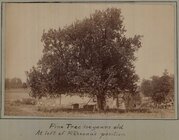
Here is the pic:

hafely-cabin-jpg.jpg
 

Attachments

  • hafely-cabin-jpg.jpg
    hafely-cabin-jpg.jpg
    369.3 KB · Views: 30
Here is the thing:

The field of view does not only depend on the lens it depend on the size of the "film" (or whatever the image is imprinted upon.) A modern example is with most modern dSLR cameras where a normal (ie. what you get from the lens is about what you get from your eye) 50mm lens in a 35mm film camera, becomes a telephoto (ie. magnifies what you see and reduces the field.).

So to calculate, you really need the size of the "negative". Interestingly enough, there is another way to tell by looking at a picture, is to figure out the distortion of the image pictured. That one looks pretty close to distortion-free from here. So if you know the size of the "negative", and assume that the woman picture was about 5 feet tall, you can calculate the exact spot this picture was taken from the tree with some geometry.

Hope this helps...
 
Here is the thing:

The field of view does not only depend on the lens it depend on the size of the "film" (or whatever the image is imprinted upon.) A modern example is with most modern dSLR cameras where a normal (ie. what you get from the lens is about what you get from your eye) 50mm lens in a 35mm film camera, becomes a telephoto (ie. magnifies what you see and reduces the field.).

So to calculate, you really need the size of the "negative". Interestingly enough, there is another way to tell by looking at a picture, is to figure out the distortion of the image pictured. That one looks pretty close to distortion-free from here. So if you know the size of the "negative", and assume that the woman picture was about 5 feet tall, you can calculate the exact spot this picture was taken from the tree with some geometry.

Hope this helps...
It does for sure. I'm just not sure the negative even exists anymore. The photo is from an exposé on the battle of Perryville that was never published as intended in century magazine. Did photographers tend to have a preference with the size negative they shot with? If so, I know the name of the photographer and might be able to determine that if he has several surviving negatives. He was a photographer from Kentucky.
 
It does for sure. I'm just not sure the negative even exists anymore. The photo is from an exposé on the battle of Perryville that was never published as intended in century magazine. Did photographers tend to have a preference with the size negative they shot with? If so, I know the name of the photographer and might be able to determine that if he has several surviving negatives. He was a photographer from Kentucky.

The "negative" was the glass plate and it was determined by the camera they used.

here is great link on the subject (and way more than you want to know.) In the US, full, half and quarter plate cameras were mostly in use back then. And they did not have enlargers. So the size of the positive is the size of the negative. Just figure out the size of the picture. Full plate is 6-1/2 x 8-1/2, half plate is 4-3/4 x 6-1/2, and quarter plate is 3-1/4 x 4-1/4. Willing to bet that this picture was taken by a full plate camera, since the other 2 were mostly studio cameras. Full plate is kinda close to "modern" medium format 6" x 6" and smaller than "modern" large format (8" x 10"). A "normal" lens for medium format is close to 65mm. So you will probably looking at an 80mm lens taking that picture.

Nerding out here, but you kinda asked for it ;)
 
How would it affect things if the picture was cropped? Say a full plate was printed and then the paper print trimmed down to 5"x7"? I know it's possible to compose perfectly on the glass, but there was an advantage to trimming off the edges where an older lens showed some distortion, and this image seems cropped quite close with no distortion. But if it was taken later, technology might have changed--not sure when adjustable apertures came in--and distortion wouldn't be a concern. Still, there might be cropping for aesthetic reasons.
 
The "negative" was the glass plate and it was determined by the camera they used.

here is great link on the subject (and way more than you want to know.) In the US, full, half and quarter plate cameras were mostly in use back then. And they did not have enlargers. So the size of the positive is the size of the negative. Just figure out the size of the picture. Full plate is 6-1/2 x 8-1/2, half plate is 4-3/4 x 6-1/2, and quarter plate is 3-1/4 x 4-1/4. Willing to bet that this picture was taken by a full plate camera, since the other 2 were mostly studio cameras. Full plate is kinda close to "modern" medium format 6" x 6" and smaller than "modern" large format (8" x 10"). A "normal" lens for medium format is close to 65mm. So you will probably looking at an 80mm lens taking that picture.

Nerding out here, but you kinda asked for it :wink:
Wow! That is incredible info, but just parousing it, would an 80mm lens left to right range be affected by the distance it was moved from the plate? I mean, would the number of degrees change as it was extended or retracted to or from the plate?
 

Learn About Us
About CivilWarTalk
Contact the Webmaster
Meet the Staff
Link to CivilWarTalk
Join Our Community
Register
Browse Forums
View Today's Discussions
Search the Forum
Get Help
FAQ
Student Guide
Forum Rules & Etiquette
Copyright / DMCA

     Contact Us CivilwarTalk on Facebook CivilWarTalk on YouTube CivilWarTalk on Twitter RSS Feed

Bringing the American Civil War and More to Life.
© 1999 - , CIVILWARTALK, LLC - Site Version 10.0

SlaveryTalk.com - SecessionTalk.com - CivilWarTalk.com - ReconstructionTalk.com
Back
Top