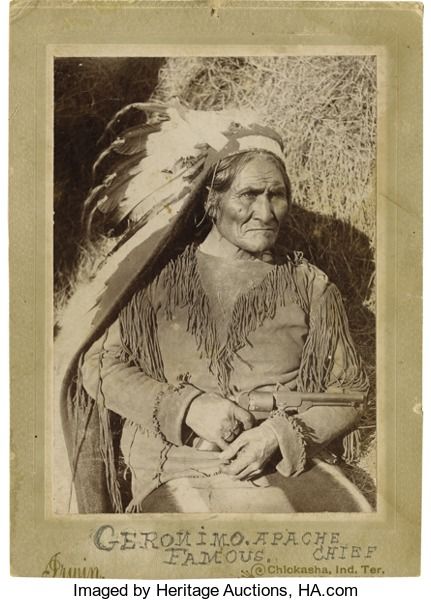
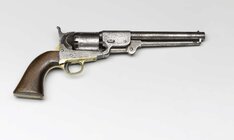
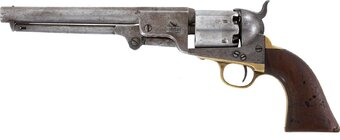
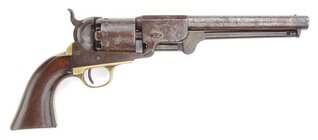
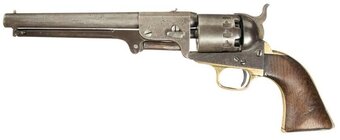
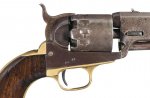
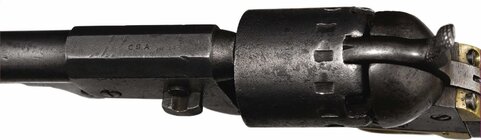
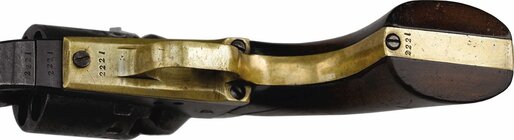
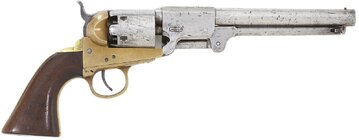
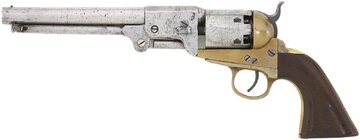
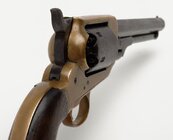
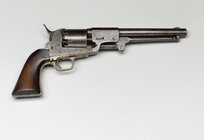
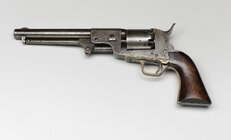
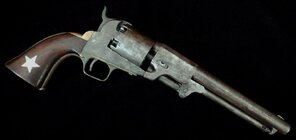
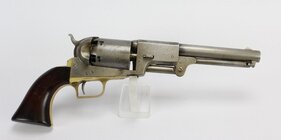
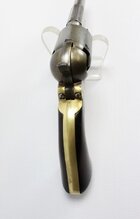
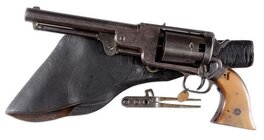
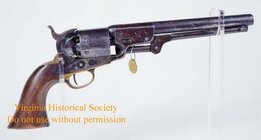
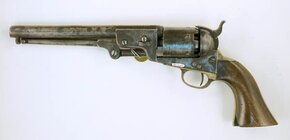
This thread only scratches the surface of a complex subject. Dance & Brothers manufactured revolovers in both .36 and .44 caliber. The most famous photograph of a Dance revolver is the one of Geronimo.
https://www.wikitree.com/wiki/Dance-199
"Biography
In 1848 James Henry Dance traveled to Brazoria County, Texas, and in 1853 he moved to Texas with most of his family, including father, brothers, cousins, and slaves. The family jointly purchased 450 acres of land in the Cedar Brake section, where they established a plantation. In 1858 they built a spacious home in the thriving riverport town of East Columbia, on the Brazos River. Across the street from their residence they opened a manufactory for metal and woodwork, named J. H. Dance and Company and operated by James Henry Dance and his brothers David Etheldred and George Perry. J. H. Dance and Company prospered before the Civil War manufacturing gristmills and cotton gins.
The Texas Convention adopted the ordinance of secession from the United States on Feb. 1, 1861. News of the attack on Fort Sumter reached Austin on April 17, 1861, and within a week the Confederate government called on Texas for 8,000 troops, wrote Gary Wiggins in his book "Dance & Brothers, Texas Gunmakers of the Confederacy." Most of the Texas troops were sent to defend Virginia, where there was a flurry of military activity. The protection of Texas, which had more than 400 miles of coastline, was left up to the state. The state also had a need for weapons, Wiggins wrote. "A county-by-county survey for arms was accomplished soon after the takeover by the Confederacy and only 40,000 arms of various makes and calibers were tallied," Wiggins wrote. "Among these were a multitude of flintlocks and obsolete arms." There was only a small amount of weapons, and there weren't many shops that produced them. Most of the skilled men who could be used in the production of firearms had enlisted. It was decided they could better help the south by manufacturing guns, Wiggins wrote. "The infant Confederate government took steps to remedy this situation in the early months of the war," Wiggins wrote. "Many foundry workers, machinists, ship builders, engineers, tailors and craftsmen were reassigned to industry while still serving in the military. Such was the case with the Dance brothers. Because of their skills, they were detailed to their own company so they could perform contract work with the south."
At the outbreak of the war James Dance enlisted in the Brazoria Volunteers; he later became first lieutenant in the Thirty-fifth Texas Cavalry. His brothers George, David, and Isaac enlisted, but because of their abilities and skills, they were detailed to their steam factory at Columbia by early May 1862. Isaac died of measles in 1863. Initially the Dances' primary tasks were mounting cannons and repairing wagons for the Confederate Army and grinding cornmeal for Bates Company. In April 1862 George Dance wrote Governor F. R. Lubbock requesting an advance of $5,000. He claimed that this sum would enable the Dances to begin firearm production with an output of fifty revolvers a week. Evidently they received some aid, for on July 5, 1862, a letter written by George's cousin Mattie Duff states that "the boys think they will soon get some three or four of their pistols finished." While production may have been at a somewhat slower pace than originally anticipated, by October 2, 1862, the Dances were able to ship a dozen revolvers to the San Antonio Arsenal.
By Oct. 1862 the brothers were selling handguns to the Confederacy. An invoice from that month shows the San Antonio Arsenal received 11 six-shot pistols. In 1863, production increased and more men were assigned to work in the pistol factory, Wiggins wrote. On Nov. 2, 1863, federal soldiers under the command of Gen. Nathaniel P. Banks came into Texas through Brownsville and moved east along the coast until they occupied Matagorda Island, Wiggins wrote. "This posed a direct threat to Brazoria County," Wiggins wrote. "Indeed, as a result of General Banks' successful offensive on the Texas coastline, the Confederate Army concentrated a large number of troops in Brazoria County." In a report in the winter of 1863-1864, General John B. Magruder, who commanded forces in Texas, lists that at the Camp San Bernard there were 1,359 troops, and at Camp Cedar Lake there were 1,489 troops. Perry's landing had 312 soldiers, Velasco had 896 troops, and a camp at Caney Creek had 1,609 soldiers.
By November 1863 the Dances had decided to sell their business to the Confederate government. Cousin Mattie wrote that "the boys think it quite possible they will quit the shop soon" and added that George had left for Houston "to see if he could make a government affair of it." Further, "he thinks perhaps it will be done." Revolver production had come to an end in East Columbia by December 10, 1863, and Mattie wrote that she had been "in town all week helping the boys to leave."
The federal occupation of Matagorda Island, located just off the Texas coast near Brazoria County, prompted the belief that the county was about to be invaded. The Confederate government doubtless wanted to consolidate the Dances' skills farther inland and out of harm's way. The Dances relocated to a site three miles north of Anderson in Grimes County, and here the Confederate government built a powder mill and pistol factory. On February 7, 1864, Mattie Duff received word from Uncle Harrison that "they were not quite ready for making pistols but soon will." One of the last known shipments of Dance revolvers took place on April 18, 1865; a lot of twenty-five six-shot pistols was sent from Anderson to the Houston Depot of Supplies. At the end of the war the Dances returned to East Columbia and the manufacture of gristmills and cotton gins.
A few miles north of Anderson on FM 244 off Highway 90 is Texas Historical Marker #8603. It states: "Site of a munitions factory of the Southern Confederacy, established 1861, in operation until 1865." It is believed that Otto and Alexander Erichson, sons of famed German immigrant gunsmith Gustav Erichson of Houston, worked at the Dance munitions factory at Anderson. At least one of the Dance revolvers survives stamped "G. Erichson. Houston. Texas."
In all, only about 300 pistols were ever produced and few have survived, said Mary Dance McNeill, the granddaughter of David Etheldred Dance. Dance descendants, who still live in Brazoria County, have only one of the pistols that was produced. One Dance pistol was recently appraised at $40,000, McNeill said. After the war ended in 1865, the Dances returned to East Columbia. The Dance factory continued to operate until it was destroyed in the 1900 storm, Wiggins wrote. McNeill said growing up she heard little about the pistol factory from her dad. She said what is known by the family is in Wiggins' book. The family allowed Wiggins access to documents in his effort to write the book. "Our daddy never talked about it," McNeill said. "I guess it wasn't good to talk about what you did during the Civil War." While the family may not have talked much of their past, collectors have great interest in the pistols. They are surviving artifacts from a bloody conflict that divided a nation.
Firearms collectors are willing to pay big bucks for vintage Colt revolvers but the most valuable of all the old guns that were used on the Texas frontier might be the Dance pistols, which were manufactured in Texas. A number of factors make the Dance guns so attractive to collectors. There is a legend-and-lore aspect, as certain outlaws, Indian fighters and gunfighters stuck with their old Dance percussion pistols even after centerfire cartridge technology made them otherwise obsolete. One of the most notorious Dance loyalists was Bloody Bill Longley, who has endured in history and folklore despite being nothing more than a murderous psychopath. He claimed to have killed 32 men, which proves him to be a braggart and a liar as well as a murderer. Longley killed one man while he was plowing a field and another, a preacher, while he was milking a cow. The way Longley told it and Longley apologists repeated it for decades afterwards, Bloody Bill took on his victims, who were all richly deserving of murder by his estimation, in gunfights featuring his .44 caliber revolver manufactured by the Dance brothers of Texas. There was perhaps one area where Longley's word is apparently good, and that is in his praise of the Dance pistols' craftsmanship. That, as well as their rarity, is what makes them something of a holy grail for today's gun collectors."




![Civil War; Confederate.cavalry.weapons- Kerr.revolver.44-cal.[imported.from.Britain].,....jpg](https://civilwartalkxf.nyc3.digitaloceanspaces.com/data/attachments/121/121180-5e8560941bde77667c5805b15b45de61.jpg?hash=XoVglBved2 "Civil War; Confederate.cavalry.weapons- Kerr.revolver.44-cal.[imported.from.Britain].,....jpg")
![Civil War; Confederate.cavalry.weapons- Kerr.revolver.44-cal.[imported.from.Britain].,.......jpg](https://civilwartalkxf.nyc3.digitaloceanspaces.com/data/attachments/121/121181-aa0aaaccfba1673231713f7a259e3686.jpg?hash=qgqqzPuhZz "Civil War; Confederate.cavalry.weapons- Kerr.revolver.44-cal.[imported.from.Britain].,.......jpg")


 Forum Host


 Bringing the