Button Found - History Uncovered

Tom Hughes

Sergeant Major
Joined
May 27, 2019
Location
Mississippi
Those of us that use metal detectors to search for and uncover history, face this daunting task from time to time - Trying to get a positive I.D. on an artifact that we know is going to be a good one.
Such is the case with a recent button find I made in Mississippi.
With the land owners permission, I was given the "go-ahead" to search a very historic piece of property. It was a large plantation home whose builders came from Virginia to Natchez and beyond to govern the new territory, and now state, as it entered the union in 1817.

crownbutton1.jpg


When I detected this button, I immediately noticed the crown imprinted on the facing.
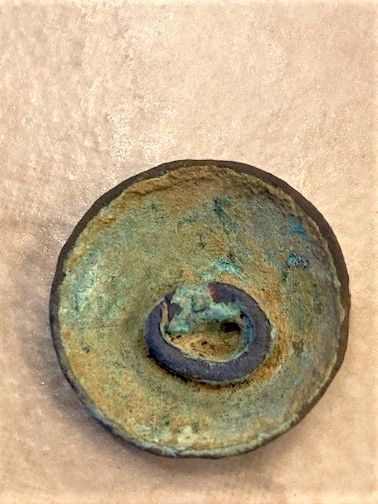
crownbuttonback.jpg


The construction of the button (one-piece solid cast with soldered eye hook) helped to date the button since there was no backmark. The button dates circa. 1787-1820.

It was believed to be a British militia button, but yet, many unanswered questions remained....Until now.

The identity of the button is now believed to be known, and it has an interesting history indeed. So much so that I wanted to share my findings on this forum with the group.

This is believed to be a LIVERY BUTTON. Livery is an insignia on a button. Livery buttons in early America were buttons worn by the male servants of a household identifying the servants to their masters. My button has the image of a crown. However, there are many images depicted on the face of these livery buttons. An internet search provides many depictions from family crests to animals and scenes.
In Europe, livery among the aristocrat and noble class was popular.
As the aristocracy of the Southern planter class sprung up, so did the need to identify the enslaved with their masters. This directly paralleled their European cultural identity.
Some wealthy planters saw slaves working in their households as a reflection of their wealth and status. Livery clothes were a "step up" and would be a way of showing this status and were provided to the males of the household help serving as coachmen, valets, footmen, and other household domestic help.

coat.jpg


Here's an example of a livery coat worn by a Mississippi plantation slave that is on display at a Texas museum (internet photo). It was made by the clothing firm of Brooks Brothers. This firm specifically made livery clothes for the domestic male slave population in the South.

As I walked off the plantation property with my newly dug button in my pocket, I had no idea what a livery button was. But it all makes sense now. These buttons, which were imported from Europe, were used on these livery coats and served a specific purpose. Although these livery buttons adorned a coat worn by a man bound by slavery and not one worn by a paid servant. It casts a historical light on plantation facts that aren't easily digested in our society but are a big part of our shared history.
My artifact collection now has a new addition that will help tell this story.
 
You said this is the second one you've ever seen dug. Was the first one also a "Crown" design livery?
Yes, but if I remember correct it just had the crown design and not the thing on top but was a 1 piece just like yours. It was found at a plantation site in Yalobusha County by a friend when we were digging the CS camps outside Grenada. I'll see if I can get him to send me a photo. Happy New Year.
 
Yes, but if I remember correct it just had the crown design and not the thing on top but was a 1 piece just like yours. It was found at a plantation site in Yalobusha County by a friend when we were digging the CS camps outside Grenada. I'll see if I can get him to send me a photo. Happy New Year.
Thanks and Happy New Year as well!
 
Those of us that use metal detectors to search for and uncover history, face this daunting task from time to time - Trying to get a positive I.D. on an artifact that we know is going to be a good one.
Such is the case with a recent button find I made in Mississippi.
With the land owners permission, I was given the "go-ahead" to search a very historic piece of property. It was a large plantation home whose builders came from Virginia to Natchez and beyond to govern the new territory, and now state, as it entered the union in 1817.

View attachment 461474

When I detected this button, I immediately noticed the crown imprinted on the facing.

View attachment 461475

The construction of the button (one-piece solid cast with soldered eye hook) helped to date the button since there was no backmark. The button dates circa. 1787-1820.

It was believed to be a British militia button, but yet, many unanswered questions remained....Until now.

The identity of the button is now believed to be known, and it has an interesting history indeed. So much so that I wanted to share my findings on this forum with the group.

This is believed to be a LIVERY BUTTON. Livery is an insignia on a button. Livery buttons in early America were buttons worn by the male servants of a household identifying the servants to their masters. My button has the image of a crown. However, there are many images depicted on the face of these livery buttons. An internet search provides many depictions from family crests to animals and scenes.
In Europe, livery among the aristocrat and noble class was popular.
As the aristocracy of the Southern planter class sprung up, so did the need to identify the enslaved with their masters. This directly paralleled their European cultural identity.
Some wealthy planters saw slaves working in their households as a reflection of their wealth and status. Livery clothes were a "step up" and would be a way of showing this status and were provided to the males of the household help serving as coachmen, valets, footmen, and other household domestic help.

View attachment 461477

Here's an example of a livery coat worn by a Mississippi plantation slave that is on display at a Texas museum (internet photo). It was made by the clothing firm of Brooks Brothers. This firm specifically made livery clothes for the domestic male slave population in the South.

As I walked off the plantation property with my newly dug button in my pocket, I had no idea what a livery button was. But it all makes sense now. These buttons, which were imported from Europe, were used on these livery coats and served a specific purpose. Although these livery buttons adorned a coat worn by a man bound by slavery and not one worn by a paid servant. It casts a historical light on plantation facts that aren't easily digested in our society but are a big part of our shared history.
My artifact collection now has a new addition that will help tell this story.
What a great find, and thanks for sharing the information about livery buttons. As you mention, many feature animals, and I often see dogs represented on livery buttons. Here are a couple of my favorites. I believe both to be British but I have no idea of their ages.

1672516981516.png
1672517132118.png
 
I found my book on livrey buttons. It's actually a very small book, but it addresses civilian uniform buttons, such as fire departments or railroads, family crest livrey buttons, and some associated with royalty of Great Britian.

Cover.jpg
Table of Contents.jpg


It had some crown buttons from the uniforms of those who worked in the palaces. One looked very similar to yours.

Button D24.jpg
Button Group.jpg


The D24 button is for servants at one of Queen Victoria's castles. If this is your button, and it might be by a different button maker so that it appears a little different, then it would fit the time frame. Now you have to ask yourself:

Is it the same button?

Is it from the time of Queen Victoria or later?

If it is from the time of Queen Victioria, would it have been sold to someone not representing the royal household? In other words, could a plantation owner have purchased buttons like this or would they have had to come from someone in the royal household gifting them to someone who was not authorized to wear them? If they were exclusive to the royal houshold then it may have been gifted by someone to a member of the plantation family and there may be an interesting story behind that. If there are other buttons found, suggesting they were used on a coat, for example, you would have to ask yourself if a plantation owner would put the buttons of Queen Victoria's houshold on a coat to be worn by a slave on a plantation. That might also lead to an interesting story.

If the button was obtained after Victoria's reign might it have been a souvenir from someone's travel to England and visit to a gift or antique shop. If the plantation was abandoned before 1900 or so, it is unlikely that someone would bring it to the property where it could be lost. If the plantation lasted into the 20th century you might want to see if any of the family traveled to England after Victoria's death as a tourist or perhaps in the military.

That should give you something additional to think about and some questions to answer. You never know where a clue might lead.
 
I found my book on livrey buttons. It's actually a very small book, but it addresses civilian uniform buttons, such as fire departments or railroads, family crest livrey buttons, and some associated with royalty of Great Britian.

View attachment 461900 View attachment 461915

It had some crown buttons from the uniforms of those who worked in the palaces. One looked very similar to yours.

View attachment 461924 View attachment 461922

The D24 button is for servants at one of Queen Victoria's castles. If this is your button, and it might be by a different button maker so that it appears a little different, then it would fit the time frame. Now you have to ask yourself:

Is it the same button?

Is it from the time of Queen Victoria or later?

If it is from the time of Queen Victioria, would it have been sold to someone not representing the royal household? In other words, could a plantation owner have purchased buttons like this or would they have had to come from someone in the royal household gifting them to someone who was not authorized to wear them? If they were exclusive to the royal houshold then it may have been gifted by someone to a member of the plantation family and there may be an interesting story behind that. If there are other buttons found, suggesting they were used on a coat, for example, you would have to ask yourself if a plantation owner would put the buttons of Queen Victoria's houshold on a coat to be worn by a slave on a plantation. That might also lead to an interesting story.

If the button was obtained after Victoria's reign might it have been a souvenir from someone's travel to England and visit to a gift or antique shop. If the plantation was abandoned before 1900 or so, it is unlikely that someone would bring it to the property where it could be lost. If the plantation lasted into the 20th century you might want to see if any of the family traveled to England after Victoria's death as a tourist or perhaps in the military.

That should give you something additional to think about and some questions to answer. You never know where a clue might lead.
That looks exactly like my button. Very good information. Mine certainly dates to the early 19th century. Buttons that served a royal castle would certainly or did certainly make good livery buttons on Southern plantations it would seem. I have seen several examples of the identical button as this one that has been dug in different parts of the South. I'm certain there is a story here somewhere....one lost to history. The owner of the plantation where I found this button was a Revolutionary War veteran and was a personal friend of French General Lafayette. He moved from Virginia to Mississippi in 1812 and eventually became governor of the state. He owned 64 slaves that worked his plantation and worked in his home. I've seen several variations of "crown" livery buttons from England, France and Prussia. I'm assuming these royal buttons were sent or gifted to someone and worn as livery button to represent the master and his family....Let me know your thoughts. Once again, thank-you for some great information on my button
 

Learn About Us
About CivilWarTalk
Contact the Webmaster
Meet the Staff
Link to CivilWarTalk
Join Our Community
Register
Browse Forums
View Today's Discussions
Search the Forum
Get Help
FAQ
Student Guide
Forum Rules & Etiquette
Copyright / DMCA

     Contact Us CivilwarTalk on Facebook CivilWarTalk on YouTube CivilWarTalk on Twitter RSS Feed

Bringing the American Civil War and More to Life.
© 1999 - , CIVILWARTALK, LLC - Site Version 10.0

SlaveryTalk.com - SecessionTalk.com - CivilWarTalk.com - ReconstructionTalk.com
Back
Top